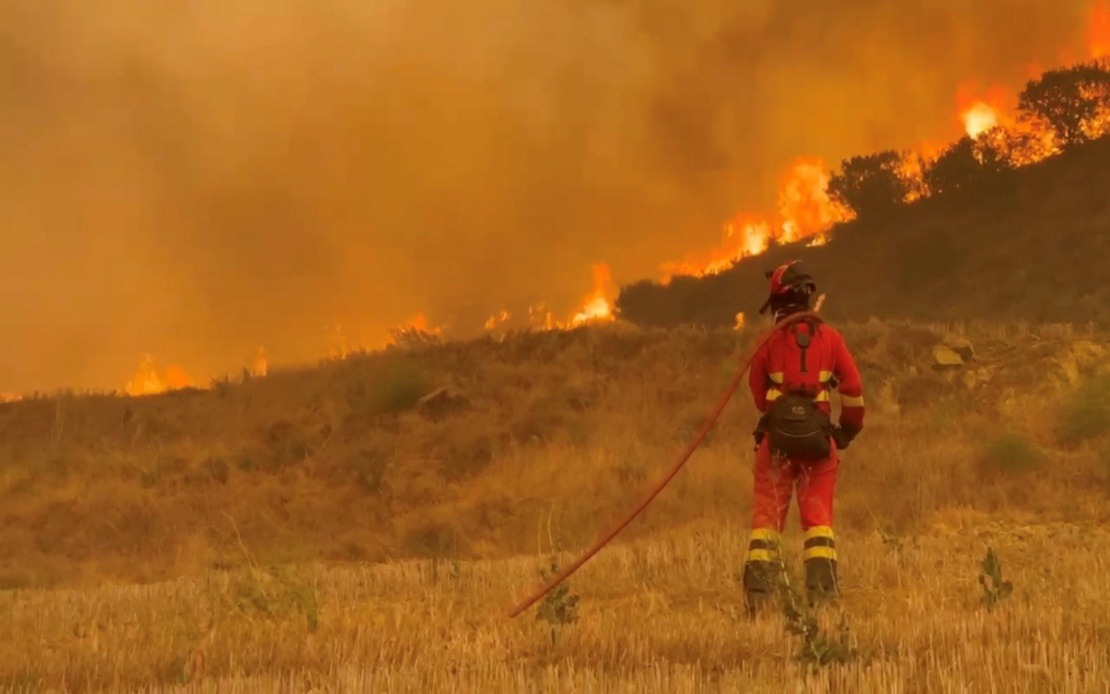
Spain is grappling with its worst wildfire season incident this year, with an enormous blaze ravaging nearly 12,000 hectares across the northeastern province of Zaragoza. The fire, which ignited on Wednesday in the Cinco Villas region, has necessitated the immediate displacement of more than 1,100 residents from affected areas. Despite intensive firefighting operations, the blaze remains dangerously active, with authorities reporting significant overnight expansion that demonstrates the fire's continuing volatility and unpredictability.
The geographical scale of the disaster is staggering. The fire has expanded across a perimeter stretching approximately 60 kilometres, creating a sprawling danger zone that has disrupted transportation networks and forced the closure of several major roads throughout the region. The evacuation directive encompasses five municipalities within Zaragoza province plus one additional municipality in the neighbouring region of Navarre, illustrating how swiftly the fire has crossed administrative boundaries and threatened communities far from its origin point.
Emergency response mobilisation has been substantial though challenged by the fire's intensity. On Thursday alone, authorities deployed around 400 ground-based firefighters alongside 19 aircraft dedicated to aerial firefighting operations. The overnight priority shifted to defending the municipality of Uncastillo, where personnel concentrated efforts on protecting residential structures from the advancing flames. This strategic focus reflects the dual imperative facing Spanish emergency services: containing the fire's expansion while simultaneously protecting human life and property.
The Zaragoza fire is not operating in isolation across the Spanish landscape. Simultaneously, a second significant wildfire has been burning in La Mierla, located in Guadalajara province to the north. This secondary blaze has consumed approximately 900 hectares and triggered its own evacuation protocols and lockdown procedures in neighbouring communities. The overlap of multiple major fires stretching emergency resources across the broader region has compelled regional authorities to request reinforcements from Spain's Military Emergency Unit, which dispatched around 100 additional personnel to assist with suppression operations.
A third wildfire near Lozoyuela, situated north of Madrid, presents a somewhat more optimistic but still uncertain situation. Emergency services have reported that this fire is progressing favourably compared to the others, yet it remains neither fully controlled nor completely contained. The unpredictability characterising all three fires underscores the precarious nature of wildfire management in the current climatic conditions affecting Spain.
Infrastructure disruptions have been widespread, though authorities have managed to restore electricity to all communities affected by the Zaragoza fire. However, parts of the Cinco Villas region have remained under lockdown conditions, with two major roads in the vicinity staying closed indefinitely. These sustained restrictions on movement reflect ongoing safety concerns and the continued proximity of the fire to populated areas.
Investigative authorities have already made an arrest relating to one of the fires. The Civil Guard has detained a man suspected of deliberately starting the wildfire in the Madrid region, with the regional government announcing its intention to participate in legal proceedings as a civil party. This criminal dimension adds investigative complexity to an already severe natural disaster situation.
Environmental conditions have conspired to create exceptionally dangerous circumstances for fire propagation. Meteorological factors including abnormally high temperatures, strong sustained winds, and markedly low humidity levels have accelerated the fires' spread exponentially. Paradoxically, abundant vegetation across the landscape—a consequence of substantial rainfall during the preceding spring season—has furnished ample fuel for the flames, creating ideal conditions for rapid fire expansion.
Beyond immediate weather patterns, experts and environmental analysts identify deeper structural vulnerabilities that amplify Spain's wildfire susceptibility. Climate change represents a fundamental underlying factor, with scientists documenting how shifting atmospheric patterns are intensifying heat waves and creating more volatile weather systems across the Mediterranean region. Concurrently, the systematic abandonment of rural agricultural areas has allowed vegetation to accumulate unchecked, essentially stockpiling natural fuel across landscapes that once benefited from active human land management.
For Malaysian and Southeast Asian observers, Spain's current wildfire crisis illuminates vulnerabilities that transcend geographic boundaries. Both regions face intensifying heat episodes and extreme weather patterns linked to broader climatic disruption. Southeast Asia's experiences with transboundary haze from uncontrolled agricultural burning demonstrate how wildfire dynamics can rapidly overwhelm firefighting capacity and create cascading regional consequences. Spain's crisis underscores the necessity for integrated landscape management strategies that combine traditional fire suppression techniques with preventative measures addressing vegetation accumulation and rural land stewardship.
The incident also highlights institutional coordination challenges facing multi-jurisdictional emergency responses. When fires cross provincial and regional administrative boundaries, as these Spanish blazes have done, coordinating resources, evacuations, and tactical decisions becomes exponentially more complicated. Similar coordination issues regularly challenge Southeast Asian nations confronting transnational environmental crises, suggesting that Spanish authorities' experiences managing overlapping emergencies across multiple provinces may offer valuable operational insights.
As firefighting operations continue, Spanish authorities face a prolonged struggle against multiple simultaneous threats. The Zaragoza fire's status as the nation's largest wildfire incident this year, combined with the persistence of two additional significant blazes, indicates that Spain's 2024 wildfire season may intensify further before climatic conditions moderate. The fundamental drivers—accumulated fuel, extreme heat, atmospheric instability, and rural abandonment—suggest that such catastrophic incidents will likely recur with increasing frequency absent comprehensive landscape transformation and climate adaptation strategies.

