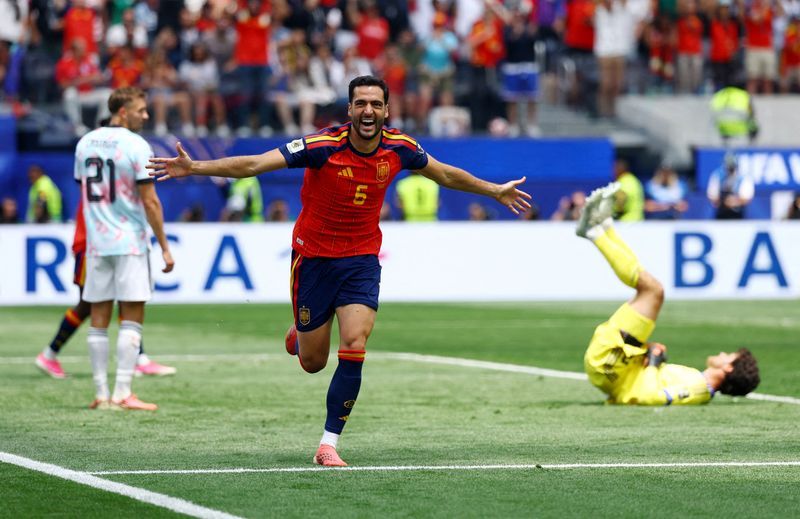
Mikel Merino proved himself a clutch finisher once again as Spain overcame a resilient Belgium side 2-1 on Friday in Los Angeles, advancing to the World Cup semi-finals and earning a tantalising encounter with France on Tuesday. Playing at the sold-out Los Angeles Stadium in oppressive heat, Merino struck in the 86th minute after Belgium's backup goalkeeper Senne Lammens failed to secure Pau Cubarsi's low drive, allowing the substitute to pounce and seal Spain's progression with his second knockout-stage winner of the tournament as a replacement player.
The victory marks a significant milestone for the European champions, representing their first World Cup semi-final appearance since 2010, the year they claimed their sole world title. Spain's path to this stage has been methodical and, increasingly, impressive in execution. With two matches now standing between them and championship glory, the team enters their semi-final against France brimming with confidence despite facing the competition's favourites. Coach Luis de la Fuente's squad has demonstrated tactical flexibility and clinical finishing throughout their campaign, qualities that will prove essential when they travel to Dallas to face the star-studded French outfit.
Merino's moment of glory capped an outstanding individual performance in a match that oscillated between Spanish dominance and Belgian desperation. The attacking midfielder's emergence as a decisive force in knockout football reflects broader patterns in modern tournament play, where fresh legs and clinical finishing often determine outcomes. His ability to deliver when introduced late into matches—a feat he has now accomplished twice in this World Cup—suggests Spanish tactical acumen in managing squad rotation and game management. The player himself attributed his success to thorough preparation, emphasising that positive outcomes in high-stakes scenarios stem from meticulous groundwork rather than chance.
Belgium's defeat, though fought with determination throughout, was substantially complicated by injury circumstances that emerged both before and during the competition. Captain Youri Tielemans suffered a warm-up injury shortly before kickoff, forcing Hans Vanaken into the starting lineup as his replacement. More significantly, the absence of midfielder Amadou Onana, sidelined by an ACL tear sustained during their previous round-of-16 victory over the United States, deprived Belgium of crucial midfield creativity and defensive stability. These absences fundamentally weakened Belgium's capacity to control the game's tempo and rhythm, ultimately contributing to their undoing.
Spain established early control through Fabian Ruiz's 30th-minute strike, which came after Belgian goalkeeper Thibaut Courtois executed an excellent diving save only to see Ruiz capitalise on the rebound, driving the ball between Timothy Castagne's legs past Unai Simon in the Spanish goal. De la Fuente's selection of Ruiz over regular starter Pedri initially appeared a significant gamble, yet the Paris Saint-Germain midfielder's early-game energy vindicated the coaching decision. However, Belgium's response came swiftly, with Charles De Ketelaere levelling matters eleven minutes later through a perfectly-timed run and header from Castagne's cross. This strike marked the first goal Spain had conceded throughout the tournament, ending their defensive impermeability.
The equaliser injected fresh vigour into Belgium's performance, and the teams proceeded to halftime locked at 1-1. The oppressive Los Angeles conditions favoured neither side, though both squads battled with intensity and commitment. Belgium, led by veteran figures Kevin De Bruyne and Romelu Lukaku, refused to surrender despite their personnel disadvantages. They sought another equaliser after Merino's late intervention, with several promising attacking opportunities emerging before the final whistle. Ultimately, however, Spain's attacking momentum and superior depth of resources proved decisive in separating the sides.
Spain's second-half resurgence reflected careful tactical adjustments and personnel management by De la Fuente. The introduction of Pedri and the continued prominence of 18-year-old sensation Lamine Yamal transformed Spain's attacking shape and rhythm. Young Yamal, in particular, demonstrated the explosive potential that has marked him as one of world football's most exciting emerging talents. His constant movement and creative danger tormented Belgium's defensive structure, especially once fatigue began setting in. Spain controlled possession in the second period, systematically dismantling Belgium's backline through incisive passing and intelligent positioning.
The match represented a broader shift in tournament dynamics, with established powers and innovative squad management strategies increasingly determining outcomes. Spain's victory underscores the tournament's unpredictability and the critical importance of squad depth, tactical flexibility, and the capacity to manage pressure in knockout football. Belgium's injury circumstances, while unfortunate, also highlight how competitive balance can shift dramatically when key personnel become unavailable. For Southeast Asian and Malaysian observers, the encounter demonstrated how European football's elite navigate World Cup progression through meticulous planning and the cultivation of impact players capable of delivering in decisive moments.
Spain's progression sets up Tuesday's semi-final showdown with France in Dallas, a fixture that promises compelling football and significant implications for the tournament's narrative. France, despite their favourites' status, enters the match having faced stiffer opposition en route to the semi-finals. De la Fuente expressed appropriate respect for his opponents while maintaining his team's belief in their capacity to compete. The Spanish coaching staff has already begun preparing for what promises to be a tactical and physical examination against Didier Deschamps' formidable French squad. Both nations possess the technical quality and experience to reach the final, making Tuesday's encounter one of the tournament's most anticipated fixtures.
Notably, the match attracted significant celebrity attention, with musicians Courtney Love and Noel Gallagher, American actor Brad Pitt, and Spanish actors Penélope Cruz and Javier Bardem present among the crowd. The attendance of such high-profile figures underscores the World Cup's cultural significance beyond football, reflecting how the tournament captures global popular imagination. For Spanish audiences and football enthusiasts throughout Asia and the wider world, the implications are clear: Spain has orchestrated its passage to the semi-finals with conviction and quality, positioning itself as a genuine contender for football's greatest prize.

