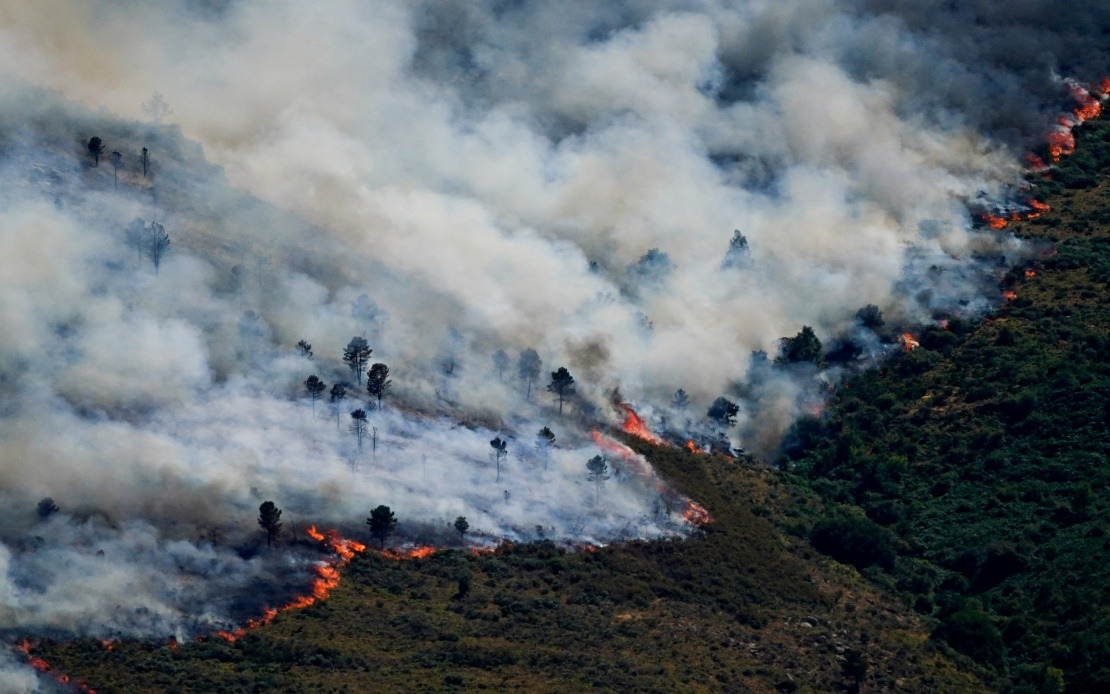
Spain's government mobilised a massive evacuation operation on Saturday as intense forest fires threatened communities across the Madrid region and surrounding provinces, displacing tens of thousands of residents from their homes. The scale of the emergency underscored the mounting pressures that European nations face from increasingly severe seasonal wildfires, a phenomenon that has become more pronounced across the Mediterranean and Atlantic-facing regions in recent years.
Authorities confirmed that approximately 30,000 residents in the province of Ávila, situated north-west of the capital, were forced to abandon their homes as flames approached. Francisco Martín Aguirre, the Spanish government's prefect for Madrid, disclosed these figures to assembled journalists. The evacuation reflected the speed and intensity with which the fires had spread through populated areas, leaving residents minimal time to gather belongings before departing.
Beyond the Ávila evacuation, an additional 29,488 people were displaced from communities encircling Madrid itself, bringing the total number of those forced to flee to nearly 60,000. The sheer volume of displaced persons created logistical challenges for emergency services coordinating shelter, transportation, and basic supplies across multiple municipalities simultaneously.
The Interior Ministry also reported a deeply concerning secondary crisis: more than 28,000 residents remained trapped in their homes, unable to evacuate safely due to the rapidly advancing flames and deteriorating conditions. This figure comprised 20,262 people in the greater Madrid metropolitan area and approximately 8,000 in Ávila. These stranded populations represented an acute risk, as emergency services struggled to maintain communication and prepare rescue operations should conditions deteriorate further.
Recognising the extraordinary nature of the emergency, Prime Minister Pedro Sánchez's administration took the significant step of declaring a "state of emergency of national significance" on Friday, extending across both the Greater Madrid region and Ávila province. This designation mobilised additional federal resources and streamlined bureaucratic procedures to accelerate emergency response efforts. Such declarations remain relatively uncommon and signal that authorities viewed the situation as exceeding the capacity of regional and local resources to manage independently.
By Saturday morning, weather patterns shifted in a manner that offered cautious optimism to firefighting teams. The Interior Ministry announced that overnight conditions had improved, creating more favourable circumstances for aerial operations and ground crews attempting to contain the flames. The change in atmospheric conditions—likely involving reduced wind speeds and shifting humidity levels—allowed tactical advantages that had proven elusive during the initial fire outbreak.
Speaking from the emergency services command centre, Sánchez conveyed a measured assessment of the evolving situation. He acknowledged that improved weather conditions created a realistic opportunity to achieve meaningful control over the fires during the coming weekend, a development that would substantially reduce the risk to remaining populations. However, the prime minister's remarks balanced this cautious optimism with frank acknowledgment that the emergency remained serious and unpredictable.
Sánchez emphasised that preserving human life remained the paramount objective guiding all operational decisions. This statement reflected awareness that resource allocation—whether prioritising property protection, infrastructure preservation, or civilian evacuation—must ultimately defer to the fundamental imperative of ensuring immediate safety. Spanish authorities demonstrated understanding that the financial and property damages, however substantial, were secondary considerations when measured against the irreplaceable value of lives at risk.
The Madrid wildfires occurred amid a broader European context of escalating fire danger and changing seasonal patterns. Southern Europe, including Spain, Portugal, Italy, and Greece, has experienced progressively earlier and more intense fire seasons in recent decades, a trend that climate scientists attribute substantially to rising temperatures and shifting precipitation patterns. For Malaysia and other tropical Southeast Asian nations, the Spanish crisis offers perspective on how regions with developed emergency infrastructure and substantial resources face mounting challenges from environmental shifts that affect fire seasonality and intensity.
The evacuation operation itself demonstrated the complex interplay between environmental hazards and urbanisation patterns. As Spanish cities have expanded outward, residential areas increasingly encroach on forested regions where natural fire cycles historically operated with minimal human consequence. The resulting interface between human settlement and wildland creates friction zones where fire behaviour becomes exponentially more dangerous and resource-intensive to manage, as emergency services must simultaneously prioritise civilian protection while preventing infrastructure loss.
The situation highlighted critical gaps in preparedness infrastructure. That approximately 28,000 people remained unable to evacuate despite authorities having declared a national emergency several hours earlier suggests either that evacuation routes became impassable more rapidly than anticipated, or that communications regarding evacuation orders failed to reach all affected populations. Such operational breakdowns, common in large-scale emergency responses, underscore the importance of pre-positioned evacuation planning and regular community drills.
Spain's experience also illuminates the resource competition that European fire services face. Mediterranean nations share limited quantities of aerial firefighting assets—helicopters and tanker aircraft—which must be distributed across multiple active incidents simultaneously. During severe fire seasons affecting multiple countries, these shared resources become strategically critical, sometimes requiring mutual aid agreements and burden-sharing arrangements among neighbouring nations.
As the weekend approached, emergency officials maintained vigilance despite improved conditions. Wildfires rarely extinguish completely after initial suppression; they frequently reignite through smouldering underground root systems or residual hotspots that escape initial detection. The extended operational phase following initial containment often proves as resource-intensive as the acute response phase, requiring sustained firefighting capacity, ongoing evacuee support, and environmental monitoring to prevent secondary flare-ups.

