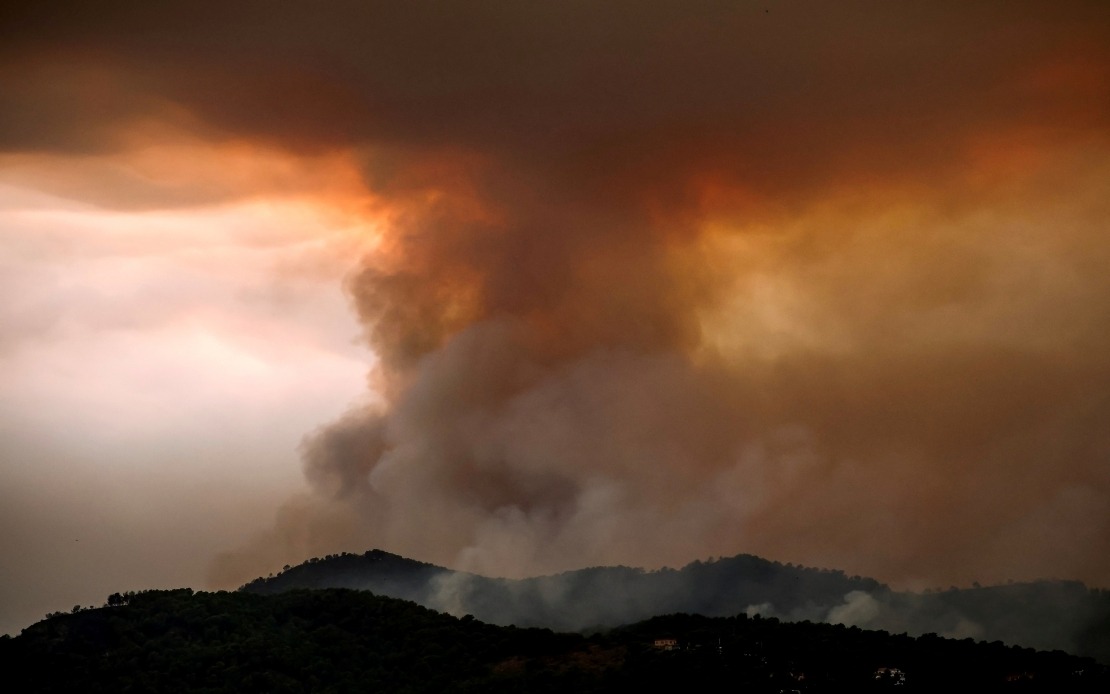
Spain confronted an unprecedented environmental crisis on Sunday as multiple wildfires ravaged central regions of the country, with the Avila province blaze marking the largest conflagration in the nation's recorded history. The scale of destruction has strained emergency response capabilities across three provinces, transforming the region into a complex operational zone where firefighting efforts remain fluid and the threat of further escalation persists.
The wildfires engulfing Madrid, Avila, and Toledo provinces have collectively consumed more than 77,000 hectares according to official accounts from Spain's Third Deputy Prime Minister and Minister for Ecological Transition Sara Aagesen. The Avila fire alone has torched approximately 50,000 hectares, surpassing all previous records of wildfire extent in Spanish territory. This scale dwarfs typical European wildfire incidents and reflects the intensity of conditions now gripping the Iberian Peninsula during summer months.
The humanitarian impact has been staggering, with nearly 100,000 residents either evacuated or confined to their homes across 46 separate municipalities. This displacement represents one of Spain's largest emergency evacuations in recent years, placing immense strain on local authorities tasked with managing shelter, supplies, and logistics for displaced populations. Additionally, a separate fire in the eastern province of Castellon has affected over 16,000 people across 18 municipalities, suggesting the wildfire phenomenon is not isolated to central regions but represents a broader environmental crisis affecting Spain simultaneously.
Responding to the emergency, Spain has mobilized thousands of firefighting personnel, coordinated through the country's Military Emergency Unit (UME), while deployment of aerial assets including firefighting aircraft and helicopters provides crucial support from above. Lieutenant General Francisco Javier Marcos Izquierdo, commanding the UME, reported that the Avila and Madrid fires, while geographically proximate, have remained operationally distinct. The fires have only converged along what officials characterize as a very limited and discontinuous line near San Martin de Valdeiglesias, suggesting that separation between the two major blazes has prevented a catastrophic merger that could exponentially complicate containment efforts.
Firefighting crews indicated they had successfully arrested the spread of flames across the connecting zone between the two fire zones, though securing the complete fire perimeter remained unfinished work. This partial success demonstrates tactical progress, yet the persistence of unsecured perimeters indicates the fires retain potential for renewed expansion. Minister Aagesen, speaking from the advanced command centre in Navalcarnero west of Madrid, characterized the overall situation as profoundly complex, with emergency crews deployed across multiple operational fronts simultaneously. She cautioned that the evacuation order could expand if conditions deteriorated, while emphasizing that residents displaced from their homes would not be permitted to return until authorities certified that safety conditions had been restored.
Prime Minister Pedro Sanchez visited the affected zones on Sunday, delivering a nuanced assessment that acknowledged the extreme complexity facing firefighters while noting signs that portions of the blazes were transitioning toward greater control. His statement suggested an emerging trajectory toward stabilization, though the enormous scale of the fires and their continued intensity indicate any optimism remains provisional and subject to changing conditions. The government's careful messaging appears designed to balance urgent communication of the crisis's seriousness with reassurance that coordinated response efforts were yielding results.
The Spanish monarchy joined national leadership in demonstrating solidarity with affected populations. King Felipe VI and Queen Letizia traveled to disaster zones to receive detailed briefings on the emergency response mechanisms and expressed personal support for both the residents enduring displacement and the emergency personnel working exhausting shifts on the fire lines. Such high-level engagement underscores the political significance the government attaches to managing this unprecedented environmental emergency.
Broader context reveals that Spain's wildfire problem extends well beyond the current central crisis. Data from the Ecological Transition Ministry indicated that nationwide, wildfires had already consumed 172,453 hectares by July 24, before the Avila fire reached its record proportions. This suggests that Spain is experiencing a particularly severe fire season overall, likely driven by elevated temperatures, prolonged drought conditions, and other climatic factors increasingly common in Mediterranean regions.
For Malaysia and Southeast Asian observers, Spain's wildfire crisis carries instructive significance regarding climate resilience and disaster management at scale. While Malaysia experiences different fire dynamics—primarily peatland and forest fires during dry seasons rather than the vegetation fires affecting Mediterranean climates—the Spanish experience demonstrates how rapidly environmental emergencies can overwhelm national resources. The coordination required across military units, civilian firefighting services, and aerial assets mirrors coordination challenges Southeast Asian nations face during transboundary haze events. Furthermore, Spain's experience highlights how climate change is intensifying fire seasons and geographic zones where conflagrations occur, a sobering precedent for regions already vulnerable to fire-related environmental degradation.

