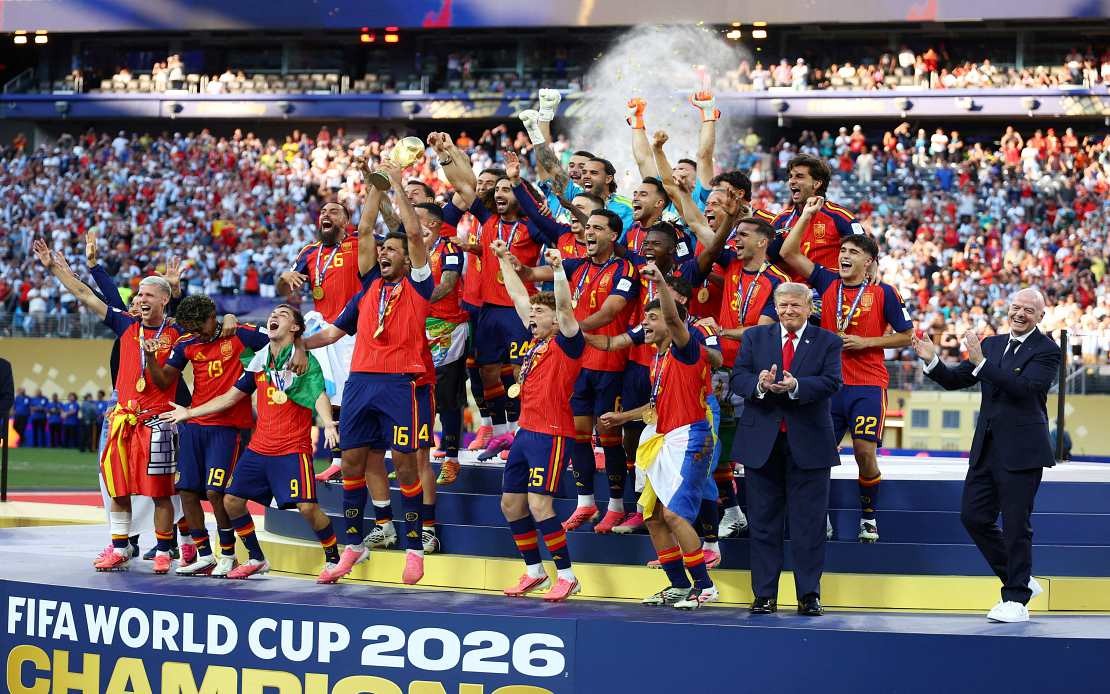
Spain's triumphant football squad touched down at Madrid airport on Monday afternoon to begin an elaborate homecoming celebration following the nation's second men's World Cup victory. Captain Rodri and his teammates were scheduled to arrive at 12.50 pm local time, marking the start of what promised to be one of the year's most significant public gatherings in the Spanish capital. The scale of the expected crowds underscored the deep connection between the national team and the Spanish public, who had followed every moment of the tournament's decisive final in the United States.
The team's return set in motion a carefully orchestrated programme of festivities that reflected Spain's football prowess and national pride. King Felipe VI received the squad at the Royal Palace later that afternoon, offering the nation's official recognition of their sporting achievement. This royal reception carried particular significance in Spain's constitutional monarchy, where such ceremonies typically honour extraordinary national accomplishments. The presence of the monarchy at these celebrations helped elevate the event beyond sport, framing it within the broader context of national identity and collective Spanish achievement.
Following the palace reception, the celebrations took to the streets as the team paraded through Madrid's central thoroughfares on an open-top bus. Organisers anticipated that hundreds of thousands would line the route, transforming the capital into a sea of Spanish flags and patriotic displays. Such public parades have become customary following major sporting victories across Europe, allowing fans who could not attend the tournament to participate directly in the celebration. The spectacle represented a moment of national catharsis and shared joy that transcended the typical boundaries of sport.
Defender Marc Cucurella articulated the team's perspective on the homecoming, emphasising their desire to share the triumph with supporters who had not travelled to the tournament. His comments revealed an understanding among the players that their victory belonged collectively to the nation, and that the parade represented an essential component of the accomplishment. Cucurella's statement reflected a broader sentiment within Spanish football culture, where the connection between team and populace carries particular weight.
The celebrations reached their crescendo at Cibales Square, where a major public event was scheduled to commence at 6 pm, with the squad expected to arrive at 9 pm. This venue, central to Madrid's cultural and civic identity, provided an appropriate backdrop for the final gathering. The extended timeline of the celebrations, stretching from early afternoon into the evening, demonstrated the comprehensive nature of the planned festivities and the importance placed on allowing maximum public participation.
Spain's victory itself came through a dramatic extra-time goal by Ferran Torres against Argentina in the World Cup final held in the United States. The tournament, hosted across American cities, had captured global attention throughout its duration. Torres' decisive strike secured Spain's second men's World Cup title in the nation's football history, cementing the current generation's place among the sport's elite. The goal itself became instantly iconic, representing the culmination of months of preparation and tactical execution by the Spanish coaching staff and players.
The presence of high-ranking Spanish officials at the final underscored the political significance attributed to football success in contemporary Spain. King Felipe VI attended the match at the New Jersey stadium, joining Prime Minister Pedro Sánchez in witnessing the triumph. Such attendance by heads of state and government has become standard practice at World Cup finals, reflecting how thoroughly football has been integrated into the apparatus of national governance and public diplomacy. Sánchez subsequently posted on social media platform X: "We Are World Champions. Our national team is tremendous. Thanks, Team." His message captured the sentiment of millions of Spanish citizens and positioned the government as sharing in the celebration.
The homecoming celebrations took on additional resonance given the broader context of Spanish society and politics. Football remains one of the few domains in which Spain projects unified national identity across regional boundaries, transcending the linguistic and cultural differences that sometimes characterise political discourse. A World Cup victory therefore possesses the capacity to provide moments of genuine national cohesion that extend beyond sporting achievement into the realm of social and political symbolism.
For Malaysian readers, Spain's celebration offers interesting parallels to Southeast Asian nations' sporting ambitions and the role of football in national identity. While Malaysia has yet to achieve World Cup success, the passion and organisation demonstrated by Spain's homecoming illustrates the profound connections between football achievements and national pride that resonate across cultures. The involvement of monarchy and government in Spain's celebrations reflects patterns seen throughout the region, where sporting victories become state occasions that unite populations and provide platforms for official recognition.
The tournament's location in the United States also underscored the global nature of modern football, with World Cups drawing participation and viewership from every continent. This universality of the sport contrasts with its ability to generate intensely local and national responses, as demonstrated by Spain's planned celebrations. For regional observers, the Spanish example demonstrates how football tournaments serve as vectors for displaying national identity and mobilising collective sentiment, dynamics equally relevant to understanding sporting culture throughout Southeast Asia and beyond.

