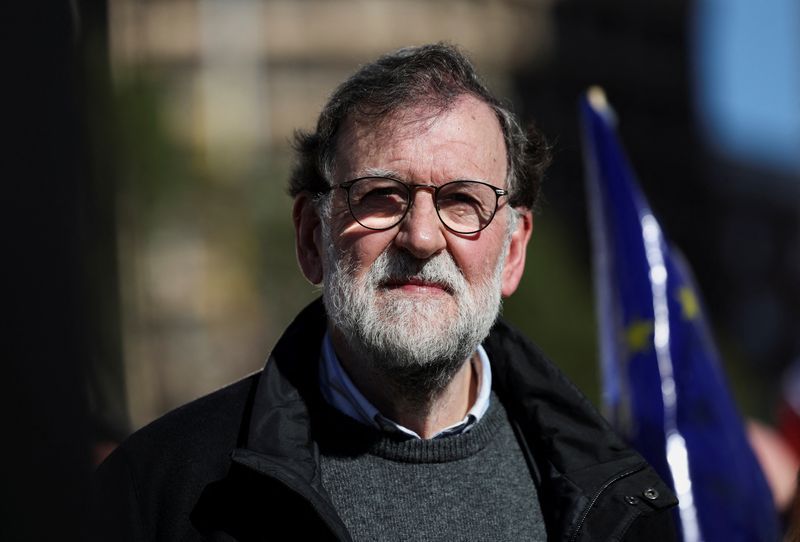
Spain's government moved swiftly to disavow remarks made by conservative former Prime Minister Mariano Rajoy about France's national soccer team, with Foreign Minister Jose Manuel Albares issuing a formal apology to his French counterpart on Tuesday. The intervention came hours before the two nations were scheduled to face each other in a World Cup semi-final, underscoring the sensitivity surrounding what many viewed as an offensive and discriminatory column.
Rajoy, who served as Spain's Prime Minister from 2011 to 2018, published his commentary in the online publication El Debate on Friday, ostensibly to praise France as a formidable opponent heading into the knockout match. However, his piece took a contentious turn when he questioned the team's "Frenchness," an apparent reference to the African and Afro-Caribbean heritage of several squad members. "France has a squad of the very highest calibre. Mind you, there are no French players in it," he wrote, a statement that immediately drew criticism across Europe.
Albares characterised Rajoy's words as "intolerable" and carrying "the poison of racism and xenophobia," emphasising that such views did not represent the position of the Spanish government or the Spanish people. During a radio interview with Cadena SER, the Foreign Minister elaborated on why the remarks warranted an official response, noting that the use of physical appearance as a metric for citizenship represented a fundamental challenge to modern European values. "It's a very serious matter to go around using skin colour to determine who can be a citizen and who cannot," he stated bluntly, signalling that Madrid understood the gravity of allowing such sentiments to pass unaddressed in a sporting context.
Spain's Prime Minister Pedro Sanchez reinforced the government's position while attending France's National Day celebrations in Paris on Tuesday. Sanchez posted on the social media platform X a direct rebuke of those who "measure nationality by a person's surname, birthplace or skin colour," explicitly describing Rajoy's comments as shamefully xenophobic. The coordinated response from multiple members of Spain's executive demonstrated a deliberate strategy to ensure that diplomatic relations and Spain's international reputation would not be tarnished by the remarks of a former political leader.
The People's Party, Rajoy's own political formation, attempted to minimise the controversy through party spokesperson Borja Semper, who suggested that the column had been written without malicious intent and should be understood as sarcasm rather than a serious statement. This framing proved unconvincing to observers who noted that the apparent humour depended entirely on the premise that players of African descent could not be authentically French—a proposition rooted in racial categorisation. The party's defensive posture contrasted sharply with the clearer condemnation emanating from government circles.
The timing of Rajoy's column proved particularly unfortunate, arriving just days after an international incident involving a Paraguayan senator had already brought issues of race and national identity to the forefront of World Cup discourse. Senator Celeste Amarilla had posted a racist attack on France captain Kylian Mbappe following Paraguay's elimination from the tournament, describing him as a "colonised Cameroonian, desperately trying to pass himself off as French." That earlier outburst had already demonstrated how easily sporting competition could become a vehicle for xenophobic sentiment, making Rajoy's subsequent remarks appear to be part of a broader pattern rather than an isolated misstep.
Mbappe himself had responded to Amarilla's tirade with remarkable dignity, defending not only his own position but also extending solidarity to the Paraguayan players who had been unfairly tainted by their senator's behaviour. His response characterised Amarilla as unfit for public office and called her remarks despicable. The French Football Federation subsequently filed a criminal complaint, and Paraguay's government formally distanced itself from Amarilla's comments, acknowledging that her words contradicted the nation's stated values. This international response had established a clear precedent that such remarks would face serious consequences.
In France, Rajoy's column generated rare political unity, with both the centrist government and the far-right National Rally opposition party condemning his words without equivocation. Foreign Minister Jean-Noël Barrot told BFM TV that the remarks were "pathetic," before articulating France's modern understanding of national identity: "Once and for all, France has no skin colour. Any statement to the contrary is a sign of idiocy, racism, or both combined." The statement represented not merely a rebuttal but a philosophical assertion about what it means to be French in a contemporary, diverse democracy.
National Rally spokesman Julien Odoul, speaking to FranceInfo television, employed unambiguous language to describe Rajoy's position, calling the comments "scandalous, shameful, deplorable" and directly labelling the former Prime Minister as racist. The willingness of France's far-right opposition to join centrist officials in condemning the remarks reflected the intensity of feeling about what many saw as a fundamental attack on France's conception of itself as a multiethnic nation-state.
The episode raised broader questions about how European political figures should conduct themselves when commenting on international sporting events, particularly when their observations veer into matters of race and identity. Rajoy's apparent attempt to make a clever quip about team composition had instead illuminated the persistence of essentialist thinking about nationality—the idea that certain ethnic or cultural markers should determine who legitimately belongs to a national community. For Malaysian observers, the controversy underscored how easily racial and ethnic categorisation can become embedded in seemingly innocent sporting commentary, and how such remarks, regardless of intent, carry serious consequences in contemporary international relations.
The swift diplomatic response from Spain, combined with the unified condemnation from France across the political spectrum, suggested that European institutions and political leaders were increasingly alert to the need to police xenophobic sentiment in public discourse. Yet Rajoy's comments also demonstrated that such views retained currency among some segments of European political elites, even if they could no longer be expressed without triggering significant official rebuke. The contrast between Rajoy's position and the clear statements from both Spanish and French leadership indicated that the political mainstream in both countries had moved decisively away from linking citizenship or national authenticity to ethnic or racial characteristics.

