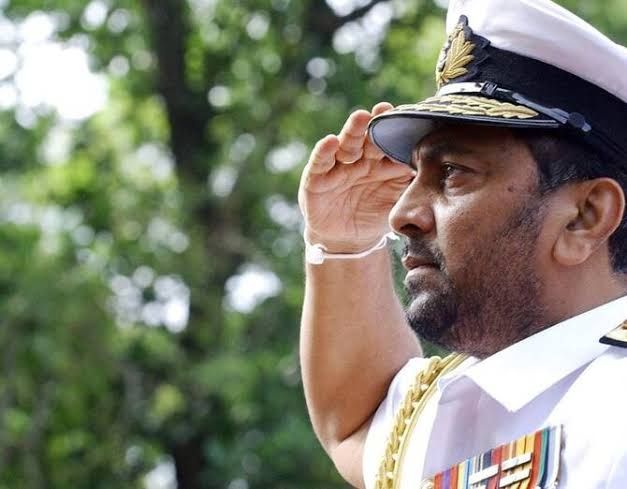
Sri Lankan authorities have arrested Admiral of the Fleet Wasantha Karannagoda, the former navy commander, on corruption allegations involving the improper recruitment of Yoshitha Rajapaksa, son of ex-president Mahinda Rajapaksa. The 73-year-old officer was taken into custody by the Bribery Commission on Friday over his role in facilitating the 2006 naval enlistment of Yoshitha without the requisite qualifications, an apparent abuse of military recruitment procedures that has now drawn official scrutiny.
Karannagoda's arrest marks a significant escalation in the legal jeopardy facing members of the prominent Rajapaksa political dynasty, whose influence over Sri Lankan affairs has faced mounting challenges since President Anura Kumara Dissanayake took office in September 2024 on an anti-corruption platform. The admiral's detention underscores the new administration's determination to pursue long-dormant investigations that were shelved or deprioritized during earlier governments aligned with the Rajapaksa family. Although Karannagoda held no active naval duties at the time of his arrest, his former rank and the gravity of the allegations signal that even high-level figures once considered untouchable are now facing legal accountability.
Yoshitha Rajapaksa, who is now 38 years old, remains at liberty on bail following his own arrest last month in a parallel investigation concerning the misuse of state resources. The younger Rajapaksa stands accused of utilizing public funds to finance advanced training at Dartmouth Naval College in Britain, an elite institution where officers from friendly nations undergo specialized instruction. The interconnected nature of these cases—involving both the son's improper recruitment and subsequent state-funded overseas training—reveals what investigators allege was a systematic pattern of privilege-granting within the military establishment that benefited the Rajapaksa family.
The Bribery Commission's formal statement confirmed that Karannagoda "has committed the offence of corruption in the recruitment and training of Yoshitha Rajapaksa," laying out a clear prosecutorial position before his detention hearing. This institutional indictment carries particular weight in Sri Lanka's legal framework, suggesting that investigative authorities have accumulated sufficient evidence to proceed with formal charges. The case also reflects broader institutional concerns about military recruitment standards and the integrity of officer training programmes, issues that resonate across South and Southeast Asia where civil-military relations remain delicate.
Beyond the corruption allegations directly related to Yoshitha Rajapaksa, Karannagoda confronts an extensive web of additional charges that span decades of alleged misconduct. British sanctions imposed against him in March 2025 identified him as complicit in serious human rights violations and extrajudicial killings during and after Sri Lanka's three-decade civil war, which concluded in 2009 when Karannagoda served as navy commander. The sanctions from London represent an international dimension to the accountability process, signalling that scrutiny of alleged abuses is not confined to domestic courts.
Most gravely, Karannagoda faces charges of conspiracy to commit murder in connection with the deaths of eleven young men killed between 2008 and 2009, a period when intense military operations were underway against Tamil separatist forces. These charges carry the potential for substantial prison sentences and represent the most serious criminal allegations against him. Significantly, these murder charges were abandoned in October 2021 when Gotabaya Rajapaksa, the ex-president's brother, occupied the presidency and pursued policies protective of military figures. The decision to revive these charges under the current administration demonstrates how legal proceedings in Sri Lanka have become intertwined with political transitions and competing visions of national accountability.
The renewed momentum behind prosecutions involving the Rajapaksa network reflects President Dissanayake's electoral mandate and stated commitment to investigating unsolved high-profile crimes and instances of alleged corruption that accumulated during the family's years in power. Since Dissanayake's September 2024 election victory, numerous cases against Rajapaksa family members and their close associates have gathered pace through the judicial system. For Malaysian readers familiar with succession politics and family-based power networks in the region, the Sri Lankan case offers instructive parallels regarding the challenges of post-transition accountability and the role courts must play in constraining executive privilege.
Yoshitha Rajapaksa himself faces multiple criminal investigations extending beyond the immediate naval recruitment matter. In a particularly revealing disclosure, investigators probed his acquisition of substantial residential property while his father controlled state power between 2005 and 2015, questioning the legitimacy of funds used for the purchase. When pressed to explain these financial sources, Yoshitha claimed he had sold gemstones gifted by his grandaunt—an explanation that merely shifted the evidentiary burden, as the elderly relative could not recall how she had originally obtained the precious stones. This murkiness surrounding asset acquisition has become emblematic of how political families leverage official access to accumulate wealth through opaque transactions.
The legal predicament has extended to other members of the Rajapaksa circle. Gotabaya Rajapaksa, the ex-president and Mahinda's brother, was subjected to a foreign travel restriction last month stemming from his alleged connections to the 2019 Easter Sunday bombings, a series of coordinated suicide attacks that killed 279 people and exposed serious intelligence and security failures. The imposition of travel restrictions against such a prominent political figure reflects the seriousness with which the current government treats these allegations and its willingness to circumscribe the movements of the nation's former leadership.
The cascade of legal actions targeting the Rajapaksa family and their network of associates represents one of South Asia's most significant post-transition accountability exercises. From a regional perspective, the cases demonstrate how electoral change can unlock judicial proceedings previously constrained by political calculations. Yet the process also raises questions about selective justice, the sustainability of legal action across changing administrations, and whether Sri Lanka's courts possess sufficient independence to adjudicate these politically charged matters fairly. For neighbouring Malaysia and other Southeast Asian nations grappling with their own governance challenges, the Sri Lankan experience illustrates both the necessity and the complexity of holding powerful figures accountable after regime transitions.

