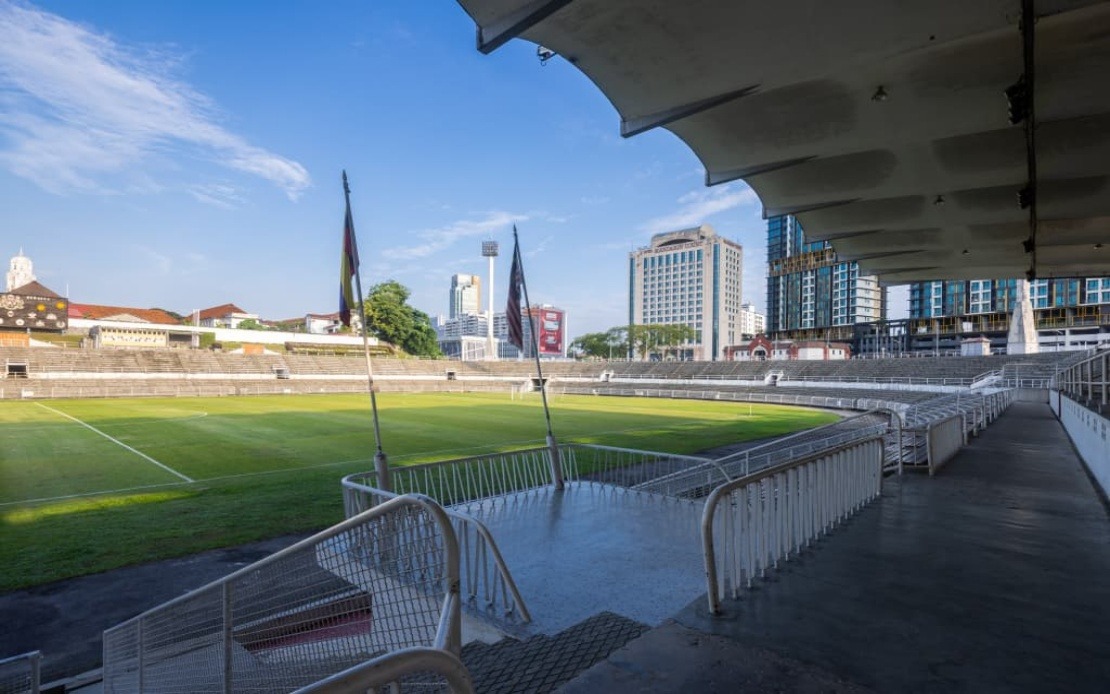
Nearly seven decades have passed since Stadium Merdeka witnessed one of the most defining moments in Asian history, yet the venue continues to pulse with the spirit of a nation's birth. Standing incongruously amid Kuala Lumpur's modern skyline, dwarfed by the gleaming Merdeka 118 tower, this architectural survivor serves as a tangible link to August 31, 1957, when the first Prime Minister Tunku Abdul Rahman Putra Al-Haj proclaimed Malaya's independence with seven resounding cries of "Merdeka!" The stadium's physical presence today—restored, accessible, and deliberately preserved—demonstrates how nations construct and maintain collective memory through heritage conservation.
The venue itself was a marvel of rapid development, constructed in just one year at a cost of approximately RM2.3 million during a period when such expenditure represented a significant national investment. This speed of construction underscored the strategic importance placed on creating a setting worthy of the independence ceremony. Yet beyond its architectural credentials, the stadium's true significance lies in its role as witness to a transformative historical moment that fundamentally reshaped the political map of Southeast Asia and established the template for decolonisation across the region.
Prof Dr Sarjit Singh Gill from Universiti Putra Malaysia articulated the deeper meaning embedded within the stadium's walls, characterising it not merely as a sports facility but as a repository of national identity and dignity. The scholar's assessment reflects a growing recognition among Malaysian intellectual circles that heritage sites possess value extending far beyond their original functional purpose. For a newly independent nation navigating the complexities of post-colonial statehood, Stadium Merdeka represented tangible proof that independence could be proclaimed, celebrated, and institutionalised through shared public space.
The stadium's historical significance expanded beyond 1957 when it hosted another pivotal event in 1963: the proclamation of Malaysian Federation formation, which formally incorporated Sabah, Sarawak, and initially Singapore into a larger political union. This second historical moment, often overshadowed by the more celebrated independence proclamation, nonetheless marked another crucial juncture in the region's political development. The venue thus accumulated layered historical meaning, becoming a stage where successive transformations of the Malaysian state were announced to the nation.
The path to preserving Stadium Merdeka was neither straightforward nor assured. During the late 1990s, the venue faced existential threats as redevelopment pressures mounted in an era of rapid urban transformation. Public resistance to its demolition, combined with government recognition of its heritage value, prevented the site's erasure from the urban landscape. The intervention proved decisive: Permodalan Nasional Berhad assumed stewardship of the facility in 2000, initiating a comprehensive preservation strategy that would ultimately secure its future. This transition from potential demolition to deliberate conservation illustrated how public memory and institutional commitment could work in concert to protect historical assets.
Permodalan Nasional Berhad's approach, articulated through CEO Datuk Dr Izwan Ibrahim, prioritises authenticity restoration over commercialisation. The conservation strategy drew upon original Public Works Department construction blueprints, guiding decisions about which elements to restore and which later modifications to remove. The removal of upper seating tiers returned the stadium to its original 20,000-seat capacity, while meticulously restoring signature features including the distinctive cantilevered roof, original scoreboard, mosaic tilework, and washroom facilities. This granular attention to architectural authenticity reflects a sophisticated understanding that heritage preservation requires fidelity to historical detail rather than merely maintaining superficial appearance.
The stadium's transformation into a public-facing heritage site represents a deliberate strategy to engage contemporary Malaysians with independence-era history through direct experience rather than passive documentation. The venue now hosts diverse programming, from community sporting activities utilising the refurbished track to cultural events such as the Bazram Merdeka bazaar, which attracted over 250,000 visitors during the current year's Ramadan period alone. This diversified programming model transforms Stadium Merdeka from monument into living venue, creating multiple entry points for public engagement across different age groups and interests.
For Malaysia's younger generations, born decades after 1957, the independence narrative risks becoming abstract historical fact divorced from emotional resonance. PNB's leadership recognises this generational challenge and has deliberately invested in youth engagement programming. The strategy involves encouraging school groups, university delegations, and individual young visitors to experience the stadium firsthand, understanding that embodied historical experience—walking the same ground, touching the same structures, breathing the same air as independence champions—creates psychological and emotional connections that classroom instruction alone cannot achieve. Early evidence suggests this approach yields measurable results, with neighbouring schools increasingly incorporating Stadium Merdeka visits into their educational programming.
The significance of lived experience at heritage sites extends beyond educational metrics into the realm of national identity formation. Long-serving facility manager Alias Daud, who devoted the final decade of his 35-year career with PNB to the stadium's stewardship, articulated this dimension with particular poignancy. His testimony illuminates how heritage site workers develop deeply personal relationships with physical spaces, understanding themselves as custodians of collective memory. The pride, gratitude, and nostalgia Daud experienced daily at Stadium Merdeka reflected an internalisation of the site's historical weight—a recognition that his daily labour of preservation contributed to something transcending individual employment.
Visitor testimonies gathered by site management indicate that many Malaysians experience surprise and emotional resonance upon learning that the unremarkable-looking stadium hosted their nation's most consequential political ceremony. This phenomenon—the gap between historical significance and present architectural grandeur—itself holds pedagogical value, teaching the lesson that momentous political events need not require monumental architectural settings. The stadium's modest scale paradoxically reinforces the centrality of human agency and collective will in shaping historical outcomes, a lesson particularly relevant in an era prone to confusing impressive infrastructure with genuine achievement.
The stadium's recognition through formal heritage mechanisms has reinforced its protected status. The 2008 UNESCO Asia-Pacific Heritage Award acknowledgement and 2009 gazettal as a National Heritage site provided institutional validation for its preservation, strengthening institutional and legal commitments to ongoing stewardship. These designations placed Stadium Merdeka within international frameworks of heritage recognition, connecting local preservation efforts to global consciousness about the importance of maintaining tangible connections to historical transformations.
As Kuala Lumpur's skyline continues its vertical ascent, with towers like Merdeka 118 literally rising above the stadium, Stadium Merdeka's significance potentially deepens rather than diminishes. The juxtaposition of historic and modern—the stadium's deliberately preserved mid-century modernity surrounded by contemporary glass and steel—visually embodies Malaysia's narrative arc from post-colonial emergence to developed-nation aspiration. The stadium thus becomes not merely a monument to past achievement but a spatial argument about national continuity and identity persistence across radical transformation.
The deliberate preservation and active programming of Stadium Merdeka reflects a mature approach to national heritage, one that understands such sites as living repositories of collective memory requiring sustained institutional attention and public engagement. For Malaysia and the broader Southeast Asian region, the stadium stands as a reminder that independence, once proclaimed, requires perpetual re-commitment through preservation, education, and the creation of spaces where successive generations can experience their national origin story with direct sensory and emotional engagement.

