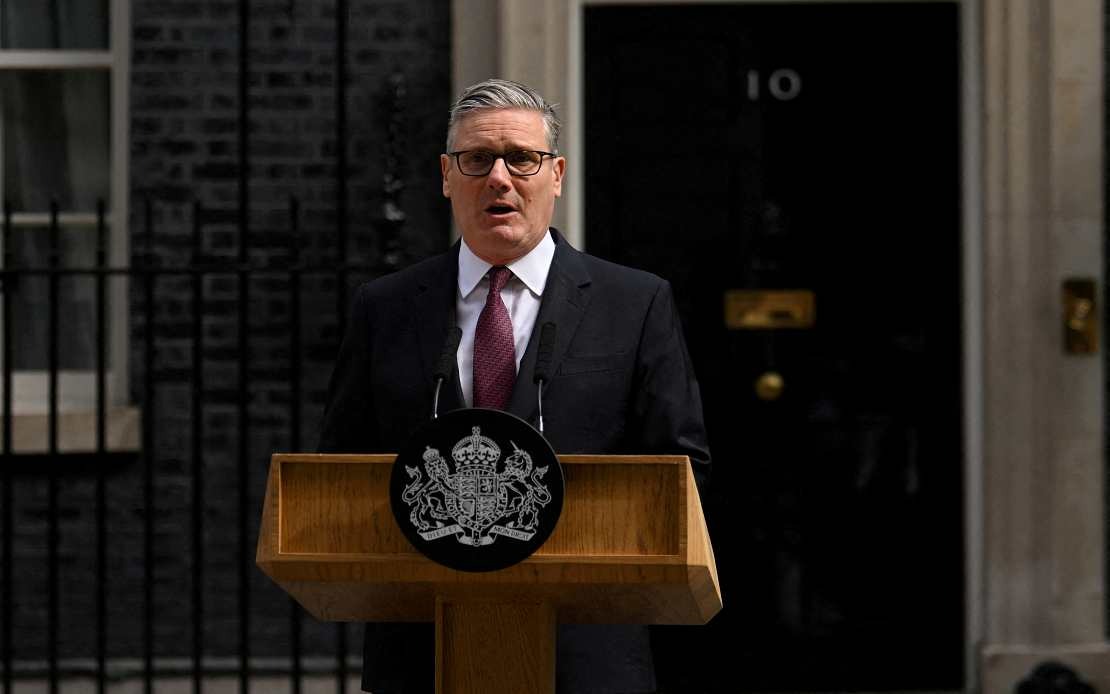
Keir Starmer brought his tenure as British Prime Minister to a close on Monday with a final address at Downing Street, stating that his "work is done" and expressing contentment as he prepared to formally end his time in office. The outgoing premier, flanked by his wife Victoria Starmer and surrounded by colleagues and friends, delivered remarks before proceeding to Buckingham Palace to tender his resignation to King Charles. In his parting statement, Starmer emphasised that the nation had emerged "stronger and fairer" during his period in power, signalling a government that believed it had successfully addressed key challenges facing British society.
Starmer's political journey underwent a remarkable transformation across the preceding six and a half years. He inherited the Labour Party in 2019 following an historic electoral defeat that had devastated the organisation's standing and morale. Through a methodical restructuring process, he fundamentally repositioned Labour as an electoral force capable of appealing to mainstream British voters. This strategic overhaul culminated in the party's commanding victory in the 2024 general election, a result that validated his approach and granted him the mandate to govern the country.
The Prime Minister's departure marks a significant juncture in British politics, with the transition of power now shifting to Andy Burnham, who appears positioned to assume the premiership. Burnham's ascendancy represents a continuation of Labour governance but also signals the beginning of a new chapter for the party and the nation. The circumstances surrounding this leadership change reflect broader dynamics within British politics, where the electoral fortunes established in 2024 are now being tested against the realities of governing and the inevitable challenges that accompany sustained power.
Starmer's remarks during his final Downing Street appearance underscored his characterisation of the Labour government's achievements. By asserting that Britain had become "stronger and fairer," he laid claim to tangible improvements in the country's economic stability, public services, and social cohesion. These assertions would likely form the basis of Labour's argument for continuity under new leadership, suggesting that the incoming administration should build upon the foundations laid during Starmer's premiership rather than embarking on a dramatic strategic departure.
The transition occurring in Westminster has implications that extend well beyond the United Kingdom's borders. As Britain recalibrates its approach to governance and international relations under new leadership, neighbouring nations and regional partners, particularly within the Commonwealth and European sphere, will be observing how the transfer of power unfolds. Any shifts in policy direction or diplomatic priorities could influence the broader geopolitical landscape in which Southeast Asian nations operate, particularly regarding trade relationships and global governance frameworks.
For Malaysian observers of British politics, Starmer's departure and Burnham's succession warrant attention given the historical and ongoing economic ties between Malaysia and the United Kingdom. British policy decisions regarding trade, investment, and regional engagement in Asia-Pacific directly affect Malaysian interests. The change in prime ministerial leadership provides an opportunity to assess whether bilateral relations and regional cooperation frameworks will experience continuity or undergo recalibration under new Westminster leadership.
The manner in which Starmer characterised his exit—with evident satisfaction and without rancour—reflects a political figure who believes his mission has been substantially accomplished. His willingness to "pass the baton" to Burnham suggests a carefully managed succession within the Labour hierarchy, contrasting with the fractious internal battles that sometimes characterise changes of political leadership. This appears to be a deliberate effort to project an image of organisational stability and institutional coherence as power transfers to new hands.
Burnham's elevation to the premiership represents a progression through the ranks of Labour's hierarchy, and his selection underscores the party's confidence that he possesses the capability to navigate the complex challenges facing modern Britain. His ascendancy also reflects generational or factional considerations within Labour's broader coalition, as different wings of the party seek to ensure their perspectives continue to influence governmental direction and policy formulation.
The political significance of this transition extends to how Labour's broader electoral coalition responds to the change in leadership. Voters who supported the party in 2024 will be assessing whether Burnham's premiership maintains the policy commitments and political direction they endorsed, or whether the new administration charts a substantially different course. This period will be critical in determining whether the party can sustain the electoral momentum it achieved under Starmer or whether the machinery of government and the complexities of policymaking generate public discontent that erodes Labour's standing.
Starmer's departure after two years in office represents a relatively brief premiership by historical standards, yet one that the departing prime minister clearly views as having accomplished its principal objectives. His statement that he is departing "with a smile" projects an image of contentment and confidence in his record, even as his successor takes on the responsibility of stewarding Britain through ongoing domestic challenges and international uncertainties. The smooth transition of power within the Labour party and the formal constitutional procedures being observed underscore the stability of British democratic institutions, even as the substantive direction of governance passes to new leadership.

