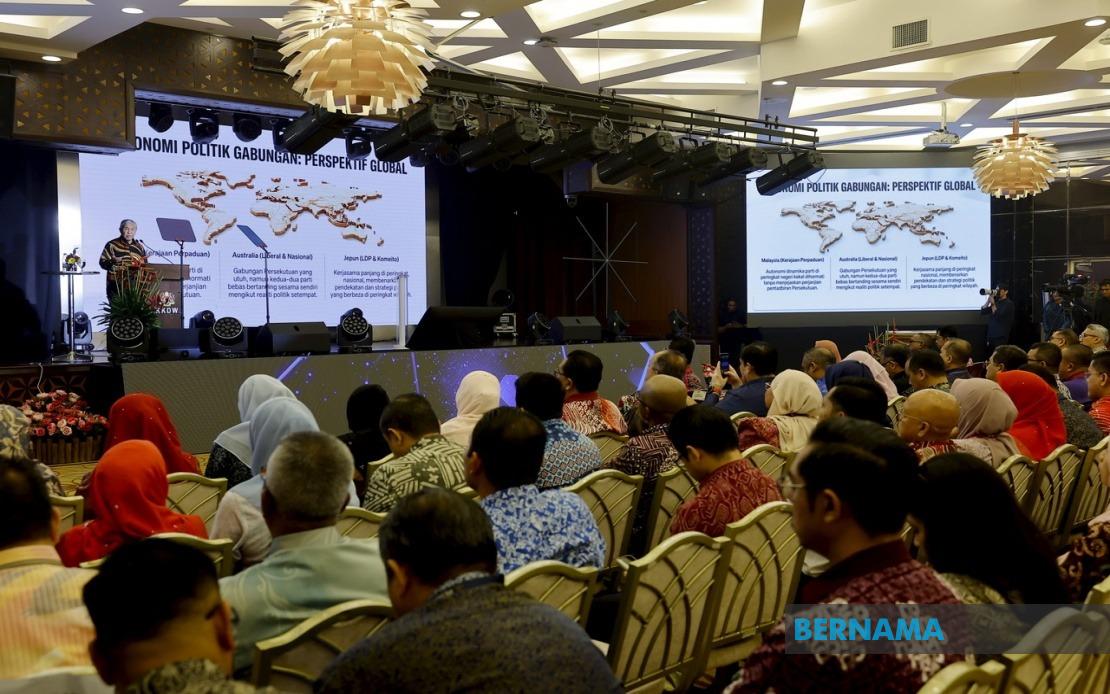
Malaysia's federal government will remain stable and fully operational regardless of political rivalries playing out across individual states, according to Deputy Prime Minister Datuk Seri Dr Ahmad Zahid Hamidi. Speaking at the Rural and Regional Development Ministry's monthly assembly in Putrajaya on August 6, the Barisan Nasional chairman sought to reassure the public that recent state-level electoral contests, particularly in Johor and Negeri Sembilan, pose no threat to the cohesion of the Unity Government or its policy agenda.
The assurance comes at a time when Malaysia's political landscape remains fluid following successive state elections. Ahmad Zahid's remarks reflect an attempt by federal leadership to maintain public confidence in governance continuity, emphasising that the institutional machinery of government will continue operating without interruption. This messaging is critical for investor sentiment and public morale, as political uncertainty—whether real or perceived—can disrupt economic activity and undermine confidence in policy implementation.
Ahmad Zahid anchored his argument in the foundational agreement that binds the Unity Government together. He stressed that the coalition was constructed on a basis of mutual understanding between its constituent parties, an accord that remains legally and politically binding until Parliament is formally dissolved. This framework theoretically insulates the federal administration from the volatile dynamics of state-level politics, allowing governments to change hands in individual states without triggering institutional collapse at the centre.
The Deputy Prime Minister explicitly addressed a concern that resonates among observers of Malaysian politics: whether parties participating in the Unity Government must surrender their individual political identities or strategic autonomy. Ahmad Zahid's answer was categorical—coalition membership does not require parties to abandon their distinct principles or electoral strategies. Instead, he invoked the concept of political autonomy within a coalition framework, suggesting that each party retains discretion to pursue its own political directions so long as it respects the overarching agreement that established the federal government.
This formulation attempts to resolve a fundamental tension inherent in Malaysia's coalition politics. The country's political system regularly produces governments comprising multiple parties with sometimes divergent interests and voter bases. Managing these arrangements requires constant negotiation and careful demarcation of spheres where parties can act independently versus areas where collective discipline is essential. The MADANI Government's approach appears to draw such boundaries around core federal stability and policy implementation, while permitting parties flexibility in state-level positioning.
Ahmad Zahid's emphasis on continuous government function carries particular weight given Malaysia's economic situation. The routine operations he referenced—administration, policy implementation, and project execution—directly affect business confidence, investment decisions, and the delivery of public services. Disruption at the federal level cascades through administrative systems and affects everything from infrastructure development to social welfare distribution. By underscoring that these functions will proceed uninterrupted, he is attempting to maintain the predictability that both domestic and foreign investors require.
The specific mention of Johor and Negeri Sembilan state elections reflects recent political developments that captured national attention. Johor, Malaysia's second-largest state by population and a significant economic centre, carries outsized political weight. Changes in state government composition inevitably generate speculation about potential shifts in federal dynamics, particularly when they involve major coalition partners. Ahmad Zahid's explicit statement that these developments will not alter the federal government's direction serves to dampen such speculation and anchor expectations around continuity.
The principle Ahmad Zahid articulated—that state-level outcomes need not destabilise federal arrangements—represents a departure from Malaysian political history, where state elections have sometimes triggered dramatic federal realignments. The relative stability of recent years suggests that Malaysia's political elite have learned to compartmentalise state and federal politics more effectively than in the past. However, this separation remains conditional and contingent upon parties honouring their coalition agreements, a commitment that is always subject to re-evaluation when electoral dynamics shift.
For Southeast Asian observers, the Malaysian government's approach to managing coalition stability offers instructive lessons. Across the region, multi-party coalitions are common, and the challenge of maintaining federal coherence while permitting constituent parties electoral autonomy applies equally to Indonesia, Thailand, and other polities. Ahmad Zahid's framing suggests that explicit codification of agreements, combined with tolerance for intra-coalition political competition, may enable more durable arrangements than attempts to impose monolithic discipline.
The practical implications for Malaysian business and civil society are significant. Government policies affecting taxation, investment regulation, infrastructure development, and social programmes all depend on federal institutional continuity. The Deputy Prime Minister's assurances suggest that businesses can plan with confidence that major policy shifts are unlikely to be triggered by state electoral changes. This stability is particularly important given Malaysia's integration into regional supply chains and the capital requirements of major development projects that span multiple election cycles.
Ahmad Zahid's message also carries implicit domestic political significance. By explicitly permitting parties to pursue separate state-level strategies, the Unity Government leadership is acknowledging a reality that would otherwise fester as unspoken tension: coalition partners have incentives to compete electorally to demonstrate their relevance and organisational strength to their respective voter bases. Allowing this competition while maintaining federal discipline represents a mature accommodation to political pluralism, one that avoids forcing parties to choose between coalition loyalty and political survival.
Moving forward, the stability Ahmad Zahid describes will remain contingent upon several factors: the election-to-election maintenance of coalition agreements, the absence of major corruption scandals that might trigger defections, and the continued absence of circumstances that force parties into choosing between federal coalition loyalty and state-level political survival. Should any of these conditions change significantly, the assumptions underlying his statement may require rapid revision.

