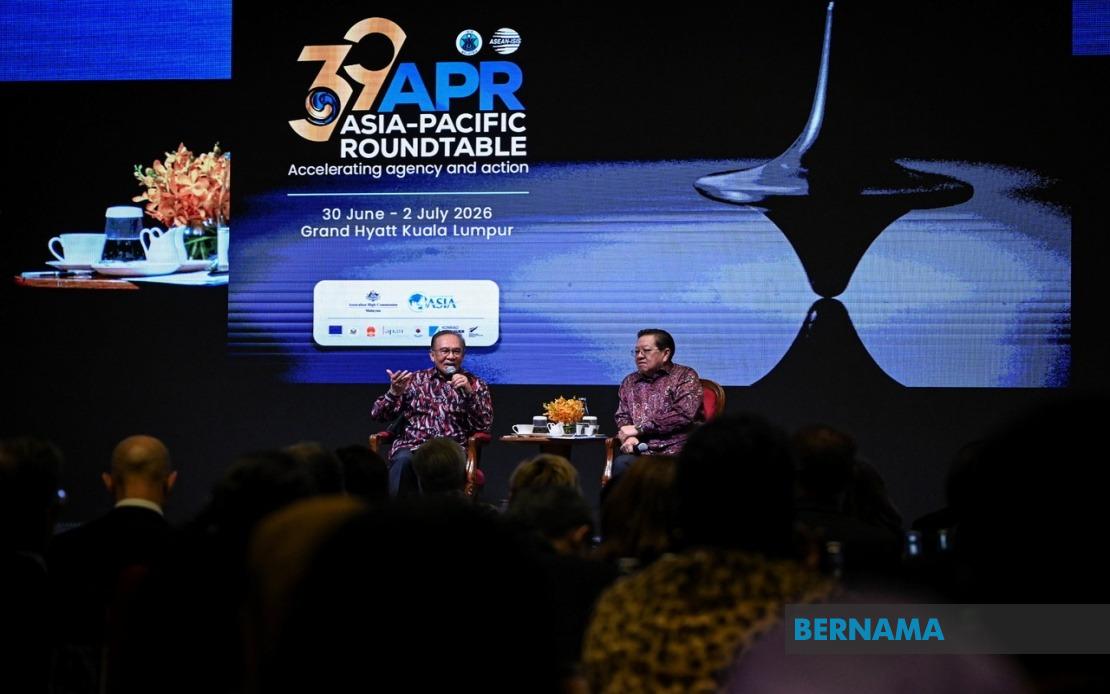
Prime Minister Datuk Seri Anwar Ibrahim has placed domestic governance reform at the centre of his administration's agenda, arguing that a nation's credibility on the world stage depends fundamentally on getting its own house in order. Speaking at the 39th Asia-Pacific Roundtable in Kuala Lumpur on July 2, Anwar made clear that Malaysia's immediate challenge lies not in leading global movements but in demonstrating that effective democratic institutions and inclusive values can flourish within a Muslim-majority nation.
The Prime Minister outlined a comprehensive domestic agenda spanning multiple policy areas. His government intends to concentrate efforts on institutional strengthening and systemic reform whilst simultaneously tackling endemic corruption that has long undermined public trust. Beyond these foundational elements, the administration is committed to narrowing socioeconomic divides that have widened over decades, ensuring that basic services—particularly education and healthcare—reach all Malaysians regardless of background or geography. These interconnected priorities reflect a view that governance quality cannot be measured by pronouncements alone but must be visible in citizens' everyday access to opportunity and security.
Anwar's emphasis on leading by example represents a subtle but significant shift in how Malaysia positions itself internationally. Rather than seeking prominent roles in major geopolitical forums or attempting to shape global narratives, the administration is signalling that Malaysia's contribution to international stability will emerge organically from its success in managing domestic complexity. This approach reflects pragmatism born from experience; a nation troubled by internal governance failures cannot credibly advise others or claim moral authority in multilateral settings.
Central to this vision is the notion that Malaysia can serve as a living demonstration of democratic pluralism functioning effectively across religious and communal lines. In a region where democratic backsliding and majoritarian tendencies have gained ground, and globally where many observers remain sceptical that Islam and democracy coexist naturally, Malaysia's performance matters beyond its borders. Anwar's framing suggests that the country's success in upholding democratic values and maintaining moderation is itself a contribution to international understanding, challenging prevailing assumptions without requiring Malaysia to assume an overtly missionary posture.
The Prime Minister directly addressed contemporary geopolitical discourse by rejecting the notion of a fundamental civilisational clash driving global conflict. He cautioned that framing international tensions as inevitable collisions between monolithic civilisations obscures more than it reveals, leading to self-fulfilling prophecies where nations and communities retreat into essentialised identities. Instead, Anwar drew on the analytical framework of scholar Edward Said to recharacterise many contemporary conflicts not as civilisational clashes but as manifestations of ignorance, misunderstanding, and prejudice. This distinction matters profoundly; conflicts rooted in ignorance can in principle be addressed through dialogue, education, and exposure, whereas supposedly inevitable civilisational collisions admit no remedy short of dominance or withdrawal.
Anwar's invocation of Said's work carries particular resonance for Malaysian audiences familiar with postcolonial critiques and the complexities of identity in multicultural societies. Said's concept of Orientalism—the systematic misrepresentation of Eastern societies by Western powers—provides intellectual scaffolding for understanding how international tensions often rest on caricatures rather than genuine comprehension. By applying this framework to contemporary geopolitics, Anwar positions Malaysia as a country that has thought deeply about how prejudice and misrepresentation operate, and has built institutional responses to counter them.
The Prime Minister grounded his philosophical observations in the MADANI framework, Malaysia's stated development paradigm. This framework explicitly attempts to synthesise technological progress with human-centred values, rejecting false choices between modernity and morality. By emphasising both dimensions equally, Anwar signals that Malaysia's model of development need not replicate Western trajectories nor retreat into defensive traditionalism. Instead, the nation can pursue advancement while maintaining emphasis on ethical foundations, social cohesion, and cultural continuity. This positioning has particular appeal in Southeast Asia, where many societies grapple with balancing rapid technological change against concerns about social fragmentation.
Investing the concept of 'li ta'arafu'—a Quranic principle often translated as mutual acquaintance or recognition—Anwar articulated an aspirational vision extending beyond mere tolerance. The phrase suggests that diverse communities should move beyond passive coexistence toward active appreciation of difference. This theological grounding provides legitimacy for pluralist governance within an Islamic framework, addressing potential objections that democratic inclusion and religious observance conflict. For a multiracial and multireligious nation like Malaysia, where communal tensions have periodically erupted into violence, the cultivation of genuine mutual understanding rather than enforced neutrality represents an ambitious but necessary goal.
The emphasis on understanding over tolerance carries practical implications for Malaysian policymaking. Tolerance can be grudging and contingent; it permits communities to remain in parallel isolation, avoiding conflict but not building trust. Understanding, by contrast, requires exposure, interaction, and genuine curiosity about others' perspectives and values. Institutionalising such understanding through education curricula, interfaith initiatives, and cross-communal engagement programmes requires sustained commitment and resources. The Prime Minister's invocation of these concepts suggests that his administration recognises the difference and intends to pursue deeper integration of Malaysia's diverse population.
Anwar's framing also implicitly addresses international scepticism about Malaysia's democratic health and governance standards. In recent years, international observers and rating agencies have scrutinised Malaysia's performance on judicial independence, press freedom, and anti-corruption enforcement. By placing these issues at the forefront of his government's agenda and linking them to Malaysia's international standing, Anwar acknowledges both the legitimacy of such concerns and his administration's commitment to addressing them. This transparency, combined with substantive reform efforts, aims to restore Malaysia's reputation and demonstrate that the country takes governance seriously.
The regional context amplifies the significance of Anwar's messaging. Southeast Asia encompasses nations with vastly different governance models, religious compositions, and political trajectories. Malaysia's success in maintaining democratic institutions whilst managing religious and communal diversity offers lessons potentially applicable across the region. Conversely, Malaysia's failures in these domains—resurgent corruption, erosion of institutional autonomy, communal polarisation—would reinforce scepticism about whether pluralism and democracy can genuinely function in Southeast Asian contexts.
Looking forward, Anwar's remarks suggest a patient, inward-focused approach to governance rather than an activism-oriented international strategy. This stance may disappoint those anticipating Malaysia to champion regional or global causes, but it reflects mature recognition that nations without their own houses in order typically lack the credibility and resources to project influence effectively. By concentrating on institutional reform, anti-corruption drives, and inclusive development, Malaysia positions itself to accumulate moral authority gradually. Should the administration succeed in its domestic agenda, Malaysia would possess both the standing and the evidence to advocate persuasively for democratic pluralism, moderate governance, and cross-communal dialogue internationally.

