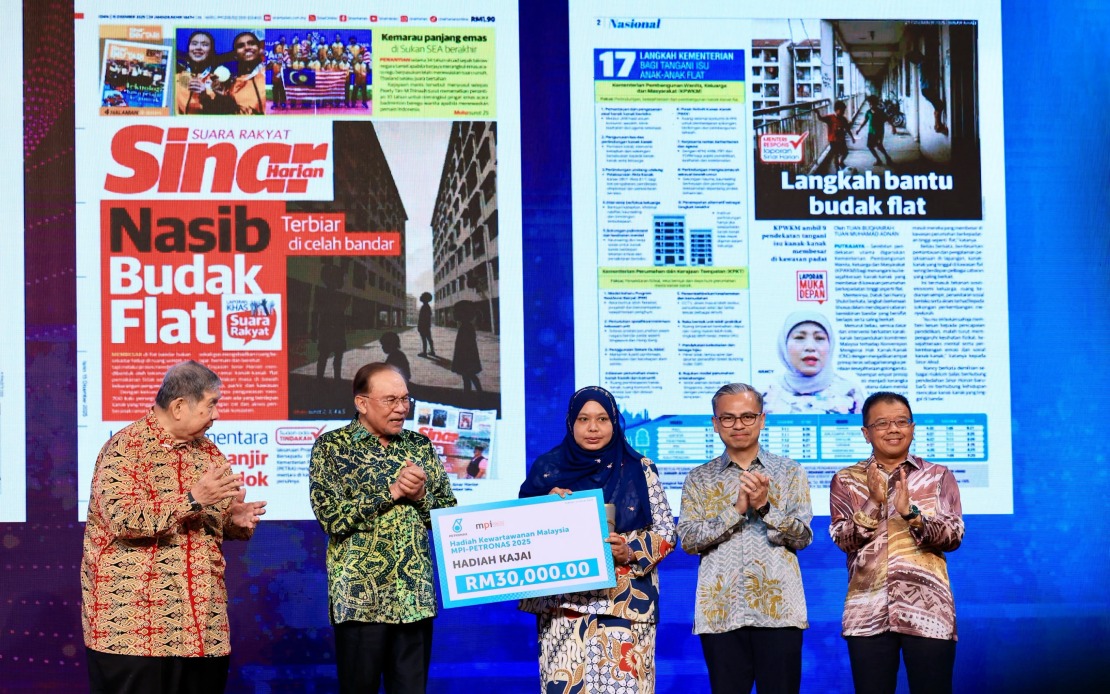
Communications Minister Datuk Seri Fahmi Fadzil has stressed that ethical, independent and responsible journalism forms the backbone of a functioning democracy and an informed citizenry. Speaking at a major industry gathering in Kuala Lumpur, Fahmi highlighted how media practitioners continue to shoulder significant responsibility in an environment increasingly complicated by misinformation and false narratives.
The minister's remarks came during the Malaysian Journalists' Night (MWM) 2026, a prominent annual event organised by the Malaysian Press Institute (MPI) that celebrates outstanding contributions to the profession. Prime Minister Datuk Seri Anwar Ibrahim also attended the gathering, which drew approximately 1,000 participants from across the media landscape, government agencies, educational institutions and the corporate sector. The evening culminated in the presentation of the MPI-PETRONAS Malaysian Journalism Awards 2025, recognising excellence and professional achievement across the industry.
Fahmi's intervention reflects growing recognition within Malaysia's political leadership that the media operates in an increasingly complex information ecosystem. The proliferation of digital platforms and social media channels has fundamentally altered how news circulates and how audiences engage with current events. Simultaneously, the challenge of distinguishing credible reporting from deliberately crafted falsehoods has intensified, placing greater pressure on professional journalists to maintain editorial standards and factual accuracy. The minister's explicit acknowledgment of these dynamics signals government understanding that combating misinformation requires not regulatory intervention alone, but voluntary commitment from media organisations to uphold professional ethics.
The Communications Ministry's emphasis on media independence carries particular significance for Malaysia's democratic trajectory. A media sector capable of operating free from undue political pressure, corporate interference, or financial distress provides crucial oversight functions essential to accountable governance. When journalists can investigate and report on matters of public interest without fear of reprisal or commercial disadvantage, democratic institutions strengthen through scrutiny and transparency. Fahmi's remarks thus position the government as recognising that media autonomy ultimately serves national interests by fostering public trust in institutions and enabling informed civic participation.
The scale of participation at the Malaysian Journalists' Night underscores the media industry's significance as a stakeholder in Malaysia's development narrative. The presence of government representatives, corporate leaders and educators alongside media professionals suggests an ecosystem increasingly aware that journalism's health matters beyond the newsroom. Corporate sponsorship of industry awards and government participation in celebrations of journalistic excellence reflect broader investment in media sustainability—a practical acknowledgment that professional journalism requires both resources and public validation.
For Malaysian media practitioners, the minister's public endorsement of ethical standards provides meaningful support at a time when news organisations navigate commercial pressures and audience fragmentation. Many regional newsrooms have downsized in recent years as advertising revenue shifted to digital platforms and subscription models remain underdeveloped. Government recognition of journalism's democratic value, combined with initiatives like the PETRONAS-sponsored awards programme, offers tangible encouragement to journalists committed to quality reporting despite these structural challenges.
The focus on combating misinformation and fake news resonates across Southeast Asia, where several countries grapple with similar challenges to information integrity. Malaysia's approach—emphasising voluntary professional standards rather than regulatory restriction—offers a model worth examining for other democracies in the region. By framing the issue around media responsibility and ethical practice rather than government policing of content, Fahmi's statement reflects a more nuanced understanding of media regulation's potential pitfalls while still addressing legitimate public concerns about false information.
The Malaysian Journalists' Night also functions as an opportunity to strengthen relationships between media organisations, government agencies and commercial entities. These professional networks facilitate better understanding across sectors and create informal channels through which journalists can develop sources and government representatives can communicate policy rationale. Such engagement, conducted within appropriate editorial boundaries, can enhance overall communication effectiveness and reduce mutual suspicion between institutions.
Looking forward, the challenge for Malaysia's media sector lies in translating expressions of support into sustainable business models and working conditions that enable quality journalism. While ministerial recognition and industry awards celebrate excellence, the fundamental viability of professional news organisations depends on readers valuing reporting enough to support it financially, whether through subscriptions, advertising or other mechanisms. The government's role in this context involves creating conditions—including press freedom protections and reasonable regulatory environments—that allow quality journalism to flourish.
Fahmi's invocation of media integrity as essential to democratic health also implicitly acknowledges that democracy requires more than electoral processes and parliamentary procedures. A democratic system depends on an engaged, informed public capable of making choices based on factual understanding. When misinformation proliferates unchallenged, public decision-making becomes distorted and democratic legitimacy erodes. By publicly championing ethical journalism, the Communications Minister recognises this deeper interdependence between media quality and democratic functioning.
The emphasis on media independence gains additional importance given Malaysia's diverse, multi-ethnic society where accurate, trustworthy reporting helps build social cohesion across community lines. When media organisations maintain editorial standards and avoid serving narrow partisan or commercial interests, they create shared informational space where Malaysians of different backgrounds encounter common facts about issues affecting them all. This unifying function of quality journalism becomes particularly valuable in plural societies navigating complex social dynamics.
Moving forward, sustaining this positive relationship between government and media institutions will require continued commitment from all parties. For journalists, the challenge involves demonstrating through their work that the public trust placed in the profession remains justified. For government and corporate sectors, it requires resisting temptations to manipulate media relationships for narrow advantage. The Malaysian Journalists' Night represents a moment of shared affirmation that such professional standards matter—an affirmation that will need regular reinforcement through concrete action and resource commitment in the months and years ahead.

