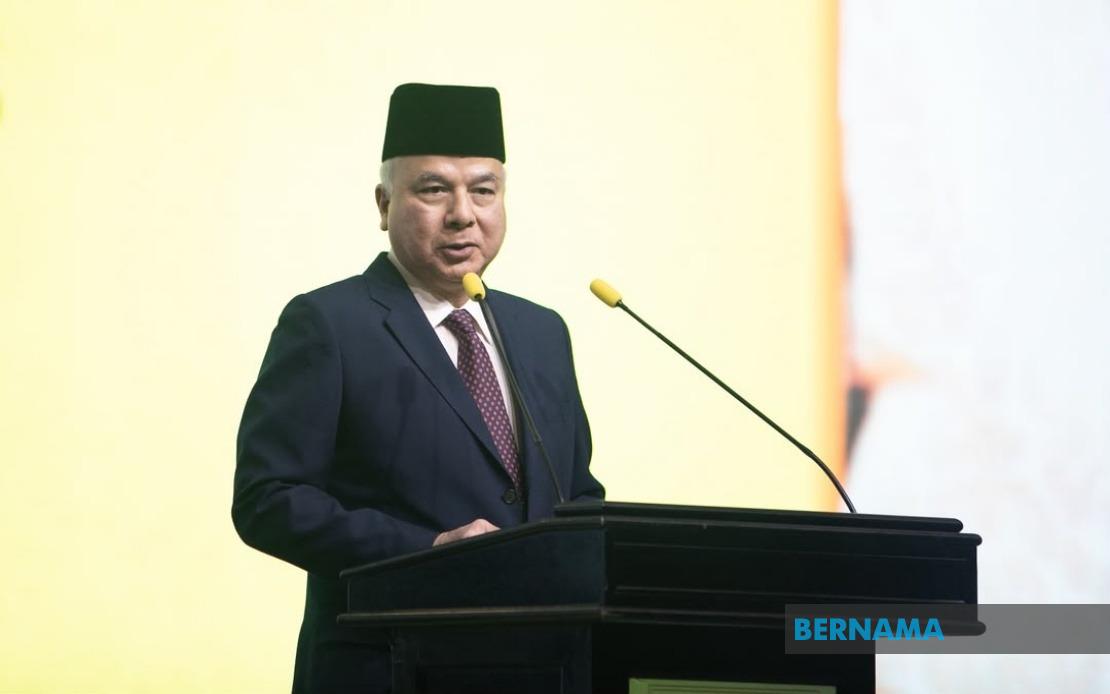
The Sultan of Perak, Sultan Nazrin Shah, has delivered a sweeping critique of governance failures, arguing that material abundance and human talent mean nothing without the institutional scaffolding to support equitable development. Speaking at the 8th World Conference on Islamic Thought and Civilisation in Ipoh, Sultan Nazrin outlined a vision of statecraft centred on institutional durability, transparent administration, and the principle that ordinary citizens matter equally in the eyes of government. The remarks carry particular weight in Malaysia, where ongoing debates about institutional independence and political culture remain contested terrain.
At the heart of Sultan Nazrin's address lies a deceptively simple but politically charged premise: that a nation's trajectory depends less on its natural endowments than on the quality of rules governing how power is exercised and contested. This argument challenges a common Malaysian narrative that positions resource wealth as the primary engine of national success. Instead, Sultan Nazrin positioned institutional strength as the variable that determines whether prosperity is broadly shared or captured by connected elites. He emphasised that institutions must possess sufficient independence and legitimacy to survive transitions of power, preventing the politicisation of the state apparatus that has plagued many developing democracies.
The concept of transparency in resource management emerged as a cornerstone of Sultan Nazrin's framework. He characterised public budgets not merely as technical financial instruments but as moral documents revealing state priorities regarding whose welfare officials genuinely prioritise. This framing has direct relevance in Malaysia, where concerns about fiscal accountability and the distribution of public spending between federal and state governments remain points of political contention. By anchoring transparency to questions of fairness rather than administrative efficiency alone, Sultan Nazrin elevated the stakes for policymakers, suggesting that opaque governance undermines the legitimacy of the entire political system.
Equally significant was Sultan Nazrin's discussion of judicial independence and the impartial application of law. He emphasised that the rule of law loses meaning when courts become instruments of political convenience or when powerful individuals escape accountability. This resonates deeply in a Malaysian context where the judiciary has faced recurring questions about its independence from executive influence, particularly during periods of intense political conflict. By framing judicial independence as essential to political stability rather than as a technocratic concern, Sultan Nazrin positioned it within a broader argument about social cohesion and trust in institutions.
Sultan Nazrin challenged a widespread misconception that political stability requires the suppression of disagreement. Drawing on examples of stable democracies characterised by vigorous debate, he argued that instability emerges not from dissent itself but from the erosion of shared procedural rules for managing conflict. This distinction has important implications for Malaysia's political discourse, where periodic tensions between maintaining harmony and protecting space for legitimate opposition create recurring governance dilemmas. His point suggests that Malaysian policymakers need not choose between openness and stability; rather, institutionalising legitimate channels for dissent paradoxically strengthens social cohesion.
The vulnerable populations most affected by institutional decay occupy a central position in Sultan Nazrin's reasoning. He noted that when citizens lose confidence in electoral fairness, judicial independence, or public integrity, the poor and marginalised suffer first and most severely. This observation anchors governance reform to questions of social justice rather than abstract constitutional principle. For Malaysia, where income inequality remains substantial and rural communities often experience service deficits compared to urban centres, this framing suggests that institutional failures have measurable consequences for the populations most dependent on effective state provision.
Sultan Nazrin extended his institutional analysis to the character of the civil service, describing a professional bureaucracy that treats all citizens equitably regardless of race, religion, or political affiliation as the embodiment of state unity. This prescription implicitly critiques patronage networks and communal preferences that have historically structured Malaysian administration. The challenge of building meritocratic institutions while navigating Malaysia's constitutional protections and communal sensitivities makes this vision neither straightforward nor uncontroversial, yet Sultan Nazrin presented it as foundational to legitimate governance.
Regarding national development strategy, Sultan Nazrin rejected isolationism while warning against dependency. He characterised trade, investment flows, and technological exchange as currents enabling modern prosperity, but cautioned that openness must not erode national autonomy. This balanced perspective addresses a substantive tension in Malaysian policymaking between maximising foreign investment and capital inflows while preserving capacity for independent policy formulation. His emphasis on building resilient, diversified domestic industries alongside international engagement reflects lessons from East Asian development experience and speaks to Malaysian debates about overreliance on particular sectors or foreign investors.
Sultan Nazrin accorded particular attention to Islamic finance as an underexploited instrument for economic cooperation within the Organisation of Islamic Cooperation. He emphasised that the sector's potential extends far beyond technical compliance with Syariah principles to encompass distinctive approaches to risk-sharing and equitable economic participation. Malaysia's position as a global Islamic finance hub creates opportunities for expanding cross-border infrastructure financing and supporting small and medium enterprises across the Muslim world. Sultan Nazrin's argument suggests that Malaysian financial institutions possess comparative advantages in developing this sector, with implications for long-term economic diversification and regional influence.
The Sultan's observations about clean water, renewable energy, and patient capital reflect an implicit critique of short-termism in both public and private sector decision-making. He suggested that Islamic finance's philosophy of asset-backing and equitable participation could mobilise long-horizon investment for infrastructure meeting urgent development needs. This connects governance quality to environmental sustainability and poverty reduction, suggesting that institutional reforms and development objectives operate in tandem rather than as separate policy domains.
Deputy Prime Minister Datuk Seri Fadillah Yusof, Perak Menteri Besar Datuk Seri Saarani Mohamad, and Higher Education Minister Datuk Seri Dr Zambry Abd Kadir attended the conference, signalling official recognition of Sultan Nazrin's themes. The presence of senior government figures suggests receptiveness to institutional strengthening messaging, though the gap between rhetorical endorsement and actual policy reform remains substantial in Malaysian governance.
Sultan Nazrin's address ultimately constructs an integrated argument connecting institutional strength, transparent administration, judicial independence, meritocratic civil service, strategic openness, and Islamic finance philosophy. These elements form a coherent vision of governance centred on treating all citizens equitably and prioritising long-term national interests over factional advantage. Whether Malaysia can translate this vision into institutional practice remains an open question, but Sultan Nazrin has articulated clearly what the alternative costs entail.

