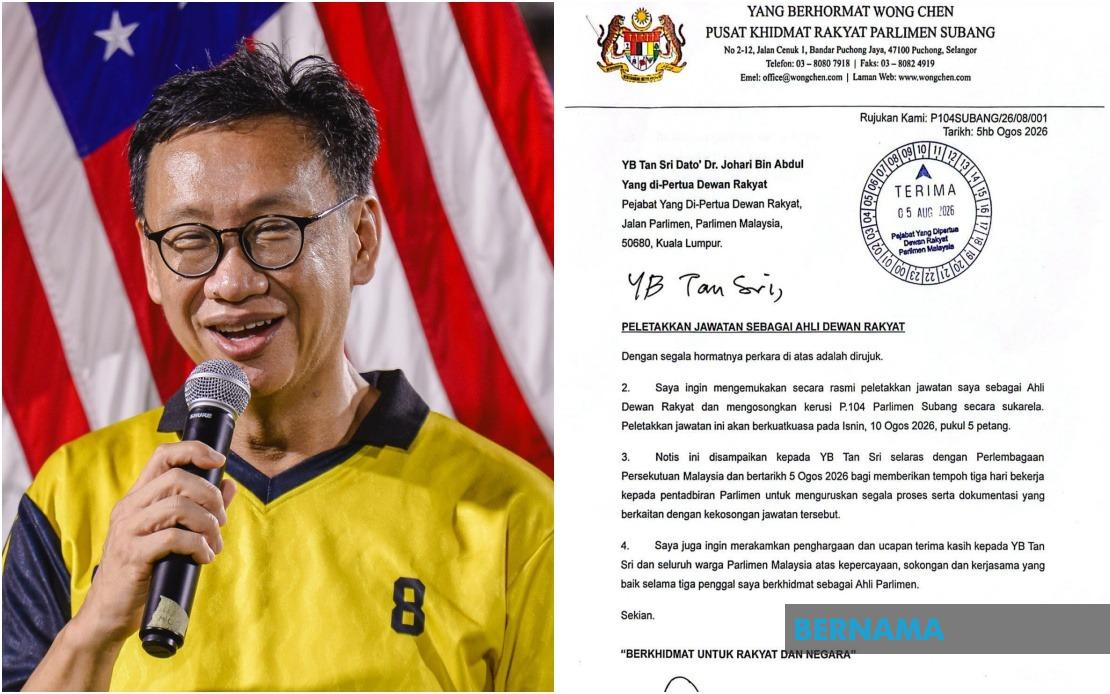
Wong Chen, the Member of Parliament representing Subang, has formally concluded his tenure in the Dewan Rakyat, with his resignation taking effect at 5:00 pm today. The move marks the end of a three-term parliamentary career for the legislator, who submitted his official resignation letter to Dewan Rakyat Speaker Tan Sri Johari Abdul on August 5. By providing advance written notice, Wong Chen ensured that the Parliament administration would have sufficient time to manage the procedural requirements and organisational aspects associated with the vacancy of the Subang seat.
In announcing his departure through a Facebook statement, Wong Chen underscored his voluntary decision to step down, emphasising that his resignation complied fully with the relevant provisions set out in the Federal Constitution. The formal letter he submitted, dated August 5, made clear that this was a deliberate choice made in accordance with constitutional requirements governing parliamentary representation. The advance notification strategy adopted by Wong Chen reflected a desire to maintain institutional stability and ensure a smooth administrative transition during the handover period.
Wong Chen took the opportunity to express his appreciation for the support and cooperation extended to him throughout his three terms representing the Subang constituency. In his resignation letter, he specifically acknowledged Tan Sri Johari and the entire Parliament of Malaysia staff for the trust and professional partnership he received during his service. This measured tone suggested a departure marked by goodwill rather than acrimony, typical of transitions within Malaysia's parliamentary system when members choose to step away.
Looking ahead, Wong Chen announced plans to hold a special press conference at 11:00 am the following day to provide further details and context regarding his resignation decision. This scheduled media engagement would give him an opportunity to address public questions and elaborate on his reasons for leaving Parliament after three consecutive terms, potentially offering insights into his future plans and intentions.
As part of his formal transition process, Wong Chen indicated that the honorific title "Yang Berhormat" would be systematically removed from all billboards, signboards, and office correspondence associated with his work, with this change taking effect from the following month. This administrative housekeeping reflects the formal conclusion of his parliamentary status and the relinquishment of the privileges and titles that accompany membership in the Dewan Rakyat.
Wong Chen's decision to resign represents a significant shift in Subang's parliamentary representation. The constituency, located in the Klang Valley region of Selangor, has long been considered a stronghold for the Democratic Action Party, and Wong Chen's departure from Parliament will trigger a by-election process. The seat will remain vacant pending the holding of a by-election, which the Election Commission must conduct within 60 days from the date of the vacancy.
The timing and manner of Wong Chen's exit underscore an important characteristic of Malaysian parliamentary democracy: the ability for elected representatives to voluntarily step down outside of electoral cycles. While by-elections can be administratively complex and costly, they remain an integral part of the democratic process when parliamentary seats become vacant. The by-election in Subang will provide local voters with an opportunity to select a new representative and effectively choose the direction of political representation in the constituency for the remainder of the parliamentary term.
From a broader perspective, Wong Chen's three-term tenure as a Member of Parliament reflects the evolving political landscape in the Klang Valley, an area that has witnessed significant shifts in electoral preferences over recent years. His departure signals potential changes in local political dynamics, particularly regarding how opposition parties consolidate or reshape their representation in this strategically important urban constituency.
The procedural elements that Wong Chen adhered to throughout his resignation process demonstrate the importance of institutional norms and constitutional compliance in Malaysia's system of governance. By submitting advance notice and maintaining formal protocols, he facilitated an orderly transition rather than creating sudden administrative disruptions. This approach contrasts with sudden or emergency resignations and reflects a commitment to institutional continuity even at the point of individual departure from office.
For the Democratic Action Party and the broader opposition coalition, Wong Chen's resignation may prompt internal discussions regarding succession planning and candidate selection for the impending by-election. The party must identify a suitable candidate who can maintain or strengthen its position in this urban constituency, which has emerged as a battleground between ruling coalition and opposition forces in recent electoral cycles.
The Subang by-election will serve as a significant barometer of political sentiment in the Klang Valley region and may provide early indicators of voter preferences ahead of the next general election. Local and national political observers will scrutinise the campaign dynamics, voter turnout, and ultimate result as reflective of broader trends in urban Malaysian electoral behaviour.

