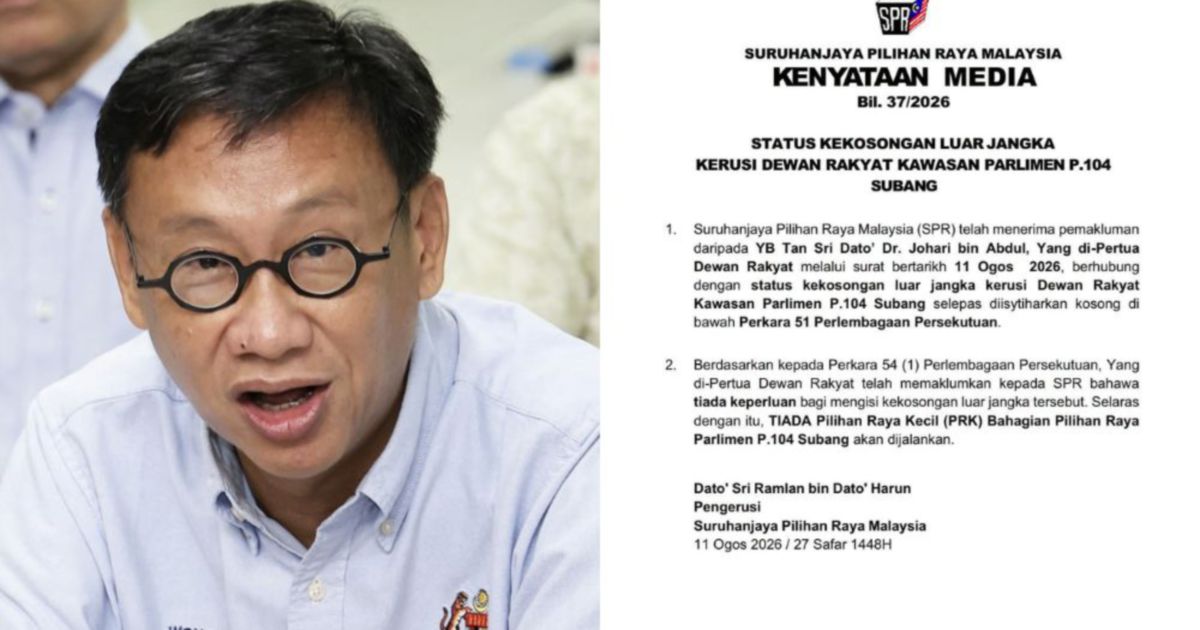
The Election Commission has officially decided against holding a by-election to fill the Subang parliamentary seat vacated by PKR politician Wong Chen, a development that closes a significant chapter in the federal constituency's recent political history. The decision by the electoral authority was confirmed in Kuala Lumpur and marks the conclusion of speculation about a potential contest to replace the long-serving representative.
Wong Chen's departure from the Subang seat represents a notable shift in the political landscape of one of Malaysia's most closely watched urban constituencies. Located in the Selangor state, Subang has been a focus of intense political activity for years, with the Selangor government's reformist agenda making the region a barometer for Malaysian public opinion on modernisation and governance issues. The absence of a by-election to fill this gap means the constituency will remain without direct parliamentary representation until the next general election is called.
The Election Commission's determination to forgo a by-election carries practical and constitutional implications. In Malaysian electoral law, certain conditions must be met before a by-election becomes mandatory, and the EC's ruling suggests that the circumstances surrounding Wong Chen's resignation did not trigger those specific requirements. This legal interpretation underscores the complexity of Malaysia's electoral framework, which distinguishes between different categories of parliamentary vacancies based on the reasons and timing involved.
For voters in Subang, the decision means they will have no immediate opportunity to voice their preference through the ballot box for a new representative. This situation can create representation challenges for constituents requiring parliamentary assistance during the interim period before the next general election. The vacuum becomes particularly significant given Subang's urban demographic, where residents typically engage actively with federal policy matters ranging from infrastructure development to economic regulation.
Politically, the ruling favours the incumbent PKR-led coalition government's broader electoral calculations. By-elections have historically served as referendums on government performance, and administrations typically face headwinds in such contests. The avoidance of a by-election in Subang eliminates a potential flash point where public sentiment regarding the government's tenure could be tested through the polling process. Opposition parties lose an opportunity to mobilise supporters and potentially alter the composition of Parliament.
Wong Chen's exit from Parliament represents the conclusion of a significant tenure representing the Subang constituency. His years in office saw him engage with various policy initiatives and constituency matters that defined the area's development trajectory. His departure, whether prompted by personal, professional, or political considerations, created the circumstance that prompted the Election Commission's recent ruling.
The decision also reflects broader patterns in Malaysian parliamentary politics, where constituency vacancies do not inevitably trigger by-elections. The discretionary or mandatory nature of by-elections depends on specific legal provisions and the official determination of their application to individual cases. The Election Commission's expertise in interpreting these provisions was central to its conclusion regarding Subang.
From a regional perspective, Malaysia's electoral procedures and the application of its voting mechanisms remain subjects of international observation. The handling of parliamentary vacancies demonstrates how electoral bodies navigate legal frameworks and policy decisions that carry both practical and symbolic significance. The Subang situation illustrates the technical dimensions of electoral administration beyond simply organising elections themselves.
For Malaysian citizens tracking parliamentary representation, understanding why certain vacancies trigger by-elections while others do not requires engaging with electoral law's finer points. The Election Commission's authority to make these determinations reflects delegated constitutional responsibility for managing the integrity and operation of democratic processes. Such decisions, while sometimes appearing technical or procedural, carry real consequences for constituent representation and democratic participation.
Looking forward, the Subang seat's status will remain unchanged until Parliament is dissolved for a general election, at which point all constituencies, including Subang, will be contested. This timeline means constituents will ultimately have their say through the broader electoral process rather than through a targeted by-election. The situation exemplifies how Malaysian electoral cycles and constitutional provisions intersect to shape the timing and nature of democratic participation opportunities available to voters.

