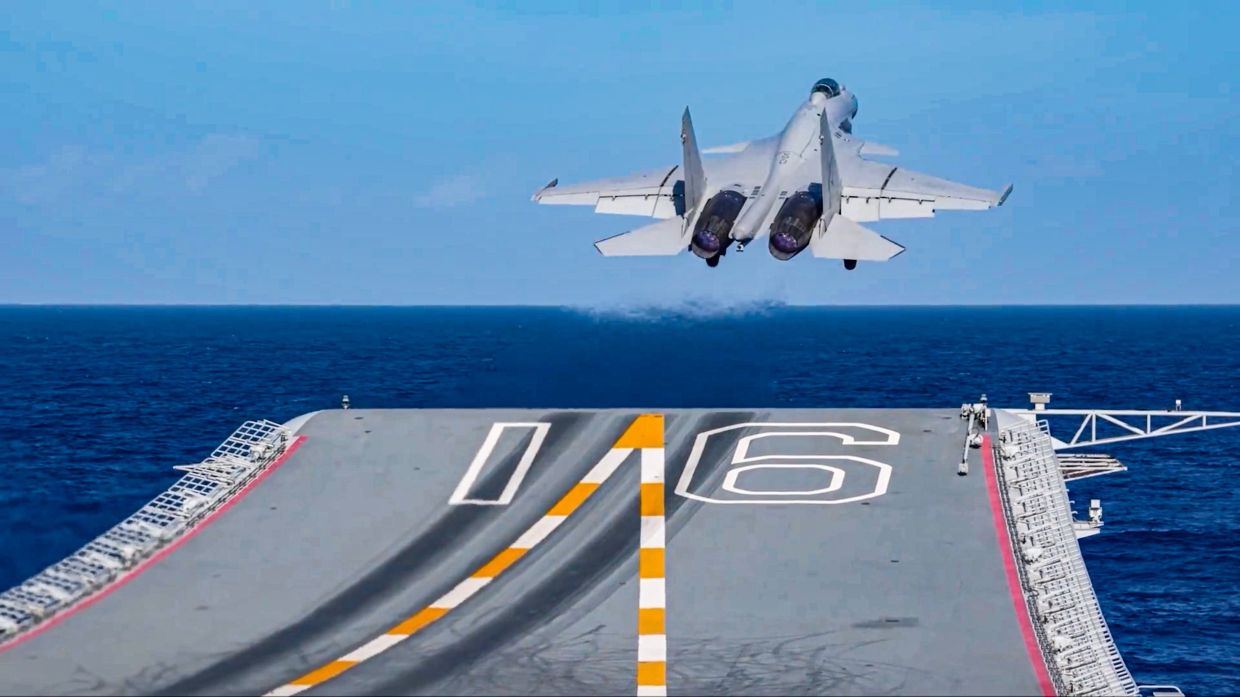
China's ambitious naval modernisation programme, centred on building a world-class carrier fleet, faces a fundamental strategic weakness that experts believe could fundamentally limit operational effectiveness: vulnerability to submarine attack. This gap in underwater defence capabilities has attracted sustained scrutiny from Washington-based strategic institutions, which argue that adversaries could exploit this weakness through coordinated operations designed to impose prohibitive costs on Chinese naval operations.
The Centre for Strategic and International Studies recently published a comprehensive analysis of how the United States and its regional allies might counter Chinese carrier deployments through a layered "cost-imposition" strategy. The framework identifies five complementary approaches: land-based strike networks capable of reaching distant targets, long-range air operations supported by satellite surveillance, cyber and electromagnetic warfare to disrupt command systems, drone swarm attacks to overwhelm defences, and critically, submarine ambushes exploiting gaps in Chinese underwater detection. Among these elements, submarine operations have emerged in expert assessments as the most credible threat to high-value Chinese carrier formations, particularly given documented deficiencies in China's capacity to detect and track submerged vessels across vast ocean areas.
Geographic factors significantly amplify this vulnerability. The western Pacific's narrow maritime chokepoints—the straits and passages through which Chinese carrier groups must transit to project power—create natural positions where submarines and coordinated allied forces could establish intercept corridors. These bottlenecks transform undersea warfare from a theoretical concern into an operationally practical strategy. Any Chinese carrier attempting to move into the Indian Ocean or deeper into the western Pacific must pass through these narrow windows, providing submarine commanders with predictable operating zones where interception becomes feasible rather than requiring lengthy hunting operations across open ocean.
Christopher Sharman, director of the China Maritime Studies Institute at the US Naval War College, emphasises that China's undersea detection shortcomings remain "significant today", though he acknowledges these are not immutable vulnerabilities. The People's Liberation Army Navy (PLAN) has indeed invested substantially in recent years to improve underwater environmental awareness and predictive capabilities. Yet critical gaps persist: Chinese oceanographic and meteorological knowledge lags considerably behind American capabilities, particularly regarding the complex underwater acoustic environment that determines submarine detection effectiveness. Beyond the first island chain—the boundary separating China's near-seas from the broader Pacific—these information deficiencies become even more acute, fundamentally constraining PLAN anti-submarine operations.
Beijing has undertaken ambitious programmes to close this gap. The Transparent Ocean initiative, conceived over a decade ago, represents perhaps the most comprehensive effort to transform China's underwater surveillance architecture. This network combines satellites, research vessels, autonomous underwater gliders, deep-ocean buoys, and seabed sensor arrays to collect oceanographic data across strategically vital regions including the western Pacific, South China Sea, and Indian Ocean. Chinese officials have explicitly connected this programme to national security imperatives, and Ocean University of China—which originally proposed the concept—reports establishing hundreds of deep-sea observation stations while expanding monitoring networks from the South China Sea into the Pacific. These developments indicate recognition within China's defence establishment that underwater dominance requires fundamental improvements in environmental knowledge.
Parallel efforts address anti-submarine capabilities directly. China has substantially expanded its fleet of fixed-wing maritime patrol aircraft and deployed Type 927 ocean-surveillance vessels equipped with advanced towed-array sonar systems. Sensor upgrades on platforms such as carrier-based helicopters and maritime patrol aircraft progressively enhance detection and tracking potential. Despite these improvements, analysts remain sceptical that China can overcome the acoustic advantages enjoyed by the quietest Western submarines, particularly American attack submarines, which represent the pinnacle of undersea technology. The fundamental challenge remains: quieter submarines are inherently harder to detect, and no amount of oceanographic knowledge fully compensates for that underlying physics.
The strategic implications extend beyond protecting expensive carriers. Undersea warfare constitutes a core component of Chinese naval strategy according to military analysts. Within the first island chain, effective submarine operations are essential for achieving sea control during wartime scenarios. Beyond this boundary and extending into the Indian Ocean, PLA strategists view underwater dominance as necessary for countering American naval superiority and preventing third-party intervention in potential Taiwan conflicts. This broader perspective reveals that submarine vulnerabilities threaten not merely individual carrier formations but entire operational concepts underpinning China's military strategy.
Taiwan represents the focal point of these strategic calculations. Beijing maintains that Taiwan constitutes an integral part of China and reserves the right to employ force for reunification. While most nations, including the United States, avoid formally recognising Taiwan's independence, Washington remains legally committed to providing defensive arms and has explicitly opposed any military conquest. In this context, Japanese intervention would dramatically complicate any scenario involving Taiwan. Japanese forces operating from their extensive coastline could target Chinese warships operating in proximate waters, rendering carrier deployment in such zones increasingly risky and potentially ineffective.
Defence analyst Timothy Heath emphasises that anti-submarine warfare remains a genuine operational challenge for China, particularly when confronting American submarine technology. He argues that Chinese strategists face difficult choices regarding carrier deployment zones. While carriers might theoretically provide air cover for naval forces seeking to delay third-party intervention near Taiwan, deploying carriers into such vulnerable positions would represent questionable strategy. Heath contends that China's land-based intermediate-range ballistic missiles (IRBMs) offer more effective means of threatening distant American and allied shipping out to the second island chain. Accepting the doctrinal reality that carriers are strategically valuable but operationally vulnerable in contested waters represents a significant constraint on Chinese power projection capabilities.
The strategic implications for regional security dynamics are substantial. American defence planners are responding to these identified vulnerabilities by advocating increased procurement of advanced torpedoes, undersea drones, and coordinated missile production with regional allies including Japan and Australia. Such investments would systematically strengthen anti-submarine capabilities across the alliance network. For Malaysia and other Southeast Asian nations navigating between American and Chinese spheres of influence, these developments suggest that undersea capabilities will increasingly determine regional military balances. The submarine domain, historically less visible than surface naval operations or aerial combat, is becoming central to great power competition in Asian waters, with profound implications for regional stability and smaller nations' strategic manoeuvre space.

