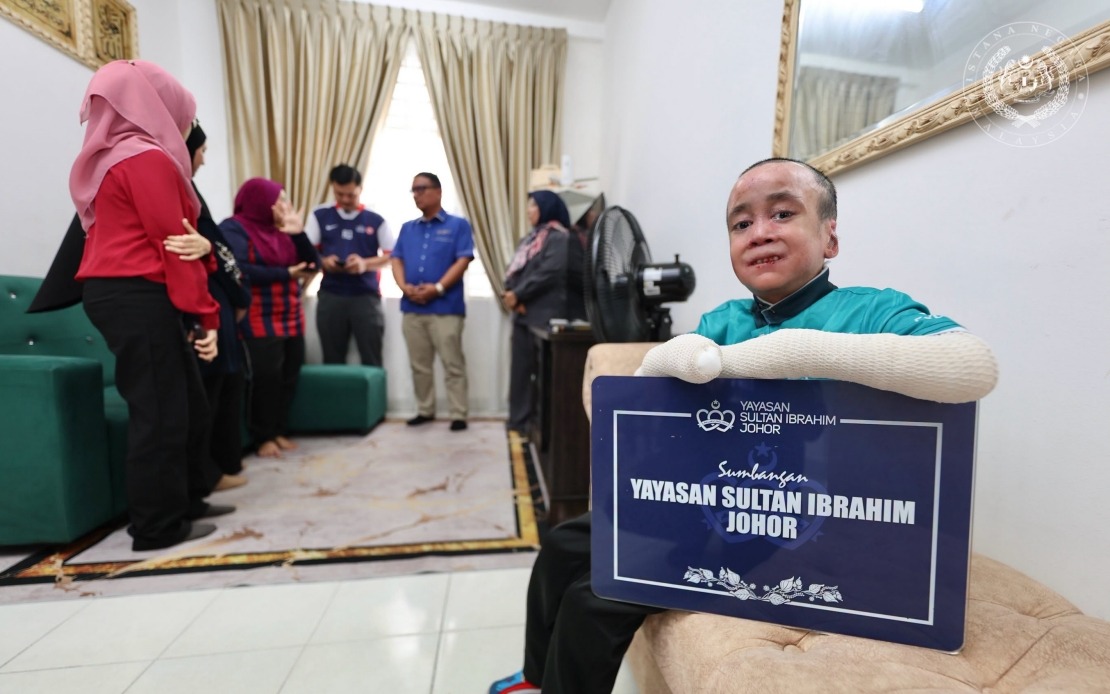
The Yayasan Sultan Ibrahim Johor (YSIJ) has stepped in to provide financial relief for Muhammad Hazreel Mikhail Hizar, a teenager living with epidermolysis bullosa, a rare and demanding genetic skin disorder that has affected him since birth. The assistance, delivered through the foundation's Ziarah Kasih compassionate care programme, was handed over at his family home in the Sungai Tiram People's Housing Project in Johor Bahru on August 18, marking a significant intervention in the life of a vulnerable household struggling with extraordinary medical and financial pressures.
Epidermolysis bullosa represents one of the most challenging chronic conditions that families can face, demanding constant medical vigilance and round-the-clock personal care. In Hazreel's case, his condition necessitates meticulous wound management to prevent potentially life-threatening infections, alongside strict environmental controls including continuous air-conditioning to maintain optimal skin conditions. These requirements translate into substantial daily costs that extend far beyond conventional household expenses, creating a financial burden that most families would find overwhelming.
The situation facing Hazreel's household illustrates the cascading challenges that arise when a family member requires intensive long-term care. His mother, Noor Halimaton Hashim, bears the responsibility of supporting three children as a single parent while providing constant attendance to Hazreel's medical and comfort needs. Her inability to pursue full-time employment stems directly from the demanding nature of his care requirements, leaving the family in a precarious financial position where medical expenses compete with basic living costs. This scenario reflects a broader issue affecting families across Malaysia caring for children with chronic conditions, where the informal care burden falls disproportionately on mothers.
The Ziarah Kasih programme demonstrates how royal patronage and structured charitable initiatives can provide targeted intervention for families in genuine hardship. By approaching the situation through a compassionate lens rather than a purely bureaucratic one, the foundation acknowledges that assistance must address the specific circumstances of individual cases. The timing of this intervention proved particularly significant for Noor Halimaton, who expressed gratitude for the support arriving when her family faced acute financial difficulty.
Epidermolysis bullosa, though rare, presents a growing challenge within Malaysia's healthcare landscape as awareness increases and more families seek support for affected children. The condition exists along a spectrum of severity, but even milder presentations require sophisticated wound care protocols and environmental management. For severe cases like Hazreel's, the integration of medical care with basic living expenses creates a unique category of need that standard social assistance programmes may not adequately address. Charitable foundations filling this gap represent a crucial safety net in communities where public healthcare and welfare systems, while present, cannot cover all contingencies.
The foundation's decision to publicise this assistance through official channels, including Sultan Ibrahim Sultan Iskandar's Facebook page and the Royal Press Office, serves multiple purposes beyond the immediate family support. Public acknowledgment of such initiatives raises awareness about rare conditions affecting Malaysian children and demonstrates institutional commitment to vulnerable populations. For other families facing similar circumstances, such visibility can provide both hope and practical information about available support mechanisms. The narrative also subtly reinforces the royal institution's role in social welfare beyond ceremonial functions.
For single mothers in Malaysia managing children with chronic illness, the psychological dimension of receiving formal recognition and support carries significance beyond financial relief. Noor Halimaton's statement expressing gratitude specifically highlighted the emotional aspect of being acknowledged by such a prominent institution, suggesting that the gesture addressed not merely economic need but also the social isolation and burden that often accompany caregiving responsibilities. This dimension becomes particularly important in Malaysian society where cultural expectations around maternal sacrifice can sometimes obscure the very real struggles these women endure.
The case also illuminates gaps in Malaysia's social protection framework regarding chronic paediatric conditions. While the country maintains various welfare schemes and health insurance programmes, coverage for rare genetic disorders often falls through structural cracks. Families may qualify for some assistance but find it inadequate for conditions requiring continuous environmental control and specialised wound management. Private charitable action, though valuable and necessary, cannot substitute for systematic policy approaches ensuring comprehensive support for such families.
Looking forward, the intervention by YSIJ suggests a model that other state-level foundations and charitable organisations might consider replicating. By combining direct financial assistance with public recognition of underlying challenges, such programmes can simultaneously help individual families while building broader awareness and advocacy around rare conditions. For Hazreel and his mother, the support provides immediate breathing room in a daily struggle that will likely continue for years. For Malaysia's social welfare ecosystem, such targeted interventions highlight both the compassion present in the system and the fragmentation that necessitates royal and charitable involvement in what arguably represent fundamental healthcare and welfare needs.

