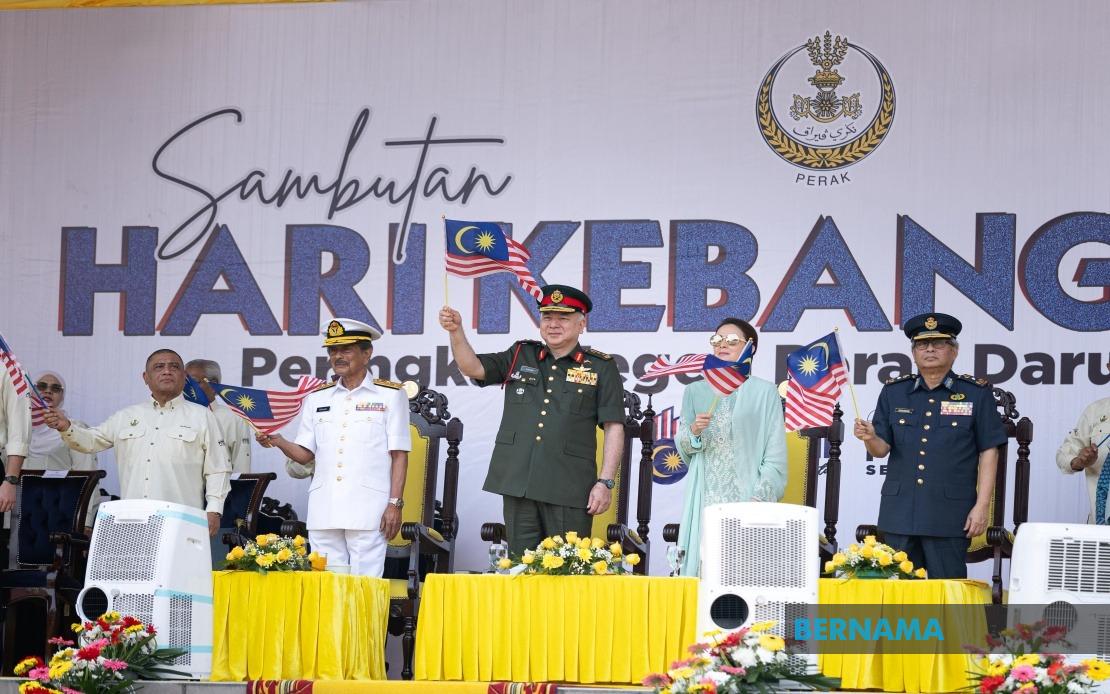
Sultan of Perak Sultan Nazrin Shah and Raja Permaisuri Tuanku Zara Salim presided over the Perak-level National Day 2026 Awards Presentation Ceremony at Dewan Bandaran Ipoh on August 31, in a poignant recognition of the sacrifices made by military and law enforcement personnel in safeguarding the nation. The royal couple, joined by Menteri Besar Datuk Seri Saarani Mohamad and other state officials, bestowed honours upon 11 individuals whose service exemplified the commitment demanded of those tasked with defending Malaysia's security and territorial integrity.
The recipients comprised personnel from across Malaysia's defence apparatus: six from the Malaysian Armed Forces, two from the Royal Malaysia Police, and three from the Royal Malaysian Navy. Each honoured individual received RM1,000 in cash alongside a certificate of appreciation, a modest but symbolic gesture acknowledging their extraordinary contributions. Among those recognised were several who bore the physical and psychological scars of their duty, testament to the genuine cost of national defence that often remains invisible to the broader public.
Warrant Officer 2 Mohamad Razali Din represented the ultimate price paid by soldiers in active operations. During Operation Naga in Banding, he stepped on a landmine, losing his left leg below the knee in an instant that would reshape the remainder of his life. Such injuries, while sometimes overlooked in statistical reckonings of military sacrifice, represent profound personal transformations—the shift from full mobility to permanent disability, the psychological adjustment required, and the determination needed to rebuild purpose and identity beyond uniform service.
Contrasting this defensive sacrifice was the aggressive heroism of Warrant Officer 2 Megat Abdullah Megat Othman, who during Operation Batu Kawah in Sri Aman successfully eliminated three communist terrorists, demonstrating the operational excellence expected during counter-insurgency campaigns. The presentation of both a commando knife and certificate of appreciation underscored the dual recognition of tactical competence and bravery under fire. The other Malaysian Armed Forces recipients—Staff Sergeant Idris Ismail, Corporal Mokhtar Sulaiman, Lance Corporal Khairul Anuar Abdul Hamid, and Lance Corporal Alias Abd Wahab—each represented the backbone of Malaysia's defence force, though their specific contributions were not detailed in the ceremony records.
The police representatives, retired Sub-Inspector Omar Jayus and retired Sergeant Major Abdul Malek Nordin, embodied the civilian security apparatus's role in maintaining domestic order and responding to threats within Malaysia's borders. Similarly, the three Royal Malaysian Navy honourees—retired First Admiral Mohamad Imran Abd Hamid, retired Commander Mohd Akhbar Mohd Yusof, and retired Warrant Officer 2 Ahmad Safwi Shaari—reflected the maritime dimension of national defence, a consideration of particular relevance to an archipelagic nation where coastal security and exclusive maritime zones require constant vigilance.
Beyond the awards presentation, Sultan Nazrin also recognised achievements in National Day parade competitions and beautification contests, demonstrating how the broader community participates in celebrating national identity through civic engagement and aesthetic contribution to public spaces. This widened scope of recognition reflected modern understandings of national defence that extend beyond military operations to encompass social cohesion and the maintenance of shared civic pride.
Menteri Besar Saarani's address during the ceremony articulated a theme increasingly central to Malaysian political discourse: the fragility of national unity amid diversity. He characterised Malaysia as fundamentally a nation built not by homogeneity but by conscious choice among diverse communities to coexist within a shared political framework. This framing represented a deliberate counter-narrative to divisive rhetoric that periodically emerges in Malaysian public discourse, grounding national identity in constitutional and institutional foundations rather than ethnic or religious purity.
Saarani emphasised the material symbols binding the nation: the Jalur Gemilang flag flown collectively, the Federal Constitution respected across communal lines, the Malay language functioning as linguistic connective tissue, and the institution of the Malay Rulers serving as constitutional guardians for all citizens regardless of background. These institutional anchors, he suggested, provided the structural integrity necessary to maintain Malaysian sovereignty and cohesion. Yet his address carried an implicit warning that such arrangements cannot be taken as permanent or self-sustaining.
The Menteri Besar identified a specific vulnerability in Malaysia's social fabric: the gradual erosion of civic togetherness when citizens begin perceiving difference before personhood, when neighbours cease being neighbours and friends cease being friends. This shift occurs when every social interaction becomes filtered through prisms of race, religion, or factional identity, transforming communal space into fragmented enclaves. Such compartmentalisation, he argued, widens psychological and social distance, gradually obscuring the accumulated historical bonds and constitutional arrangements that had unified the nation across generations.
This message resonated particularly in Perak, a state with significant demographic diversity and a complex political history spanning multiple administrations of different political colours. For Malaysian readers across the region, Saarani's warnings about the brittleness of unity echo broader Southeast Asian concerns about social cohesion in pluralistic societies. Countries throughout the region have witnessed how rapid economic change, demographic shifts, and digital communication can accelerate sectarian divisions if institutional and civic commitment to coexistence weakens.
The ceremony thus operated on two distinct registers simultaneously. Superficially, it represented routine state acknowledgement of military and police sacrifice, a ceremonial obligation of any government toward its security services. More profoundly, however, it enacted a political statement about the relationship between individual sacrifice for national defence and collective commitment to maintaining the institutional and social structures that make national defence meaningful. The heroes being honoured had risked and sometimes lost their physical integrity to defend not merely territory but a particular vision of Malaysia as a constitutionally anchored, institutionally mediated, and ethnically integrated political community.
For Malaysia and the broader Southeast Asian region, such ceremonies serve as recurring reminders that national cohesion requires both the structural underpinning provided by constitutions and rulers, and the daily civic practice of seeing fellow citizens as neighbours and fellow nationals rather than representatives of competing communal interests. The 11 honoured individuals had made this commitment tangible through their service; the challenge facing the broader society, as Saarani articulated, was sustaining this commitment through political and social practice during periods when such unity faced no immediate external threat to galvanise it.

