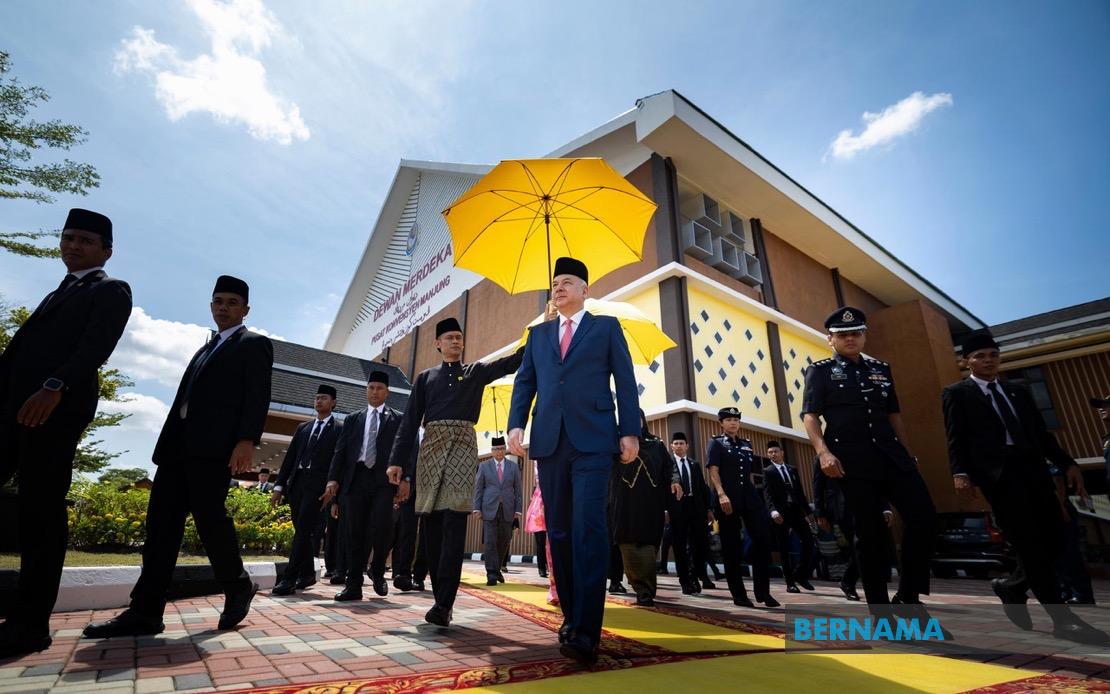
Sultan Nazrin Shah, the reigning monarch of Perak, presided over the official opening of Manjung Municipal Council's Merdeka Hall in Lumut today, underscoring the state's commitment to infrastructure development in its northern districts. The ceremony drew prominent attendance from the Perak royal household, including the Raja Permaisuri, Tuanku Zara Salim, and the Raja Di Hilir, Raja Iskandar Dzurkarnain Sultan Idris Shah, alongside key state and federal officials.
The inauguration carries symbolic weight beyond a simple ribbon-cutting exercise. Perak Menteri Besar Datuk Seri Saarani Mohamad articulated during proceedings that the completion of this facility represents the convergence of three distinct yet interrelated achievements. The project itself originated from a vision established nearly a decade ago, embodying the sort of long-term planning and perseverance often elusive in Malaysian infrastructure ventures. This continuity of purpose across administrations demonstrates a rare consistency in policy execution at the state level, particularly when federal and state interests align toward common development objectives.
The hall itself stands as a substantial investment in Manjung's civic capacity. Constructed at an expenditure of RM12.7 million and designed to accommodate 2,500 participants simultaneously, the facility transcends its primary function as a venue for official ceremonies. Officials positioned it as instrumental infrastructure for hosting conferences, cultural events, and community gatherings—the backbone of any district aspiring to regional prominence. For a municipality still developing its tourist and maritime credentials, such centralised spaces become critical in attracting business delegations, conventions, and promotional activities that generate economic momentum.
The timing of the opening assumed additional significance through its alignment with Manjung Municipal Council's silver jubilee. Established initially as a district council on 1 January 1980, the body underwent administrative elevation to municipal status on 1 August 2001, a transition reflecting the district's growing importance within Perak's administrative hierarchy. The dual celebration—facility opening and 25-year anniversary—allowed officials to frame the moment as emblematic of institutional maturity and sustained development trajectory.
Manjung's transformation narrative intersects meaningfully with broader regional development strategies in northern Perak. The district, home to the Lumut naval base and possessing significant maritime heritage, has long positioned itself as a potential catalyst for tourism diversification along Perak's coastline. The municipality's articulated ambition to attain Tourism and Maritime City designation by 2030 represents an economically motivated rebranding exercise, one that requires professional venues capable of hosting international conferences, trade missions, and cultural festivals. The Merdeka Hall functions as physical infrastructure supporting this repositioning strategy.
Menteri Besar Saarani's remarks underscored how facility completion reflected governance continuity, specifically highlighting that the initiative originated during his predecessor's tenure. This explicit acknowledgement of cross-administration support carries implications for Malaysian political observers. It suggests the capacity for Perak's executive to maintain developmental priorities regardless of intra-party transitions, a characteristic not universally evident across Malaysian states. The secured Federal Government allocation, achieved through persistent advocacy, further illustrates how state-level persuasion can channel national resources toward provincial objectives.
The nomenclature selected for this civic space merits analytical attention. By naming it Merdeka Hall, authorities consciously invoked Malaysia's independence legacy, transforming a municipal facility into a symbolic repository for national values. In his address, Saarani emphasised that the name functioned as perpetual reminder that independence itself constitutes a sacred trust requiring constant vigilance and cultivation of civilisational virtues. This rhetorical framing, particularly prevalent during state-level ceremonies, attempts to elevate utilitarian infrastructure into repositories of collective memory and national consciousness.
From a regional Southeast Asian perspective, Manjung's development trajectory reflects broader patterns of secondary cities attempting to diversify beyond traditional economic bases. Like comparable municipalities across Indonesia, Thailand, and the Philippines, Manjung seeks competitive advantage through maritime heritage valorisation and tourism infrastructure investment. The RM12.7 million expenditure, while substantial for a single municipal facility, represents modest investment compared to equivalent development schemes across the region, potentially indicating Malaysia's capacity constraints in simultaneous provincial development.
The presence of Higher Education Minister Datuk Seri Dr Zambry Abd Kadir alongside state officials suggested potential linkages between the venue's development and educational or research initiatives. Malaysian municipalities increasingly position civic halls as incubators for knowledge-sharing and institutional collaboration, particularly in districts aspiring toward higher-order economic functions. The convergence of educational and civic infrastructure development signals sophisticated municipal vision extending beyond conventional event management.
For Malaysian observers monitoring state-level governance effectiveness, the Merdeka Hall inauguration offers an instructive case study in long-term project realisation. From initial conception in 2016 through completion, the venture weathered administrative transitions, budgetary considerations, and implementation complexities typical of major infrastructure projects. That completion occurred without reported scandal, abandonment, or substantial cost overruns—circumstances far from guaranteed in Malaysia's institutional environment—speaks to competent project management and sustained administrative commitment.
Looking forward, the facility's operational success will substantially influence perceptions of Manjung's development credentials. Effective programming, consistent bookings, and demonstrated economic returns will either validate or undermine the optimistic projections surrounding its role in achieving municipal transformation. The next phase involves translating physical infrastructure into actual economic activity generation—a transition where many Malaysian facilities historically underperform relative to initial expectations.

