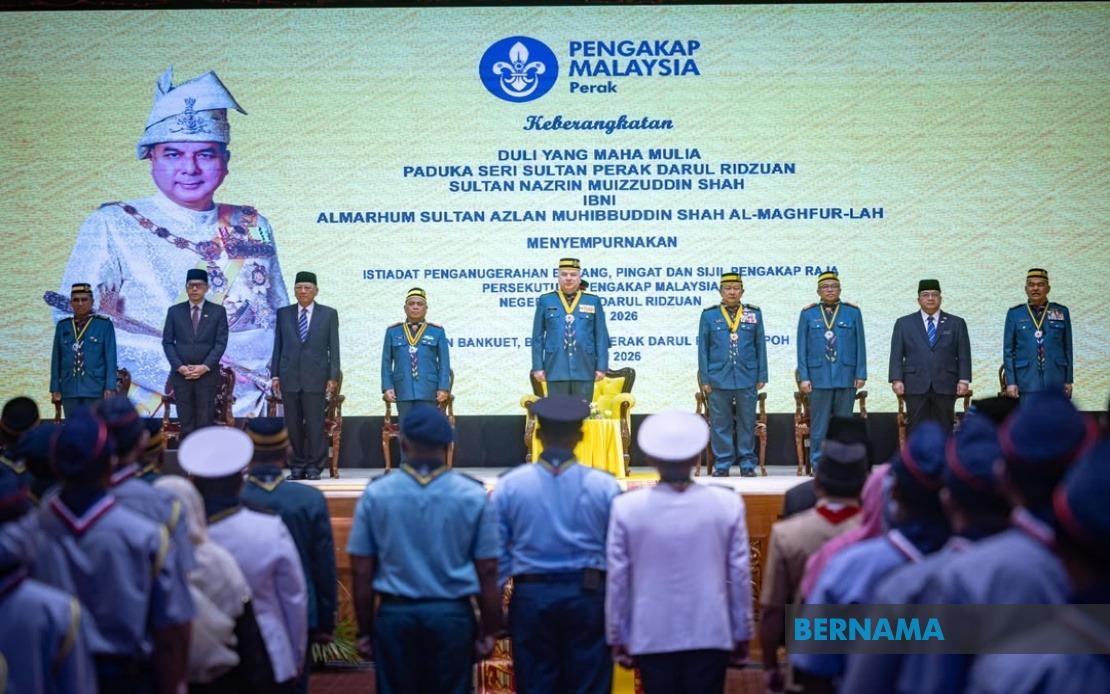
Sultan Nazrin Shah, the Sultan of Perak, presided over a significant gathering in Ipoh on July 25 to honour outstanding members of the Scouts Association of Malaysia's Perak branch. The ceremony, which distributed king's scout awards, decorations, medals and certificates to a total of 239 recipients, underscored the royal family's continued endorsement of the scouting movement and its developmental role within Malaysian society. The occasion also drew Menteri Besar Datuk Seri Saarani Mohamad and National Chief Scout Maj Gen Prof Datuk Mohd Zin Bidin, reflecting the cross-sectoral significance attached to youth development initiatives in the state.
Among the distinguished honourees was the Head of the Regional Scout Council from Indonesia's Special Region of Yogyakarta, Gusti Kanjeng Ratu Mangkubumi Hamemayu Hayuning Bawono Langgeng Ing Mataram, who received the Bintang Semangat Rimba Emas award. This accolade represents the third-highest honour bestowed by the Scouts Association of Malaysia and recognises individuals whose contributions to the scout movement have been particularly noteworthy. The presentation to an international scout leader highlighted the transnational dimensions of modern scouting and reinforced Malaysia's growing prominence within regional and global youth development frameworks.
National Chief Scout Mohd Zin's remarks during the ceremony pivoted toward the association's forward trajectory, emphasising that Malaysian scouting stands at a transformative juncture. He characterised the ongoing metamorphosis as one defined by boldness, contemporary relevance, and forward momentum—qualities he presented as essential responses to evolving societal needs and global youth challenges. This positioning suggested that Malaysia's scout movement views itself not merely as a custodian of established traditions but as an adaptive institution capable of meeting twenty-first-century expectations.
A particularly significant dimension of Mohd Zin's address concerned Malaysia's elevation within international scouting structures. The establishment of Kuala Lumpur as the headquarters of the World Scout Bureau represents a milestone achievement that places Malaysia at the epicentre of global scouting coordination and strategy. This institutional positioning creates tangible advantages for Malaysian scouts and youth leaders, facilitating direct engagement with international best practices, expertise exchange networks, and collaborative opportunities across the worldwide scout fraternity. For a Southeast Asian nation, such centrality in a major international youth movement carries implications extending beyond ceremonial recognition into concrete pathways for knowledge transfer and programme development.
The association's rebranding initiative, encompassing a redesigned logo and reimagined uniform aesthetics, featured prominently in discussions of the movement's evolution. However, Mohd Zin was careful to frame these cosmetic adjustments as expressions of deeper strategic convictions rather than superficial modernisation exercises. The messaging conveyed that Malaysia's scouts are undertaking substantive organisational evolution while retaining core scouting values—a delicate balance many established institutions struggle to maintain. This approach seeks to retain veteran scout members and traditional constituencies whilst simultaneously signalling openness to younger recruits and contemporary methodologies.
The Perak branch's approaching centenary in 2026 provided additional significance to the proceedings. Mohd Zin framed this milestone as a moment for retrospective appreciation of a hundred years of community service coupled with renewed institutional commitment to national development. The centenary becomes a natural inflection point for consolidating identity, reassessing mission relevance, and reaffirming the association's social contract with Malaysian society. For Perak specifically, a state with rich scouting heritage, the anniversary offers opportunities for historical documentation, community engagement, and youth recruitment campaigns anchored to recognisable local narratives.
The geographic and ceremonial prominence given to Perak scouting reflects broader patterns of royal patronage toward youth development across Malaysia's constituent states. By gracing the Ipoh ceremony personally, Sultan Nazrin signalled that scouting remains within the ambit of high-level state concerns. Such royal engagement carries practical consequences for funding advocacy, media attention, and social prestige—factors that meaningfully influence youth participation rates and parental support for scout membership. The Perak Sultan's presence effectively elevated a regional youth programme to a matter of state significance.
From a Southeast Asian perspective, Malaysia's growing prominence in global scouting structures and the professional modernisation of its domestic scout movement reflect broader ambitions to establish the country as a regional leader in youth development, social cohesion, and character formation. The scout movement, spanning urban and rural communities, ethnically diverse constituencies, and socioeconomic strata, functions as an instrument of nation-building and social integration. By enhancing its organisational sophistication and international standing, Malaysia positions scouting as a competitive advantage within the region.
The awards ceremony itself, whilst ceremonial in nature, operationalised concrete recognition of individual and unit achievements. The distribution of 239 decorations, medals and certificates to Perak scouts provided tangible validation of sustained engagement with scouting programmes. Such formal recognition strengthens psychological investment in the movement, establishes hierarchies of achievement within scout organisations, and creates narratives of individual progression—factors that recruitment research consistently identifies as motivating youth participation in youth movements.
Looking forward, the convergence of factors evident at this Ipoh ceremony—royal patronage, international institutional elevation, planned modernisation, and approaching centenary celebrations—suggests Malaysian scouting entering a period of expanded organisational confidence and resource mobilisation. The movement's leadership appears confident that rebranding and structural adaptation can simultaneously preserve institutional traditions and attract contemporary youth engagement, a proposition that will be tested thoroughly as the association advances its transformation agenda across the coming months and years.

