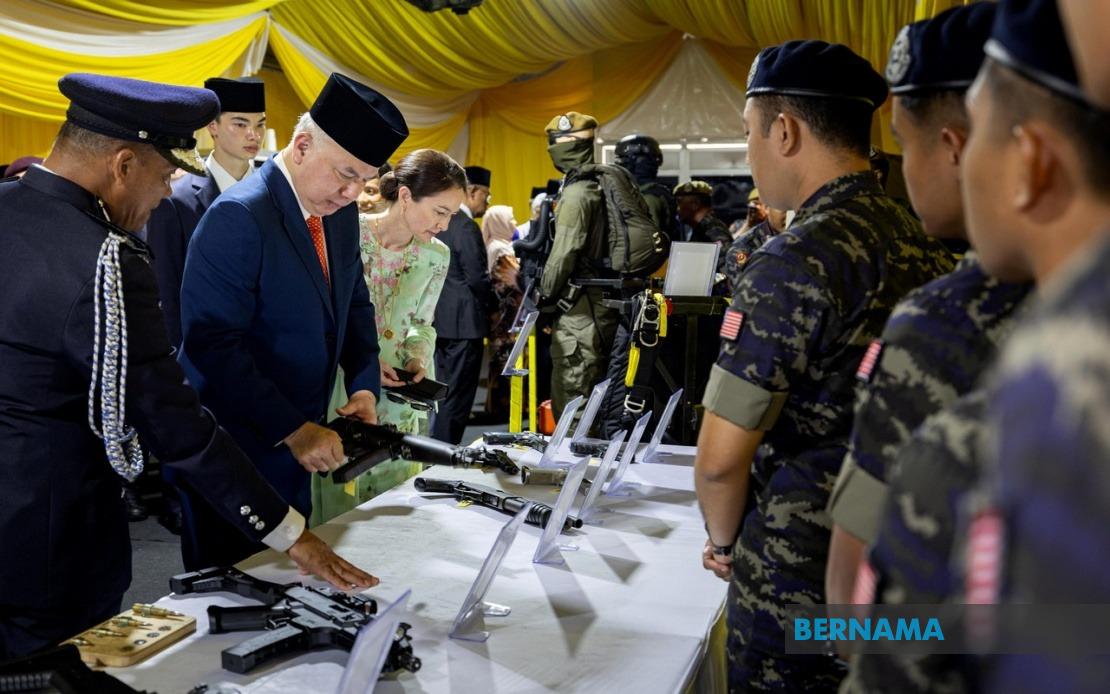
The Sultan of Perak, Sultan Nazrin Shah, has officially inaugurated the Sultan Nazrin Shah 69 Commando Camp in Ulu Kinta, Ipoh, marking a significant milestone in the nation's security infrastructure development. The ceremonial opening, held in July, underscored the government's determination to equip its elite paramilitary unit with world-class facilities as it navigates an increasingly complex security landscape. The event drew prominent figures including members of the Perak royal family, the state's chief minister, and federal security leadership, reflecting the strategic importance attached to the facility.
The newly completed base represents a substantial investment of more than RM206 million, constructed across a sprawling 338-hectare site that was meticulously designed to meet the operational demands of modern commando training and deployment. This comprehensive complex combines state-of-the-art administrative facilities, advanced training grounds, and operational infrastructure intended to serve the 69 Commando unit for decades to come. The facility was transferred to the Royal Malaysia Police in 2024, consolidating all aspects of the unit's activities under a single, purpose-built environment rather than dispersed across multiple locations.
Home Minister Datuk Seri Saifuddin Nasution Ismail used the occasion to articulate the MADANI Government's broader security vision, positioning the camp opening as tangible evidence of its commitment to fortifying Malaysia's defensive capabilities. He emphasised that the government recognises the mounting complexity of contemporary security threats, ranging from transnational terrorism to unconventional military challenges, and that investing in elite units represents a strategic imperative. The camp's development reflects deliberate policy choices about where to channel resources within the security apparatus, with particular emphasis on units proven to handle high-stakes operations.
International recognition of Malaysia's security posture added another dimension to the minister's remarks. Malaysia's ranking as the 12th most peaceful nation among 163 countries in the latest Global Peace Index was highlighted as validation of the security forces' effectiveness and the government's strategic direction. This ranking, while respectable, also implicitly acknowledges remaining challenges within the region and globally, suggesting that continued investment in elite units remains justified. The 69 Commando's track record forms a key part of this narrative of relative stability and capability.
The 69 Commando unit itself carries substantial historical weight within Malaysia's security apparatus, having been established in 1969 during the formative years of national institution-building. Over its more than five decades of existence, the unit has accumulated considerable operational experience across diverse scenarios. Its involvement in counter-insurgency operations against communist remnants, response to the Al-Maunah incident in 2000, and deployment to Lahad Datu in Sabah during the 2013 Ops Daulat operation demonstrate a unit repeatedly called upon during moments of acute national security concern. The unit's mobilisation for recovery operations following the MH17 tragedy in 2014 added another dimension to its remit, showing flexibility beyond traditional military and paramilitary roles.
The unit's specialisations span counter-terrorism operations, hostage rescue missions, and responses to high-risk security threats that exceed the capabilities of standard police or military formations. These capabilities have made the 69 Commando a go-to asset for government when facing threats that demand precision, specialist training, and rapid deployment. The establishment of a dedicated, modern base consolidates these capabilities and provides appropriate infrastructure for maintaining and developing expertise. For regional observers, Malaysia's investment signals determination to maintain credible elite security forces even as other priorities compete for government funding.
The naming of the facility after Sultan Nazrin Shah carries political and symbolic significance. The Sultan's association with the commando unit through this naming convention elevates the installation's stature and signals royal endorsement of security sector modernisation efforts. Such naming practices reflect the integration of institutional security matters with the monarchy's symbolic role in national life. The presence of the Raja Permaisuri, Raja Muda, and Raja DiHilir at the opening reinforced this institutional legitimacy and demonstrated family-level engagement with security matters.
For personnel serving in or transferring to the 69 Commando, the new facility offers tangible improvements in working conditions and training environments compared to previous arrangements. The comprehensive nature of the complex, integrating accommodation, training grounds, administrative facilities, and operational planning spaces within a single environment, should enhance unit cohesion and operational readiness. The RM206 million investment translates into superior amenities, modern equipment, and purpose-built training infrastructure that can only improve the quality of personnel development and operational preparation.
The commando unit's legacy of service and sacrifice provided the emotional and historical foundation for the government's justification of substantial expenditure on the facility. By framing the camp as recognition of decades of service by 69 Commando officers and personnel, government messaging linked infrastructure investment to national gratitude and institutional respect. This narrative positioning helps build morale within the unit and legitimises security sector spending to broader taxpayers who might question such outlays during periods of economic constraint or competing social spending demands.
Looking forward, the camp is envisioned as a nurturing ground for successive generations of commando personnel, tasked with perpetuating the unit's operational traditions while adapting to emerging security challenges. The facility's design allows for flexibility in training methodologies and operational preparation, ensuring that techniques and approaches can evolve without physical infrastructure becoming outdated. The centre's role as a hub for expertise development and inter-unit cooperation positions it as potentially strengthening Malaysia's broader security architecture through knowledge-sharing and collaborative training initiatives.
Regionally, Malaysia's continued investment in elite security forces sends subtle but important signals to neighbouring states about commitment to maintaining internal stability and contributing to regional security. Within Southeast Asia's complex geopolitical environment, states with capable, professional security forces can better manage transnational threats and maintain sovereign control over their territories. The 69 Commando's new facility demonstrates Malaysia's seriousness about security modernisation, potentially influencing perceptions of the nation's stability among foreign investors and diplomatic partners.
The opening of the Sultan Nazrin Shah Camp ultimately represents more than infrastructure development; it encapsulates government priorities regarding security sector investment, institutional modernisation, and recognition of elite units' strategic value. As Malaysia navigates shifting security challenges from terrorism to cyber threats to regional competition, facilities such as this anchor the nation's response capacity in physical infrastructure, trained personnel, and demonstrated commitment to excellence in security operations. The facility's multi-decade operational lifespan positions it as a cornerstone of Malaysia's security posture well into the future.

