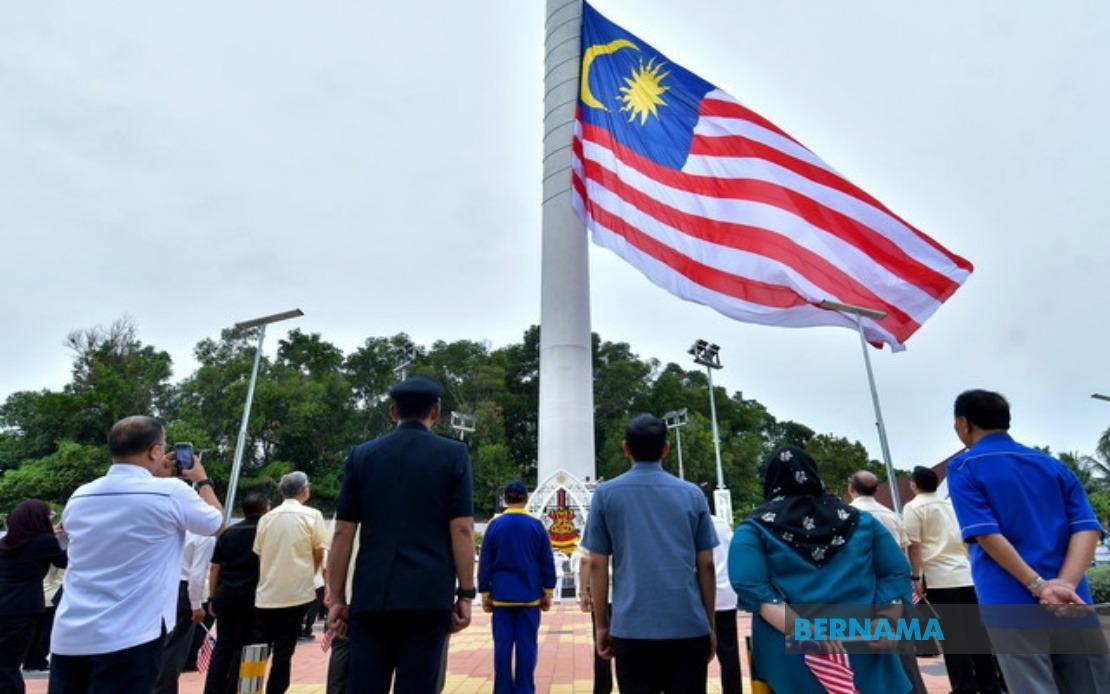
The Sultan of Selangor, Sultan Sharafuddin Idris Shah, has delivered a poignant reminder that Malaysia's national flag serves as far more than a ceremonial emblem paraded during annual celebrations. Speaking during a flag-hoisting ceremony at Dataran Selangor on August 26, the Ruler stressed that the Jalur Gemilang embodies the shared identity of a diverse nation, binding together citizens across ethnic, religious and ideological divides. His intervention comes at a time when social cohesion has faced repeated tests, making his call for unity particularly resonant across the region.
In his statement, Sultan Sharafuddin articulated a vision of national belonging that transcends the surface-level patriotism often displayed during Merdeka month. He acknowledged the profound diversity that characterises Malaysia—differences rooted in race, religion, language, political conviction and personal background—yet argued that these distinctions should be unified under a single banner of citizenship. The flag, he posited, functions as a potent visual reminder that despite such plurality, all Malaysians share an inextricable connection to the same sovereign nation. This framing rejects the notion that diversity and unity are opposing forces, instead presenting them as complementary aspects of the national identity.
The ceremony at Dataran Selangor, held to mark the beginning of Malaysia Day and National Day observances running from August 26 through September 17, provided a symbolic backdrop for this message. Sultan Sharafuddin had granted consent for the Jalur Gemilang to remain prominently displayed throughout this extended commemorative period. The decision reflects a deliberate effort to use national monuments and public spaces as platforms for emphasising cohesion during a season when Malaysian society typically engages in collective reflection on its founding principles and ongoing development.
Crucially, Sultan Sharafuddin extended his remarks beyond passive symbolism to address the active responsibilities of various segments of society. He called upon political and civic leaders to demonstrate through their conduct a commitment to moderation, compassion and mutual respect. In particular, he cautioned against the weaponisation of political, racial or religious distinctions as tools for social division—a pointed commentary on contemporary Malaysian discourse, where such fault lines have occasionally been exploited for electoral or factional advantage. His exhortation carries particular weight given the stature of the institution he represents.
The Ruler also directed his attention toward the next generation, emphasising that young Malaysians must be cultivated with values of respect and appreciation for cultural and religious pluralism. This generational dimension reveals an understanding that national unity cannot be sustained through symbolic gestures alone, but requires the inculcation of inclusive values from an early age. Educational curricula, community programmes and family-level socialisation all contribute to this project, which the Sultan implicitly advocated for throughout his remarks.
Speaking to the gap between performative patriotism and substantive nation-building, Sultan Sharafuddin offered a sobering observation: while flying thousands of Jalur Gemilang flags across the National Month requires minimal effort and investment, the genuine challenge lies in constructing a functional polity where citizens of all backgrounds feel authentically valued, embraced and proud to identify as Malaysians. This distinction cuts to the heart of contemporary Southeast Asian governance, where surface-level appeals to unity sometimes mask persistent structural inequalities or marginalisation of minority groups. The Sultan's formulation demands that leaders and society confront these deeper questions.
The Ruler's statement notably avoided naming specific ethnicities or faiths in relation to the flag's universality, instead employing inclusive language that encompasses Malays, Chinese, Indians, Kadazan-Dusun and Iban peoples, as well as followers of Islam, Buddhism, Christianity, Hinduism and other religions. This comprehensive enumeration serves both symbolic and practical purposes—it demonstrates acknowledgment of Malaysia's full demographic tapestry while reinforcing that the Jalur Gemilang stands above all such categorisations. By explicitly stating that the flag discriminates against no community, the Sultan preempts attempts by any group to claim exclusive ownership over national symbols.
For Malaysian audiences, Sultan Sharafuddin's intervention carries implications that extend beyond ceremonial rhetoric. In a regional context where some Southeast Asian nations have grappled with sectarian tensions, ethno-nationalist movements or religious polarisation, Malaysia's experience of maintaining a multi-ethnic, multi-religious state—despite periodic strains—remains significant. The Sultan's reaffirmation of inclusive nationalism provides institutional reinforcement for this model at a moment when such frameworks face global headwinds from various ideological quarters.
The Ruler concluded by reframing what independence truly signifies. Rather than treating the anniversary as a date for pageantry or the flag as a mere textile decoration, Sultan Sharafuddin presented both as manifestations of a deeper commitment: the capacity to construct a nation where diverse populations coexist in genuine peace, sustained mutual respect and authentic unity. This conceptualisation places responsibility squarely on contemporary Malaysians to continuously renew and substantiate the social contract their forebears established at independence. It is a challenge that resonates equally for a country navigating its sixth decade as a sovereign state and for a region contending with rapid social change and competing narratives about national identity.

