Puteri Mas Aishah Ramyusnali has found an unconventional muse in something most people take for granted: sunlight. The 24-year-old Penang-born artist has transformed the age-old cyanotype process into a contemporary vehicle for exploring the intricate bonds between humans and their natural surroundings, challenging conventional notions of what constitutes meaningful artistic practice in Malaysia's evolving creative landscape.
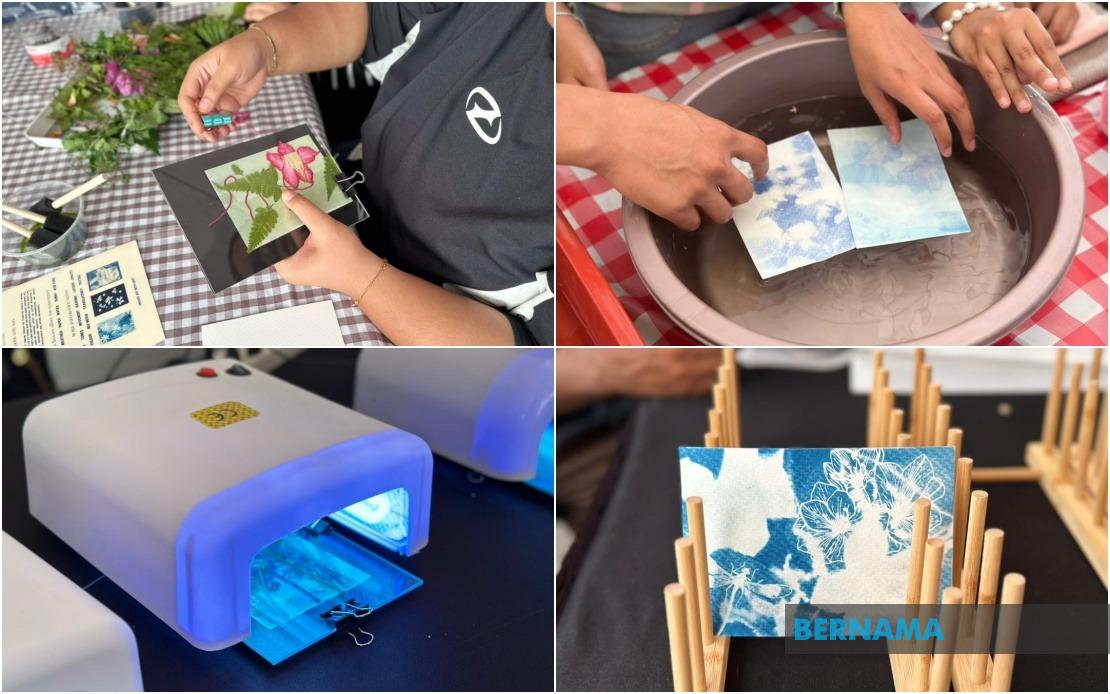
Cyanotype, a photographic printing method that harnesses ultraviolet radiation, has become the focal point of Puteri Mas Aishah's artistic journey since she embraced the technique three years ago. Rather than viewing the medium as merely a technical exercise, she has leveraged it to articulate a deeper ecological consciousness. The process itself mirrors natural cycles: objects are positioned atop chemically treated paper, exposure to sunlight imprints their silhouettes, and subsequent washing in solutions of varying acidity gradually reveals the characteristic prussian blue tones that define the final composition. This methodical interaction with elemental forces has fundamentally altered how the young artist perceives the relationship between creative practice and environmental awareness.
The unpredictability inherent in cyanotype work has emerged as a teaching point rather than a limitation. Weather patterns, atmospheric conditions, and fluctuating UV intensity directly influence the aesthetic outcome of each piece, meaning that reproducibility remains impossible and every artwork becomes a unique document of specific environmental conditions on a particular day. Puteri Mas Aishah must maintain rigorous attention to meteorological data, tracking cloud cover and solar radiation levels with the dedication of both scientist and artist. Higher ultraviolet exposure typically yields more saturated and concentrated blue hues, while overcast skies produce softer, more muted tones. This dependency on natural variables has cultivated within her a heightened awareness of environmental factors that urban populations rarely contemplate consciously.
As a Master of Fine Arts and Technology student at Universiti Teknologi MARA, Puteri Mas Aishah encountered cyanotype initially during her industrial training period, where she was tasked with introducing the technique to public audiences through participatory workshops. What began as an anxiety-inducing responsibility transformed into a passion when she recognised the potential for hands-on engagement to democratise artistic creation. Rather than positioning herself as an exclusive practitioner of a rarefied skill, she embraced the educator's role, discovering that guiding others through the cyanotype process facilitated conversations about environmental stewardship and artistic accessibility simultaneously.
Her workshop activities have expanded considerably since those tentative early sessions. Collaborating with art studios and galleries throughout Shah Alam and greater Selangor, Puteri Mas Aishah has cultivated a growing network of practitioners and enthusiasts who approach cyanotype not as an obscure historical curiosity but as a contemporary platform for environmental engagement. The RIUH Pi HAWANA Carnival held at the PICCA Convention Centre @ Arena Butterworth provided another opportunity to present cyanotype to wider audiences, embedding the technique within community celebrations rather than confining it to traditional gallery settings.
Beyond the technical mechanics of the medium lies Puteri Mas Aishah's broader conviction that artistic practice functions as a critical mechanism for environmental consciousness-building. She articulates frustration with societal tendencies to marginalise art as peripheral decoration, when in reality creative disciplines penetrate the fabric of daily existence and experience. By positioning cyanotype work as fundamentally dependent upon weather, water resources, and atmospheric conditions, she reframes art-making as an act of environmental attentiveness. Each completed print becomes evidence of specific natural conditions, a temporal and meteorological document that insists upon the observer's recognition of forces usually considered background rather than central to creative production.
The implications of this approach extend beyond individual artistic development to encompass broader questions about environmental literacy within Malaysian society. At a moment when climate variability intensifies and weather patterns grow increasingly unpredictable, cultivating populations that actively monitor and understand atmospheric phenomena carries particular significance. Puteri Mas Aishah's workshops function simultaneously as art instruction and informal environmental education, introducing participants to concepts of ultraviolet radiation, chemical reactions, and natural cycles through the pleasurable experience of creating visually striking objects. This integration of environmental consciousness within creative practice models approaches to sustainability that move beyond abstract advocacy toward embodied learning.
For younger participants especially, Puteri Mas Aishah envisions cyanotype as a gateway toward reconceptualising humanity's relationship with the natural world. Rather than perceiving nature as backdrop or resource, engagement with cyanotype positioning artists and participants as collaborators within environmental processes. The sun becomes an active partner in creation; weather conditions shape artistic outcomes; water quality influences chemical development. This redistribution of agency away from the solitary human creator toward a hybrid system encompassing artist, materials, chemistry, and solar radiation offers philosophical lessons about interdependence and environmental integration that extend far beyond the printed blue image.
The trajectory of Puteri Mas Aishah's practice also reflects shifting patterns within Malaysian contemporary art, where increasingly young practitioners draw inspiration from ecological concerns and sustainable methodologies. Her commitment to workshop-based, community-engaged practice contrasts with earlier models emphasising individual studio production and gallery exhibition. By democratising access to cyanotype techniques and materials, she participates in emerging conversations about art's social responsibility and capacity to foster environmental consciousness at grassroots levels. The specificity of her focus on this particular technique—with its inherent requirements for weather monitoring, water management, and solar awareness—demonstrates how formal artistic innovation can simultaneously become a vehicle for environmental education and behaviour change.
Moving forward, Puteri Mas Aishah's vision extends beyond accumulating individual artworks toward establishing cyanotype practice as a meaningful cultural conversation about environmental interdependence. She advocates for recognition that artistic engagement represents not luxury or entertainment but essential practice through which communities develop deeper literacy concerning natural systems. As Malaysia navigates environmental challenges from urban water scarcity to shifting climate patterns, practitioners like Puteri Mas Aishah who embed environmental awareness within creative practice contribute vital perspective. The humble blue prints produced through sunlight and chemistry carry messages about humanity's embeddedness within natural processes that increasingly urgent cultural moment demands.