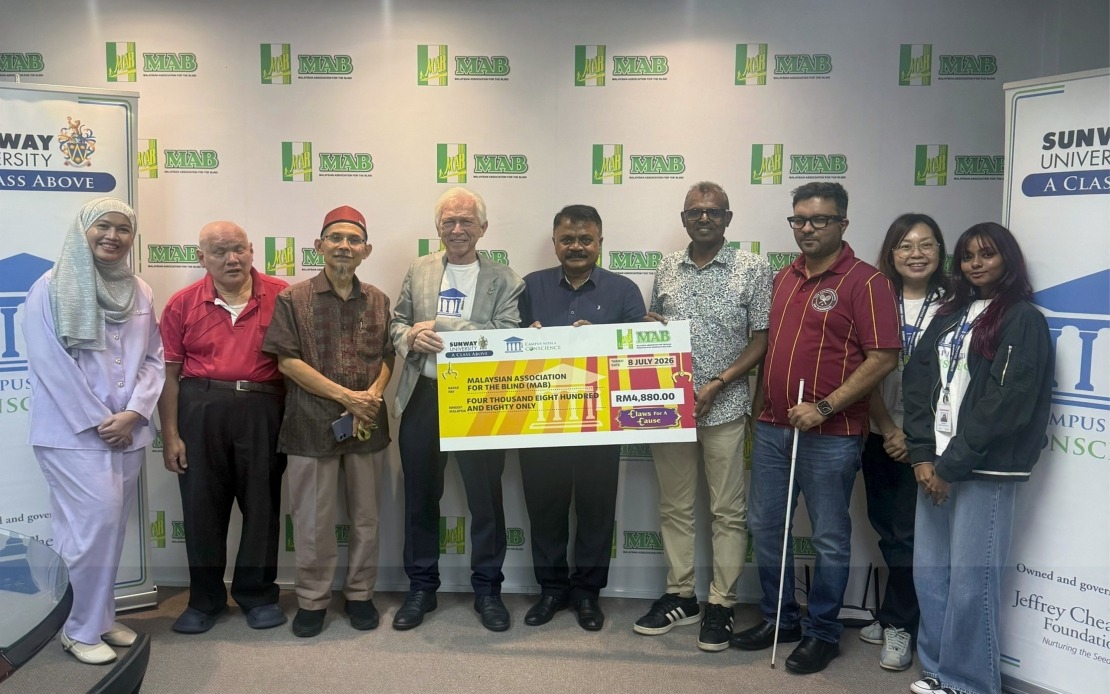
Sunway University has generated RM4,880 in donations for the Malaysian Association for the Blind (MAB) through a collaborative campus fundraising campaign that transformed a simple recreational activity into a charitable drive. The week-long initiative, termed "Claws For A Cause," operated a claw machine game on campus with proceeds directed entirely to supporting the visual impairment advocacy organisation, demonstrating how educational institutions can leverage everyday engagement to advance community welfare.
Executed under the university's broader Campus With A Conscience programme, the fundraising drive benefited from a partnership with Space Panda, an entertainment company that provided the claw machine equipment and operational support. This collaboration underscores a growing trend among Malaysian universities to integrate corporate partnerships into social responsibility initiatives, creating mutually beneficial arrangements where businesses gain positive brand association while charitable causes receive tangible support. For Sunway University students and staff, participation in the activity offered a low-barrier entry point to philanthropy—engaging in entertainment while directly contributing to a cause that serves one of Malaysia's most vulnerable populations.
The Malaysian Association for the Blind, the beneficiary organisation, serves individuals with visual impairments across the country through rehabilitation services, education support, and advocacy programmes. The RM4,880 donation, though modest in absolute terms, represents meaningful assistance for an organisation that frequently relies on grassroots fundraising and community support to sustain operations. Particularly in Southeast Asia's context, where government funding for disability services remains limited, private sector and institutional contributions prove critical to maintaining service delivery standards.
Sunway University President and Vice-Chancellor Professor Sibrandes Poppema framed the initiative as consistent with the institution's institutional philosophy and strategic direction. He emphasised that the university's mission transcends traditional academic delivery, encompassing research, innovation, and sustained community engagement as core functions. This statement reflects a broader shift within Malaysian higher education toward embedding social responsibility within institutional identity rather than treating charitable activities as peripheral exercises. The "mission-driven, fifth-generation university" terminology used in his remarks indicates Sunway's positioning within a competitive educational landscape where social impact credentials increasingly influence institutional reputation and student recruitment.
The involvement of Space Panda leadership in the fundraising effort revealed how private entertainment companies increasingly recognise opportunities to align commercial operations with social causes. Marcus, director of Space Panda, articulated the company's philosophical commitment to leveraging its business model for charitable purposes, arguing that seemingly minor acts of compassion collectively generate substantial social outcomes. This perspective resonates particularly within the context of Malaysia's Vision 2030 national development framework, which emphasises inclusive growth and social equity as central planning pillars.
Supporting organisations dedicated to empowering individuals with visual impairments holds particular significance given Malaysia's disability rights landscape. While the country has implemented legislative frameworks such as the Persons with Disabilities Act 2008, practical barriers to employment, education access, and social integration persist for many individuals with sensory impairments. Initiatives channelling resources toward MAB indirectly reinforce broader societal efforts to strengthen disability inclusion infrastructure and expand opportunity pathways for affected populations.
The fundraising mechanism itself—utilising a claw machine game—exemplifies creative social enterprise design. Traditional fundraising approaches often encounter participation fatigue among university populations; by embedding charitable giving within an entertaining activity, organisers likely achieved higher engagement rates than conventional donation collection methods would generate. This gamification of philanthropy demonstrates sophisticated understanding of behavioural economics and motivation psychology, suggesting how educational institutions can evolve fundraising strategies to reflect contemporary preferences and expectations.
From an institutional perspective, Sunway University's emphasis on university-industry partnership in driving social impact highlights important relationships within Malaysia's education ecosystem. As universities increasingly operate as anchor institutions within broader community systems, their capacity to convene stakeholders—students, staff, commercial entities, and nonprofit organisations—around shared social objectives becomes strategically valuable. Such initiatives generate reputational benefits for all parties while creating tangible community outcomes that validate institutional social responsibility commitments.
The campaign's success demonstrates that meaningful philanthropic engagement need not require substantial infrastructure investment or complex logistical arrangements. A single piece of entertainment equipment, deployed strategically across a defined period, generated sufficient voluntary participation to produce meaningful charitable outcomes. This scalability potential suggests similar initiatives could be replicated across other Malaysian universities and institutions, potentially establishing the claw machine format as an accessible fundraising mechanism within higher education contexts.
Looking forward, the initiative establishes a precedent potentially encouraging other academic institutions and corporate partners to design comparable collaborative campaigns. For the Malaysian Association for the Blind specifically, the donation contributes directly to programme expansion and service enhancement. More broadly, the fundraising effort reinforces the principle that disability advocacy organisations merit sustained support from diverse societal sectors, ensuring that disadvantaged populations benefit from institutional and commercial resources positioned beyond traditional government allocation channels.
This initiative ultimately illustrates how Malaysian universities can operationalise their stated commitments to social responsibility through pragmatic partnership arrangements that engage campus communities in meaningful charitable activity. By connecting student and staff participation directly to tangible outcomes benefiting vulnerable populations, Sunway University has created a replicable model demonstrating that campus social engagement need not be abstract or performative but can generate concrete support for organisations addressing Malaysia's persistent social challenges.

