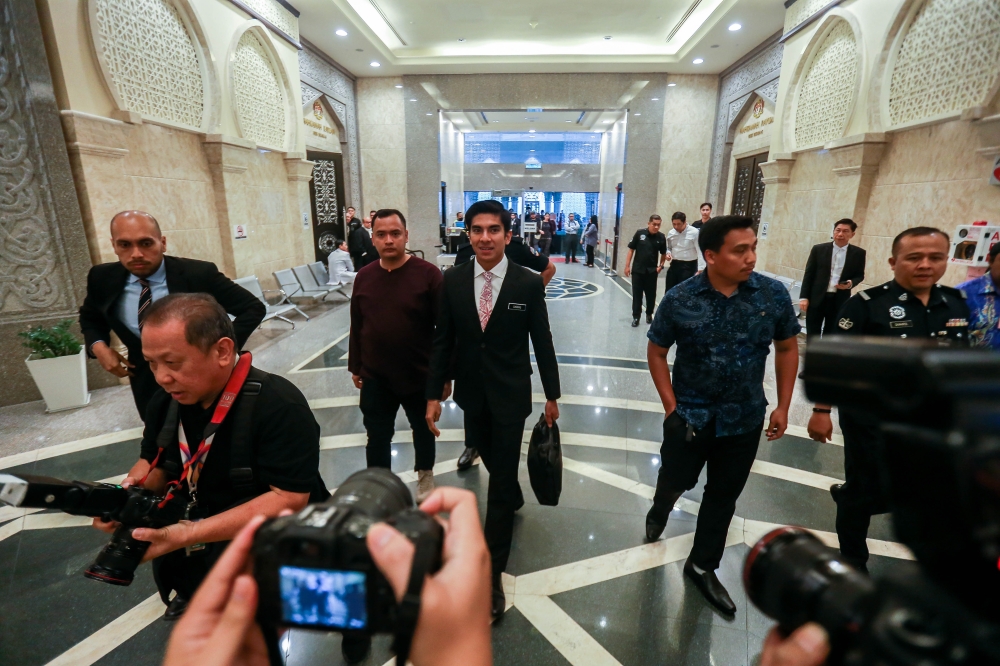
Muar Member of Parliament Syed Saddiq Syed Abdul Rahman appeared at the Palace of Justice in Putrajaya on July 13 to await what legal observers described as a career-defining court decision. The gathering drew considerable attention from political observers and media, with Syed Saddiq's family members, close associates, and his fiancée joining him for the occasion. The presence of such a broad support network underscored the gravity with which the opposition politician and his circle regarded the impending judgment.
Syed Saddiq, who has maintained a prominent position within Malaysia's political opposition despite his relatively young age, has emerged as a notable figure in the country's contemporary political discourse. His attendance at the Palace of Justice, accompanied by immediate family and supporters, reflected the high-stakes nature of proceedings that have drawn significant media and public interest. The early arrival of supporters and the visible mobilisation of his political base suggested an anticipation that the court's decision would carry substantial consequences for his parliamentary career and broader political influence.
The case under adjudication has captured attention across Malaysian political circles and among civil society observers who have followed developments closely. Federal Court rulings on cases involving sitting parliamentarians carry particular significance in the Malaysian constitutional and political system, where judicial decisions can alter electoral eligibility, parliamentary representation, and party dynamics. The involvement of multiple family members and his fiancée in the courtroom gallery indicated the intensely personal dimensions of what remained fundamentally a legal proceeding with profound public implications.
For the broader opposition movement, the outcome held potential consequences extending beyond Syed Saddiq's individual circumstances. The opposition coalition in Malaysia has undergone considerable realignment in recent years, with younger politicians like Syed Saddiq attempting to establish themselves within a competitive leadership landscape. A ruling against him could remove a prominent voice from parliamentary debates, while a favourable verdict would likely strengthen his position within opposition ranks and potentially enhance his influence on policy discussions and party strategy.
The Palace of Justice, located in Putrajaya's administrative precinct, has been the venue for numerous high-profile cases involving Malaysian political figures. The gathering of supporters outside this institution reflected a tradition whereby controversial court decisions affecting politicians generate public demonstrations of solidarity or opposition. Syed Saddiq's supporters' presence served both practical and symbolic functions, demonstrating public backing while signalling to the judiciary that the decision would be subject to considerable political and social scrutiny.
The timing of the ruling in mid-July positioned it within a broader calendar of significant political and legal developments affecting Malaysia's opposition parties. The period has frequently witnessed important judicial pronouncements on matters relating to parliamentary eligibility, party registration, and electoral law, making it a particularly consequential season for political actors navigating the country's complex legal and constitutional framework. For Syed Saddiq specifically, the decision would either validate his continued participation in parliament or trigger potential challenges to his seat and political standing.
The composition of those gathered at the Palace of Justice—including family members and his fiancée—highlighted how legal proceedings affecting politicians invariably intersect with personal and domestic dimensions of their lives. The decision would not merely affect his career trajectory but could influence major life decisions, including wedding plans and family circumstances. This intersection of the personal and political characterised much Malaysian political discourse, where the boundary between public roles and private matters often blurs significantly.
Syed Saddiq's positioning within the opposition bloc has evolved considerably over recent years, marked by strategic alliances, parliamentary activism, and visible efforts to appeal to younger voters increasingly important to Malaysia's electoral mathematics. A Federal Court ruling against him would complicate these efforts, potentially limiting his platform and influence during a period when the opposition seeks to consolidate support ahead of potential electoral contests. Conversely, a favourable decision would represent a substantial boost for both his personal political prospects and the broader opposition coalition's parliamentary strength.
The case exemplifies broader tensions within Malaysia's political system regarding the treatment of opposition figures, judicial independence, and the role of courts in mediating political disputes. While the Federal Court remains the apex of Malaysia's judicial system, with decisions theoretically insulated from political pressure, high-profile cases involving sitting parliamentarians invariably generate scrutiny regarding the independence and impartiality of judicial processes. The gathering of supporters at the Palace of Justice reflected these underlying concerns about how the courts handle sensitive political matters.
Looking forward, the Federal Court's decision would likely generate significant political discourse across parliamentary and media circles, with implications extending well beyond Syed Saddiq's individual circumstances. The ruling would influence broader conversations about opposition party strength, parliamentary representation, and the trajectory of Malaysian politics during a period of considerable flux. For Syed Saddiq himself, the judgment would prove pivotal in determining whether he could maintain his parliamentary seat and continue his political activities, or whether his influence would diminish substantially in the coming months.

