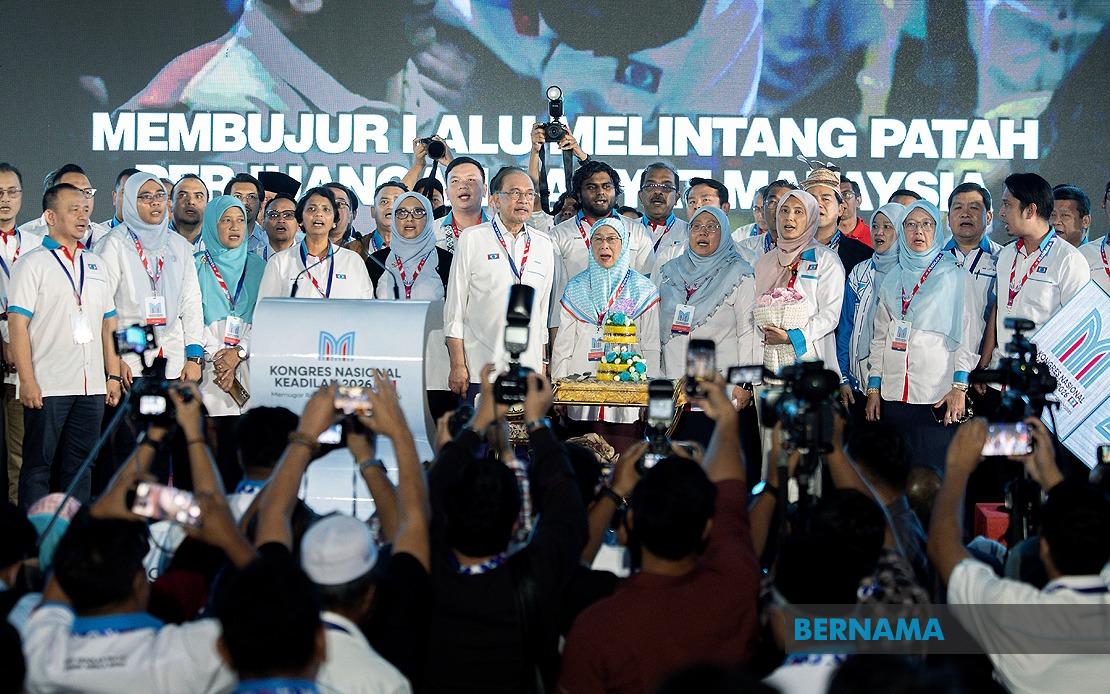
Prime Minister Datuk Seri Anwar Ibrahim has committed to amending the Tabung Haji Act 1995 (Act 535), signalling the MADANI Government's determination to rebuild institutional credibility and restore faith among the Muslim community in managing the pilgrim's fund. The reform agenda forms part of a comprehensive governance strengthening programme that seeks to address longstanding institutional vulnerabilities and restore public confidence in critical bodies managing citizen assets and entitlements.
Speaking as both Prime Minister and Finance Minister, Anwar emphasised that institutional reform represents a cornerstone of his government's policy direction. The commitment extends beyond a single amendment, reflecting a systemic approach to cleaning up governance structures across multiple agencies and departments. By placing institutional weakness at the centre of his reform narrative, Anwar is signalling that addressing structural problems takes precedence over short-term political considerations, a message reinforced by his acknowledgement that comprehensive governance strengthening must be pursued relentlessly and without compromise.
The Tabung Haji amendment arrives amid broader questions about the fund's management and its ability to deliver on its core mission of facilitating affordable pilgrimage for Malaysian Muslims. The 1995 Act, which has governed the institution for nearly three decades, requires updating to reflect contemporary governance standards and to address accumulated concerns about operational efficiency and transparency. This legislative action suggests the government recognises that trust in major institutions cannot be assumed but must be actively reconstructed through concrete institutional reforms and accountability measures.
Paralleling the Tabung Haji reform, Anwar called for the complete repeal of the Universities and University Colleges Act (AUKU) 1971 without replacement by comparable restrictive legislation. This dual commitment—reforming one crucial institution while dismantling another—underscores the government's philosophy that institutional effectiveness requires removing impediments to democratic participation and institutional responsiveness. The AUKU repeal specifically addresses student voice, suggesting that governance reform encompasses not merely financial stewardship but also the protection of civic freedoms and institutional pluralism.
The Prime Minister's statements came during the conclusion of the 2026 Parti Keadilan Rakyat (PKR) National Congress, where Anwar, serving as party president, articulated a vision of PKR as a platform transcending narrow factional interests. He stressed that the party's strength derives not from concentration of power but from principled leadership committed to advancing justice for all Malaysians across ethnic, religious, and geographic boundaries. This framing positions institutional reform as an extension of PKR's broader ideological commitment to equitable governance and rule-based decision-making.
Crucially, Anwar reiterated that the government's responsibility extends equally to citizens in opposition-led states, a pronouncement that addresses persistent concerns about regional partisan disparities in resource allocation and service delivery. By emphasising that economic growth must translate into improved quality of life regardless of local political alignment, the Prime Minister articulated a governance principle that, if implemented consistently, would constitute a significant departure from historical patterns where resource distribution often reflected electoral calculus. This commitment, made during a party congress, carries additional weight as it implicitly constrains the government's own partisan instincts.
The institutional reform agenda reflects broader Southeast Asian trends toward governance strengthening following periods of institutional strain. Malaysia's experience with Tabung Haji, coupled with ongoing questions about institutional independence and integrity across the region, positions these reforms as part of a wider conversation about rebuilding public trust in institutions that manage collective resources. For neighbouring countries observing Malaysia's governance trajectory, the amendment signals either a genuine commitment to institutional renewal or, alternatively, an attempt to address symptom rather than systemic causes—a distinction that will become clear only through implementation.
For Malaysian Muslim pilgrims, the amendment carries immediate significance. Tabung Haji has long served as a vehicle for realising the Hajj for ordinary Malaysians unable to accumulate sufficient personal savings. Any legislative reform must therefore balance modernisation with protection of the fund's core social mission. The amendment's success will be measured not merely by its technical provisions but by whether it restores confidence among contributors that their accumulated funds are managed with scrupulous care and genuine commitment to their pilgrimage aspirations.
Anwar's articulation of strength as a trust rather than a tool for personal enrichment speaks to longstanding concerns about institutional capture and the use of public office for private advantage. By explicitly rejecting the notion that power should benefit office-holders, their families, or connected interests, the Prime Minister established a rhetorical standard against which his government's actions will inevitably be measured. This explicit framing suggests awareness that institutional reform requires not only legislative amendments but also cultural and behavioural transformation among officials managing these institutions.
The timing of these announcements—made during a party congress where electoral strategies typically dominate discussion—indicates that governance reform occupies central rather than peripheral importance in the government's agenda. Whether this commitment will withstand the pressures of political competition and resource constraints remains an open question. Nevertheless, the public articulation of these reform commitments creates accountability mechanisms and establishes benchmarks against which the government's performance can be assessed by observers across Malaysia and the wider Southeast Asian region.

