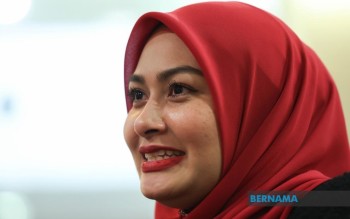
The government faces renewed pressure to tackle Lembaga Tabung Haji's (TH) heavy financial dependence on sukuk income from Urusharta Jamaah Sdn Bhd (UJSB), with lawmakers raising concerns that the arrangement leaves the pilgrimage fund vulnerable to structural risk. Speaking during parliamentary debate on the Royal Commission of Inquiry (RCI) Report into the institution's troubles, Bentong MP Young Syefura Othman highlighted that UJSB sukuk currently supplies nearly 26 per cent of TH's total annual income—a concentration that warrants urgent policy intervention and strategic repositioning.
Young Syefura, representing Pakatan Harapan, framed the issue as one of institutional resilience rather than mere accounting. For Tabung Haji to regain the confidence of its millions of account-holders, she argued, its financial soundness must rest on the breadth and quality of its investment portfolio and the calibre of its governance systems, not on outsized exposure to a single sukuk facility. This distinction matters deeply: a pilgrimage fund serving over 10 million Malaysians requires stability that cannot be anchored to one income stream, no matter how reliable that stream may appear on paper.
The Bentong MP pressed the Minister in the Prime Minister's Department (Religious Affairs), Dr Zulkifli Hasan, to furnish Parliament with concrete timelines and mechanisms for early redemption of the UJSB sukuk. Without such detail, she suggested, investors and account-holders alike remain in the dark about how swiftly and under what terms the institution plans to loosen this financial knot. The question carries weight: any redemption strategy must balance the desire for independence against the loss of income that would immediately follow, forcing TH to lean harder on other revenue sources that may not yet be mature or robust.
Equally pressing is the matter of TH's legacy of poor investment decisions. The RCI identified 14 major investment ventures that have since deteriorated in value, warranting forensic review to establish whether losses stemmed from honest misjudgment or something more culpable. These investments span TH Plantations Bhd, TH Properties, FGV Holdings, and several others—commitments that collectively represent a significant share of the fund's asset base and the source of much of its current distress. Young Syefura demanded that Parliament learn not only the magnitude of these accumulated losses but also how much, realistically, could still be salvaged from these troubled positions.
The forensic audit process itself remains shrouded in uncertainty from a public accountability standpoint. Parliament and the public have yet to see definitive findings on whether negligence, conflicts of interest, or breaches of fiduciary duty played a role in these costly missteps. If such misconduct is uncovered, responsible individuals and decision-makers must face consequences—a principle that speaks to the rule of law and the restoration of public trust in state-owned institutions. Young Syefura's insistence on this point reflects a broader parliamentary frustration that the RCI Report, while illuminating, has not yet triggered visible accountability measures.
To shore up TH's investment governance going forward, Young Syefura proposed widening the circle of supervisory oversight. Bank Negara Malaysia and the Securities Commission Malaysia, she suggested, should deepen their involvement in TH's financial and investment decisions, bringing specialized expertise and regulatory muscle to bear. Such an arrangement would introduce external checks and balances, reducing the risk of groupthink or insular decision-making that may have contributed to earlier missteps. The model mirrors international best practice for sovereign wealth funds and large pension schemes, where multiple regulators and independent auditors maintain constant vigilance.
Independent risk assessments and rigorous due diligence must become mandatory prerequisites for any major investment by TH, Young Syefura argued. The fund's track record suggests that past due diligence processes either did not exist in meaningful form or were compromised by internal pressures and conflicts of interest. An independent expert review, conducted by external parties with no stake in the outcome, would provide an objective assessment of whether a proposed investment aligns with TH's risk appetite and long-term strategy. Such discipline, while potentially slowing decision-making, would likely have prevented or significantly limited exposure to the troubled assets now haunting the fund.
The appointment of board members and senior management at TH must henceforth follow the "fit and proper" principle rigorously applied, Young Syefura urged. This standard, familiar in banking and insurance regulation, ensures that individuals entrusted with fiduciary responsibilities possess the requisite qualifications, integrity, and experience. Its application to TH would be a departure from past practice, in which political patronage and informal networks appear to have played a role in top-level appointments. Enforcement of such a principle would signal that TH intends to align itself with corporate governance norms expected of institutions handling the savings of ordinary Malaysians.
The broader context here is TH's standing within the Malaysian financial ecosystem and among the Muslim-majority population it serves. As a storied institution managing savings earmarked for the Islamic pilgrimage to Mecca, TH carries symbolic as well as practical weight. Its reputation suffered grievously during the investment losses and governance lapses detailed in the RCI Report. Restoring that reputation demands not merely corrective action but demonstrable reform in how the institution conducts business. Young Syefura's parliamentary intervention signals that such reform cannot be left to incremental adjustments; meaningful structural change is expected.
The government's response to these parliamentary calls will shape whether TH can truly transform itself or whether it will limp forward burdened by past mistakes and structural weaknesses. The UJSB sukuk dependency, the unresolved losses, the governance gaps—these are not arcane technical matters but issues that touch the financial security of millions of Malaysian families. Parliament's role, as embodied by Young Syefura's intervention, is to ensure that the executive branch translates the RCI's diagnostic findings into substantive, time-bound remedial action. The Bentong MP has raised the bar for what accountability looks like in this instance.

