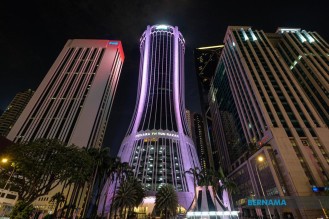
The entire approval process for Lembaga Tabung Haji's acquisition of a 30 per cent equity stake in Putrajaya Perdana Bhd in 2014 occurred during a period when the construction company was purportedly under the command of fugitive financier Low Taek Jho, commonly known as Jho Low, through his vehicle Utama Banking Group Bhd. Finance Minister II Datuk Seri Amir Hamzah Azizan presented this finding to the Dewan Rakyat during a special sitting convened to review the Royal Commission of Inquiry report on Tabung Haji's governance and operations, drawing on sworn testimony extracted from the SRC International criminal proceedings.
The chronological overlap between Jho Low's control and Tabung Haji's investment process is particularly striking when examined against documentary evidence. According to court testimony from Putrajaya Perdana director Datuk Rosman Abdullah, SRC International—a former 1Malaysia Development Bhd subsidiary allegedly covertly managed by Jho Low—transferred RM170 million into Putrajaya Perdana's construction subsidiary across three separate disbursements during July and August 2014. These cash flows occurred precisely as Tabung Haji's own investment approval machinery was in motion, suggesting overlapping periods of influence that raise serious governance questions.
The timeline of approvals reveals the compressed nature of the decision-making process. Tabung Haji's Investment Panel granted its blessing on July 24, 2014, followed by board approval on August 25 and ministerial authorisation on August 27. The sale and purchase agreement itself was formally executed on December 3, 2014, with Tabung Haji paying RM193.5 million to Cendana Destini Sdn Bhd in the following month to secure its 30 per cent holding. Critically, according to Amir Hamzah's account of the court testimony, Putrajaya Perdana remained under Jho Low's dominion through UBG until April 13, 2015, when the company's sale was finally completed—meaning the investment was approved and executed while this alleged control structure remained in place.
What makes this transaction particularly problematic for Tabung Haji depositors is the absence of fundamental due diligence safeguards. The Investment Panel specifically requested on July 24 that management identify the seller's ultimate shareholder, yet the fact-finding report from 2023 contains no record of management providing this critical information. Despite this conspicuous gap in background investigation, the transaction proceeded without interruption, suggesting either inadequate oversight mechanisms or troubling indifference to ownership transparency. Due diligence procedures were only conducted after all necessary approvals had already been secured, meaning decision-makers lacked essential investigative findings when endorsing what would ultimately become a catastrophic investment.
The valuation process itself invites scrutiny. Tabung Haji's Research Division initially challenged the proposed RM206 million price tag for the 30 per cent stake, submitting its own assessment that the equity warrant valuations ranging from RM124 million to RM155 million. Yet the final approved sum of RM193.5 million emerged without any documented written justification for why the valuation was elevated beyond the research team's recommendation or why the acquisition size expanded from 25 per cent to 30 per cent. This absence of transparent reasoning for material amendments to deal parameters raises fundamental questions about decision-making discipline within the institution.
The broader context of pricing becomes even more damaging when scrutinised against historical precedent. The seller had originally acquired the entire equity stake in Putrajaya Perdana for RM260 million in 2012, meaning a 30 per cent proportional holding would have represented approximately RM78 million in value at that time. By 2014, merely two years later, Tabung Haji agreed to remit RM193.5 million for the identical stake—an almost threefold escalation in value for which compelling commercial justification appears nowhere in the record. This extraordinary price appreciation within such a compressed timeframe, absent documented business rationale, suggests investors' funds may have been deployed at severely inflated valuations.
The investment was underpinned by two fundamental promises that entirely failed to materialise. Tabung Haji was assured that Putrajaya Perdana would undergo relisting on the stock exchange within twelve months and would achieve RM86 million in annual profit during 2015. Neither commitment was honoured, yet the institution's governance architecture failed to trigger any meaningful accountability or remedial action at that juncture. Adding to the dysfunction, the then-chairman of Tabung Haji simultaneously occupied the chairmanship of Putrajaya Perdana itself, creating a troubling conflict of interest that should have prompted governance concerns during the approval phase.
When reality diverged sharply from projections, Tabung Haji initially attempted to protect itself through contractual mechanisms. In March 2018, the institution exercised a put option requiring the seller to repurchase the shares at RM210.7 million—the price at which Tabung Haji sought to exit what had become an unmistakable liability. However, the seller refused payment, effectively stranding Tabung Haji's investment. As of the 2024 financial year, the entire RM193.5 million has been written off as a complete loss, representing funds that ordinary Malaysian pilgrims and savers entrusted to the institution's stewardship.
Tabung Haji is now pursuing recovery through the courts, having filed a writ and secured a Mareva injunction to prevent asset dissipation by defendants. Court-supervised mediation was scheduled to occur on August 11, with trial proceedings not anticipated until June 23, 2027—a timeline that reflects the complexity and contentiousness of recovering funds from what appears to be a substantially compromised transaction. The extended litigation horizon means resolution remains years away, leaving Tabung Haji's balance sheet burdened with this impairment indefinitely.
For Malaysian pension and pilgrimage fund participants, this episode represents a cautionary tale about how institutional safeguards can erode when approval mechanisms operate in isolation from adequate due diligence and when governance conflicts remain unresolved. The investigation has exposed systemic vulnerabilities in how investments were evaluated, approved, and monitored. The 2023 fact-finding assessment identified a broader pattern whereby four separate investments failed to undergo requisite due diligence before commitment, while risk management recommendations were consistently sidelined in the approval hierarchy. These structural weaknesses suggest that individual transaction failures reflected deeper governance dysfunction rather than isolated lapses, raising questions about whether reforms subsequently implemented have adequately fortified the institution's investment discipline and decision-making transparency.

