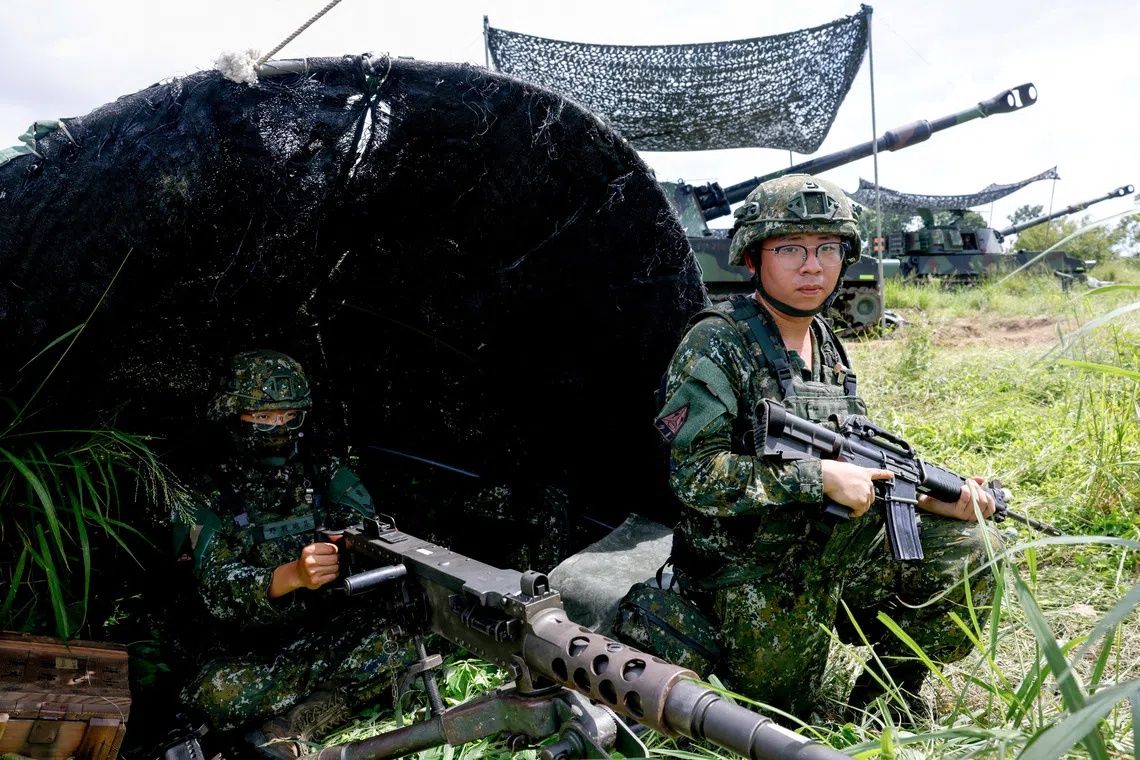
Taiwan initiated its largest military exercise of the year this week, deploying a comprehensive strategy designed to fortify the island's defence infrastructure against the persistent threat posed by China's military modernisation. The 10-day Han Kuang drills, which commenced on Wednesday, represent a significant escalation in the sophistication and realism of Taiwan's war preparedness efforts, moving beyond traditional scripted scenarios towards authentic field conditions that commanders might encounter during an actual conflict.
The exercise encompasses more than 20,000 troops, including approximately 5,000 reserve personnel, and was set in motion by orders issued from an underground command centre in Taipei. The coordinated operations include the dispersal of fighter aircraft to alternative airfields, emergency mobilisation of naval assets, and deployment of civilian industrial capacity to support military operations. These elements underscore Taiwan's recognition that any future conflict would necessitate the seamless integration of military and civilian resources on a scale not previously tested during routine drills.
A novel feature distinguishes this year's Han Kuang exercise from its predecessors: the temporary degradation of mobile internet speeds throughout the island. This deliberate measure reflects Taiwan's assessment that Chinese military strategy might target digital infrastructure to undermine civilian communication networks. By simulating bandwidth constraints, officials seek to understand how the general population would adapt to severely limited connectivity and what alternative communication protocols might prove essential during a genuine crisis. This represents the first time in the 40-year history of the annual exercise that such realistic infrastructure challenges have been deliberately introduced.
Among the most significant innovations is the adoption of a "backbrief" methodology derived from American military doctrine. Under this system, junior officers who receive operational instructions must restate the mission details and their understanding of the commander's intent before proceeding. This seemingly straightforward practice addresses a critical vulnerability that military analysts have long identified: the potential for miscommunication between different command levels during high-stress combat situations. By institutionalising this verification process, Taiwan aims to eliminate ambiguity that could prove catastrophic when split-second decisions determine outcomes.
A central focus of the drills involves preparing Taiwan's military and civilian establishment to withstand a decapitation strategy. Chinese military theorists have emphasised the importance of neutralising command infrastructure, port facilities, logistics networks, and defence manufacturing sites during the opening phase of any military operation. Taiwan's exercises therefore stress the survival and functionality of these critical nodes under sustained attack, testing whether backup systems, dispersed operations centres, and redundant supply chains can maintain Taiwan's capacity to resist and sustain a prolonged conflict.
The exercise moves beyond pure military considerations to encompass broader societal resilience. Officials have introduced an "embedded reporter" mechanism to evaluate how Taiwan would manage wartime information control and combat Chinese disinformation campaigns. This recognition that modern warfare extends into the information domain reflects the lessons learned from recent conflicts globally, where narrative control has proven as consequential as territorial gains. Taiwan's media and information strategy will be tested alongside its military capabilities.
Previous Han Kuang exercises faced criticism for maintaining overly controlled, laboratory-like conditions where outcomes were largely predetermined and military units performed rehearsed responses to anticipated scenarios. The current iteration represents a deliberate pivot towards injecting genuine unpredictability into the drills. Senior officials overseeing the exercises have emphasised that commanders will confront "unexpected scenarios" requiring rapid reassessment of the tactical situation, adjustment of previously issued orders, and distribution of new directives under time pressure. This stress-testing of adaptive command capacity reflects hard lessons from military conflicts where initial plans invariably require modification as circumstances evolve.
The drills also incorporate simulation of critical wartime logistics challenges, including the strategic relocation of major military arsenals and the mobilisation of civilian manufacturing facilities for defence production. Escort operations conducted off Taiwan's Pacific coast specifically address mounting concerns about China's capacity to threaten maritime supply lines connecting Taiwan to its Pacific allies. As Beijing's military reach extends further into the Pacific and its submarine fleet expands, Taiwan recognises that controlling sea lanes and maintaining communication with distant partners could prove decisive in any prolonged confrontation.
Taiwan's expanding emphasis on civilian preparedness reflects a maturation in strategic thinking about modern conflict. The exercises now incorporate resilience drills testing whether local government officials can maintain administrative continuity and essential services during cascading crises spanning natural disasters and military invasion. This whole-of-society approach acknowledges that military capabilities alone cannot guarantee national survival; civilian populations must possess the knowledge, infrastructure, and psychological preparation to endure disruption and contribute to the collective defence effort.
The timing of these exercises occurs against a backdrop of intensifying Chinese military activity around Taiwan. Beijing has demonstrated increasing willingness to conduct large-scale military exercises of its own, accompanied by diplomatic statements that China has not renounced the use of force to achieve reunification. For regional observers including Malaysia and other Southeast Asian nations, Taiwan's exercises carry broader implications. The island's successful defence against Chinese military pressure would require navigating complex geopolitical relationships and securing support from distant democracies, particularly the United States. Conversely, Taiwan's military collapse would reshape the entire regional security architecture, with profound consequences for freedom of navigation, supply chain security, and the balance of power throughout Asia.
Official statements emphasise that these exercises represent a fundamental reconceptualisation of Taiwan's military readiness rather than marginal refinements to existing procedures. The shift towards realistic field conditions, adaptive command structures, and whole-of-society preparedness reflects Taiwan's sober assessment that its survival depends not on hopes that conflict can be avoided, but on demonstrable capacity to prosecute an effective defence should deterrence fail. The Han Kuang exercises, scheduled to conclude on August 14, will provide Taiwan's political and military leadership with concrete evidence regarding whether the island's command structures, defence personnel, and civilian population possess the flexibility, resilience, and coordination necessary to endure and ultimately prevail in conditions of genuine national emergency.

