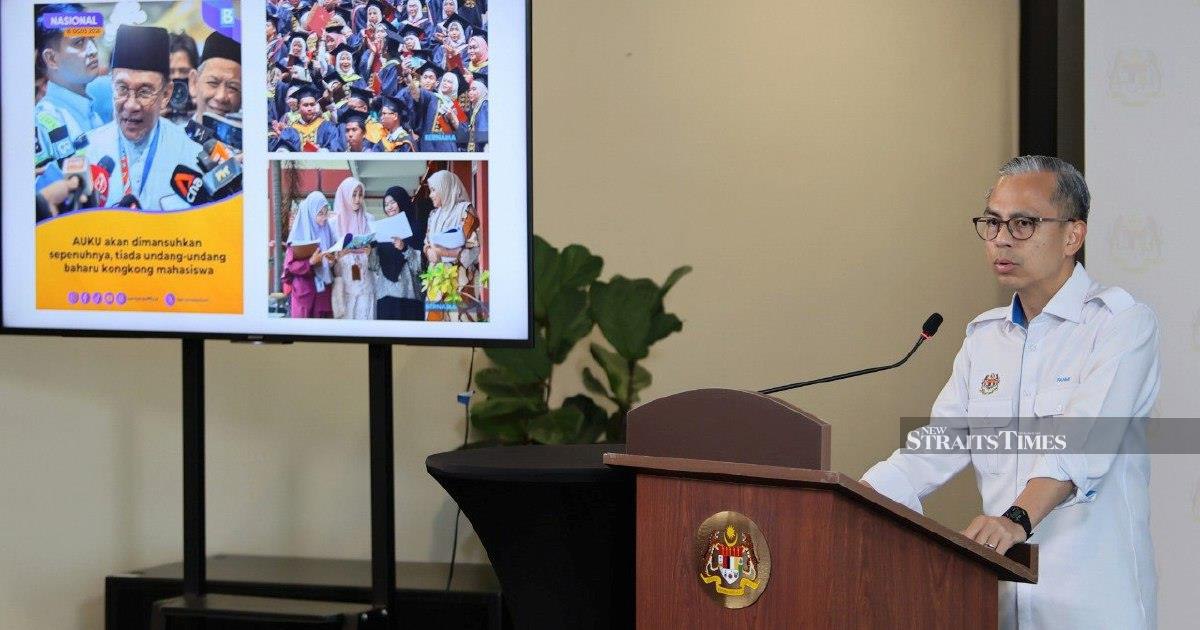
The Malaysian cabinet has not formally addressed Prime Minister Datuk Seri Anwar Ibrahim's recent statements regarding Taiwan, according to government spokesman Datuk Seri Fahmi Fadzil, despite the remarks triggering a pointed response from the island administration.
Fahmi's clarification comes in the wake of Anwar's comments, which Taipei characterised as provocative and warranting immediate diplomatic censure. The absence of a cabinet discussion on the matter underscores the complexities Malaysia faces in managing its relations across the Taiwan Strait while maintaining established diplomatic protocols with Beijing. Malaysia, like most nations globally, does not maintain formal diplomatic ties with Taiwan, having recognised the People's Republic of China since 1974.
The Prime Minister's remarks appear to have touched on sensitive geopolitical terrain. Taiwan's swift and forceful reaction suggests the comments ventured into territory that Taipei considered inconsistent with international norms regarding the island's political status. The Taiwanese government's rebuke indicates it perceived Anwar's words as either dismissive of Taiwan's democratic governance or as reaffirming Malaysia's adherence to the one-China principle in an unnecessarily blunt manner.
For Malaysian observers, the situation reflects the perpetual diplomatic tightrope Southeast Asian nations must walk. Malaysia's strategic position as a significant regional economy and established player in multilateral institutions requires careful calibration between its formal position on China and the reality of increasing cross-strait tensions. The government's deliberate non-engagement with the issue at cabinet level may itself constitute a strategic choice—avoiding amplification of the dispute through official institutional debate.
The question of why Anwar's remarks warranted no substantive cabinet review raises intriguing questions about decision-making hierarchies within Malaysia's executive branch. Either the government considers the matter sufficiently resolved through existing diplomatic channels, or it prefers to allow the controversy to dissipate without formal institutional engagement that might further complicate bilateral relations with either Taipei or Beijing. The spokesperson's statement essentially signals that the government views the episode as closed.
Taiwan's response, by contrast, reflects heightened sensitivity among the island's leadership to international statements touching upon its sovereignty and international standing. In recent years, as cross-strait tensions have escalated, Taiwan has become increasingly vocal in responding to comments it perceives as minimising its status as a self-governing democracy. The strong rebuke from Taipei indicates the island administration felt compelled to make a public statement to domestic and international audiences regarding Taiwan's political legitimacy.
For regional stability, Malaysia's apparent measured approach suggests pragmatism over escalation. The nation has longstanding commercial and cultural ties with Taiwan while maintaining its formal one-China policy. Allowing a controversial moment to pass without formal cabinet deliberation enables both sides to avoid entrenching positions that might threaten these practical relationships. Many Malaysian businesses operate in Taiwan, and Taiwanese investors maintain significant presence in Malaysia; pushing diplomatic tensions higher serves neither side's interests.
The incident also illuminates the different communication styles expected of leaders in democracies with divergent political systems and international positions. Taiwan, as a democratic island under constant scrutiny regarding its international legitimacy, must actively defend its standing through swift public statements. Malaysia, as a recognised sovereign nation with established regional influence, can afford to address matters more quietly and deliberately. This asymmetry in response urgency reflects the fundamentally different geopolitical circumstances each territory faces.
Domestically, the government's silence at cabinet level may also reflect competing priorities within Malaysia's executive structure. With numerous pressing issues demanding ministerial attention—economic challenges, infrastructure development, social policies—a diplomatic spat with Taiwan, however significant internationally, might not command urgent collective discussion if the Prime Minister's office and foreign affairs ministry have already coordinated a response.
The broader context suggests that while Malaysia maintains friendly relations with Taiwan in practical terms, the government remains conscious of Beijing's sensitivities. Any statement that appeared to elevate Taiwan's diplomatic status or question the one-China principle would risk Beijing's displeasure. By not elevating Anwar's remarks through cabinet discussion, the government signals consistency with established policy while avoiding further inflaming an already delicate situation.
Looking forward, the episode serves as a reminder that regional diplomacy in Asia requires extraordinary precision in language and positioning. Prime ministerial statements carry disproportionate weight in shaping international perceptions of national policy. The cabinet's non-engagement with this particular incident demonstrates that sometimes the most effective diplomatic management involves deliberate restraint and the refusal to amplify controversies that lack clear institutional resolution pathways.

