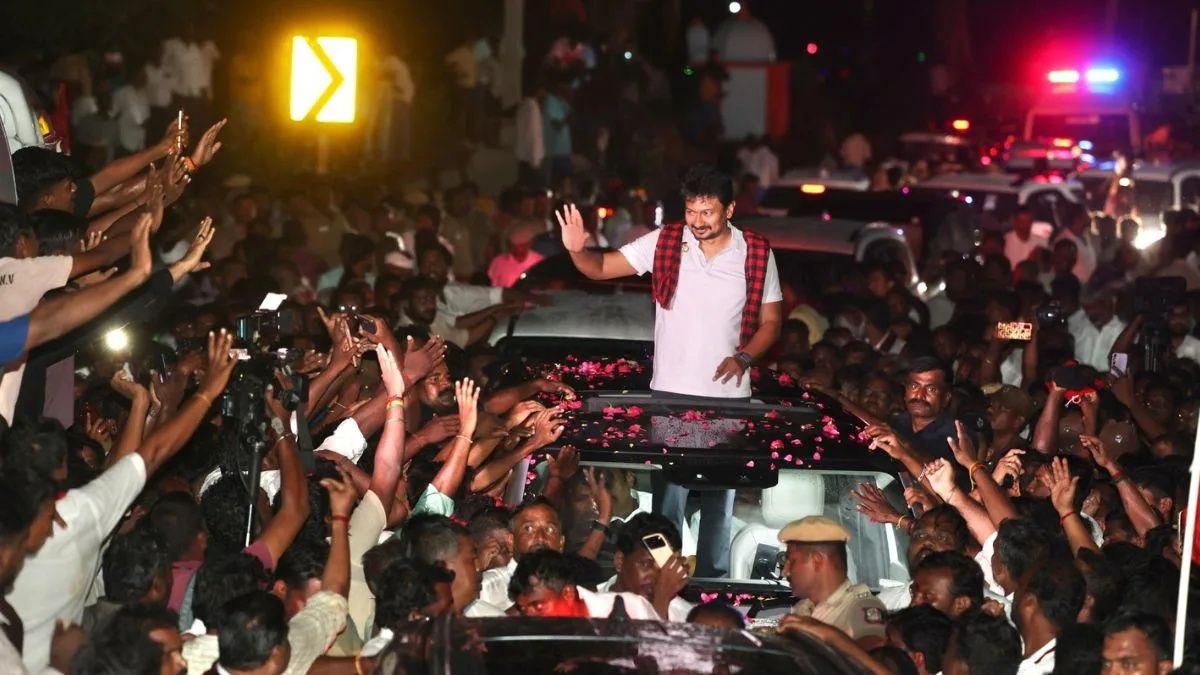
The political temperature in Tamil Nadu intensified sharply when Udhayanidhi Stalin, the Leader of Opposition, was released on station bail late Tuesday evening following an extended questioning session related to allegedly offensive remarks directed at popular actress Trisha Krishnan. The arrest and subsequent release marked another flashpoint in the escalating tensions between the opposition DMK and Chief Minister Vijay's newly formed TVK government, which has moved aggressively against political opponents since assuming power.
Stunning scenes unfolded at Sengipatti police station where Stalin had been held following his arrest earlier that day. Hundreds of DMK loyalists assembled outside the facility, demonstrating the party's organizational strength and signaling their defiance of what they characterize as governmental harassment. The gathered supporters voiced their opposition through chants critical of Chief Minister Vijay, turning the police station into an impromptu political rally and underscoring the deeply polarized state of Tamil Nadu politics.
Upon his release, Stalin moved swiftly to address supporters and media at a hastily arranged press conference, where he mounted a spirited defense against the allegations. He categorically denied any disrespectful intent toward women and reframed his arrest within a broader narrative of political victimization. According to Stalin, the government was fabricating charges to deflect public attention from substantive policy failures, particularly regarding agricultural concerns and water resource management. His characterization of the arrest as part of a governmental "diversion tactic" reflected the DMK's strategy of positioning itself as the persecuted party facing an authoritarian regime.
The controversy originated during a DMK protest rally held in Thanjavur, where Stalin was addressing water-related grievances affecting Tamil Nadu farmers. The focal point of his remarks centered on the Cauvery water dispute and Karnataka's contentious Mekedatu dam project, issues that have long generated friction between the neighboring states and remain politically sensitive in Tamil Nadu. As Stalin was articulating concerns about water availability and agricultural sustainability, an enthusiastic supporter in the crowd called out the name of actress Trisha Krishnan, who is widely perceived to maintain close personal ties with Chief Minister Vijay.
What transpired in that moment has become the subject of intense political contestation. When hearing Trisha's name mentioned, Stalin paused, smiled, and responded with the phrase: "Wherever water comes, whether it comes or not, water should come there." While Stalin's supporters and the DMK argue the statement represents a straightforward continuation of his discourse on water availability, critics—particularly those aligned with the TVK government—interpreted the remarks as containing sexual innuendo and alleged they amounted to objectification of a woman. This divergence in interpretation reflects the broader polarization characterizing Tamil Nadu's current political environment.
The ruling TVK government responded decisively to the episode by escalating the matter through multiple institutional channels. The party filed a formal police complaint and simultaneously approached the National Commission for Women, framing the remarks as constituting verbal harassment and an affront to women's dignity. This multi-pronged approach—combining police action with appeals to quasi-judicial bodies—illustrated the TVK's determination to maximize political impact from the incident and establish a narrative of protecting women against political figures from opposing parties.
Striking at the heart of Stalin's defense at the press conference was his emphatic denial that his remarks carried double meaning or any malicious undertones. He insisted his words possessed singular, straightforward significance and that he harbored no intention to demean women or engage in objectification. Stalin expanded his defense beyond the immediate controversy, using the platform to criticize the TVK government more broadly, describing it not as a legitimate administration but rather as a circus, a rhetorical flourish intended to delegitimize the regime and resonate with DMK base voters.
The incident underscores a troubling pattern that has emerged since the TVK's electoral victory, which Stalin explicitly referenced during his statement. He highlighted what he characterized as a systematic practice of arresting DMK legislators, suggesting the government weaponizes legal processes against opposition figures. This assertion taps into broader concerns among political observers regarding the politicization of law enforcement and prosecutorial discretion in Tamil Nadu, issues that have gained increasing salience as the TVK consolidates its hold on state machinery.
For Malaysian observers following South Indian politics, this episode illuminates the intense competitive dynamics within Tamil Nadu's political ecosystem and the manner in which regional parties leverage cultural and gender-related sensitivities to advance electoral calculations. The rapid escalation from a passing remark at a rural rally to a high-profile arrest and interrogation demonstrates how political actors in India's states employ institutional mechanisms—police, courts, human rights commissions—as instruments within electoral contests. The incident also reflects evolving dynamics around women's rights advocacy, where political parties instrumentalize gender concerns selectively depending on factional alignments.
The broader context reveals a state government employing aggressive tactics against the opposition while the DMK frames itself as a principled voice for farmers and agricultural interests. Stalin's arrest and swift release on bail, coupled with the show of party solidarity at the police station, suggests the controversy may ultimately strengthen opposition morale rather than damage the DMK's standing. Whether this incident proves consequential or fades as another chapter in Tamil Nadu's perpetual political theater remains to be seen, though its occurrence demonstrates how sensitive interpersonal dynamics and perceived slights can rapidly metastasize into significant political confrontations.

