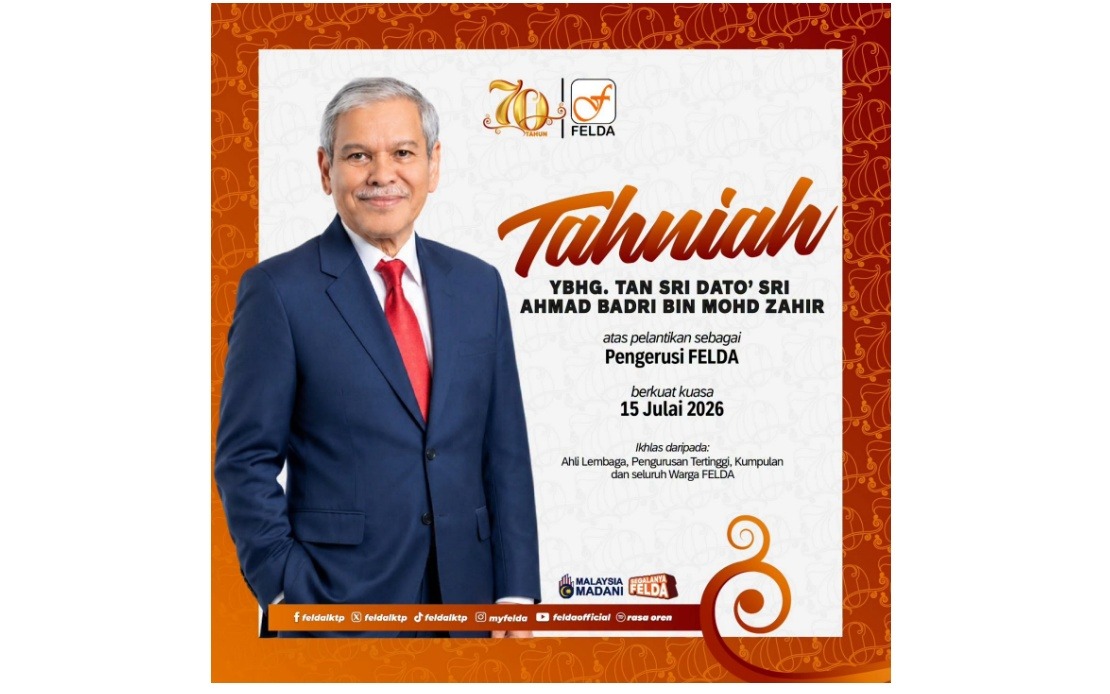
Tan Sri Ahmad Badri Mohd Zahir has been appointed as the new chairman of the Federal Land Development Authority (FELDA), marking a significant leadership transition at the organisation responsible for overseeing the welfare and economic interests of more than three million settlers across Malaysia. The appointment comes amid ongoing efforts to modernise the institution and realign its operations with broader national sustainability objectives.
The government's decision to elevate Ahmad Badri to this position reflects confidence in his demonstrated track record across Malaysia's public and private sectors, built over more than three decades of professional advancement. His career trajectory illustrates the kind of institutional experience that the government believes FELDA requires at this juncture, particularly as the organisation navigates the complexities of managing settler livelihoods against shifting economic conditions and evolving agricultural realities in the region.
Ahmad Badri's professional background showcases considerable diversity in portfolio management across multiple critical sectors. He initiated his civil service career in 1989 at the Ministry of Finance, where he progressed through increasingly senior roles. His most prominent public sector position came during his tenure as Treasury Secretary-General from 2018 to 2020, where he would have been instrumental in shaping fiscal policy during a critical period for Malaysia's economic recovery and budgetary planning.
Beyond his government service, Ahmad Badri has accumulated substantial board-level experience at some of Malaysia's most strategically important institutions. He previously led the Employees Provident Fund, the nation's primary retirement savings mechanism affecting millions of Malaysian workers. His association with Bank Negara Malaysia, Permodalan Nasional Berhad, and Tenaga Nasional Berhad demonstrates exposure to monetary policy, equity asset management, and critical energy infrastructure respectively. These roles would have provided him with insights into systemic economic challenges and institutional governance at the highest levels.
Currently, Ahmad Badri chairs RHB Bank Bhd and the Malaysian Rubber Board, while maintaining a seat on the Sime Darby Bhd board. This portfolio reveals ongoing engagement with banking, agricultural commodities, and large-scale conglomerate operations—sectors with direct relevance to FELDA's core mandate of managing agricultural land and supporting settler communities. His continued involvement in these sectors suggests he brings contemporary understanding of market dynamics affecting the very industries that FELDA settlers often depend upon.
FROM AN EDUCATIONAL STANDPOINT, Ahmad Badri holds qualifications that align with modern institutional management expectations. His postgraduate training came from the University of Hull in the United Kingdom, where he earned a Master of Business Administration, while his foundational degree in Estate Management from Universiti Teknologi MARA provides domain-specific knowledge directly applicable to land-based agricultural enterprises. This combination of formal estate management training and advanced business administration credentials suggests he brings both technical grounding and strategic management capability.
FELDA's statement emphasising Ahmad Badri's appointment underscores the organisation's intention to anchor its transformation agenda more firmly. The agency framed the appointment explicitly in terms of advancing Malaysia's sustainable and inclusive development goals, signalling that FELDA's evolution is not viewed as an isolated institutional matter but rather as integral to the nation's broader development trajectory. For the three million settlers dependent on FELDA's structures for land access and economic opportunity, the appointment carries implications for how their interests will be prioritised as the organisation modernises.
The transformation agenda referenced repeatedly in FELDA's announcement touches on sensitive terrain in Malaysian politics and development. FELDA has historically served as an instrument of economic redistribution and rural development, yet the organisation has faced periodic scrutiny regarding operational efficiency, settler welfare outcomes, and governance transparency. Ahmad Badri's background in treasury operations and financial institutions suggests an administration inclined toward fiscal rigour and institutional accountability—qualities that could reshape how FELDA operates, though such shifts would require careful management given the political salience of settler interests.
Ahmad Badri's elevation also reflects broader trends in Malaysian institutional leadership, where previous experience in revenue-generating or economically critical portfolios increasingly determines suitability for roles overseeing broader development mandates. His progression from finance ministry roles to leading an institution serving agricultural producers demonstrates how Malaysia's governance establishment views the intersection of economic management and social development. This perspective will likely influence FELDA's strategic direction in coming years.
The appointment carries particular relevance for Southeast Asia's broader development context. Regional governments have intensified focus on inclusive growth and agricultural sustainability, areas where FELDA's settler model represents a distinctive Malaysian approach. Ahmad Badri's mandate to strengthen settler welfare while advancing organisational transformation positions him at the intersection of these competing imperatives. His success or otherwise in balancing modernisation with protection of settler interests will offer instructive lessons for comparable land development initiatives across the region.
Looking forward, observers will monitor whether Ahmad Badri's institutional background translates into renewed momentum for FELDA's strategic initiatives. His banking, commodity, and treasury sector experience may facilitate closer integration between FELDA's operations and broader capital markets, potentially opening new funding channels or partnership arrangements. However, the ultimate measure of his effectiveness will rest on whether FELDA's settler communities perceive tangible improvements in their economic circumstances and quality of life under his leadership. The chairman's challenge lies in advancing institutional excellence while ensuring the organisation's foundational purpose—supporting agricultural settlers—remains paramount.

