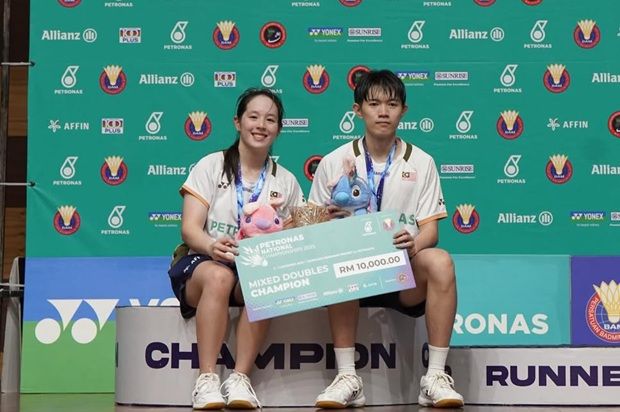
Clarissa San is stepping into the spotlight at the Japan Open next week with straightforward counsel from her new mixed doubles partner and coaching team: embrace the moment and let nervousness fade away. The 20-year-old will make her debut at one of the BWF World Tour's marquee events, having been paired with Tang Jie after Toh Ee Wei suffered an anterior cruciate ligament injury that has forced the original partner into rehabilitation in Melbourne.
The pairing represents both an unexpected opportunity and a learning curve for the Selangor-born shuttler. Clarissa has expressed genuine excitement about the prospect of competing at such a high level of international badminton, and she is determined to extract maximum value from the experience despite the unconventional circumstances of her selection. Having trained extensively with her new partner over recent weeks, she feels prepared to translate that preparation into competitive action, though she remains measured in her outlook about what the tournament might deliver.
Tang Jie's role extends far beyond simply being a doubles partner on court. Clarissa has characterised him as functioning in a dual capacity—part mentor, part older brother—whose steady presence helps counteract the psychological pressures that inevitably accompany a player's first appearance at an elite tournament. When she commits errors in rallies, Tang Jie provides immediate correction and strategic guidance, creating a supportive environment that minimises self-doubt and maximises learning efficiency. This mentoring dynamic has proved crucial in preparing Clarissa mentally for the Japan Open stage.
Mixed doubles head coach Nova Widianto reinforces this approach daily, consistently encouraging Clarissa to suppress anxiety and instead focus on enjoyment and execution. The coaching philosophy emphasises that performing well at this level requires mental composure alongside technical competence, and that players operating within their emotional comfort zone generally make better tactical decisions and execute their fundamentals more cleanly. For a player making her tournament debut at this altitude, such psychological scaffolding proves invaluable.
Clarissa's approach to the Japan Open reflects a pragmatic mindset regarding expectations. Rather than harbouring ambitions of a deep tournament run, she has anchored her primary objective to demonstrating on the professional stage what she has been perfecting during training sessions. This modest framing reduces unhelpful pressure while maintaining sufficient ambition to keep her engaged and motivated throughout the event. She openly acknowledges significant room for improvement across multiple technical and tactical dimensions, viewing the Japan Open as an investment in her long-term development as a mixed doubles specialist.
The competitive schedule ahead of Clarissa extends considerably beyond the Japan Open. She will partner with Tang Jie across three or four additional tournaments in the coming weeks, meaning this debut represents merely the first chapter of their partnership narrative. This extended timeline allows both players to develop chemistry and understanding gradually rather than expecting seamless coordination from the outset. Clarissa has emphasised her determination to extract knowledge from each match they contest together, positioning the entire series of tournaments as an extended learning opportunity.
In the opening round at the Japan Open, Tang Jie-Clarissa will confront Taiwan's Yang Po-hsuan-Hu Ling-fang, a pairing of considerable technical capability. This first-round assignment will serve as an early indicator of how well the Malaysian pair has developed synchronisation and court awareness during their preparation phase. The match presents both an opportunity to build confidence through victory and valuable learning material should the outcome prove less favourable.
Malaysia's mixed doubles contingent brings substantial depth to the Japan Open lineup. Jimmy Wong-Cheng Su Yin will oppose Japan's Yuichi Shimogami-Sayaka Hobara in their opening encounter, while the independent pair of Goh Soon Huat-Shevon Lai Jemie take on American representatives Chen Zhi Yi-Francesca Corbett. Another home pairing, Wong Tien Ci-Lim Chiew Sien, faces a sterner initial challenge in the form of China's fifth-seeded combination Guo Xinwa-Chen Fanghui, a matchup that will test their resilience against stronger-ranked opposition from the outset.
For Malaysian badminton specifically, Clarissa's Japan Open appearance carries relevance beyond her individual performance trajectory. The national mixed doubles programme continues its ongoing efforts to develop internationally competitive pairings, and successful integration of younger players like Clarissa into the elite circuit strengthens the overall competitive pool. Her progression, whether immediate or gradual, contributes to the broader objective of maintaining Malaysia's status as a badminton powerhouse within the Asian and global context.

