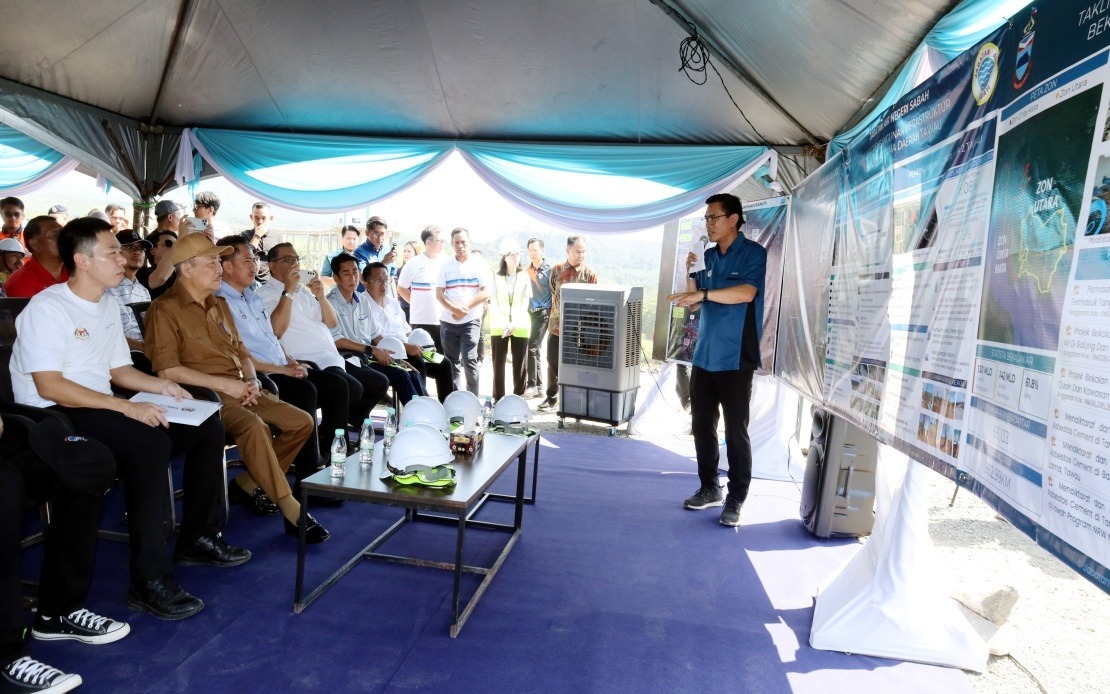
Tawau's entrenched water supply crisis, which has plagued the East Malaysian town for years, stands on the verge of resolution with the Tawau Water Supply Scheme Phase III advancing steadily toward its end-2027 completion target. Chief Minister Datuk Seri Hajiji Noor confirmed during a site inspection that the RM450.5 million infrastructure project remains aligned with its timeline, signalling imminent relief for a municipality wrestling with persistent supply deficits and rationing pressures.
The scale of Tawau's water predicament underscores the urgency surrounding this massive capital investment. The town currently operates with a production capacity of 130 million litres daily, falling 12 million litres short of the 142 million litres demanded by its population. With 53,133 registered water accounts serving the township and outlying districts, the supply-demand imbalance has created recurring service interruptions that strain households, businesses, and industrial operations alike. This structural deficit has lingered because earlier phases of water infrastructure development could not keep pace with the region's growth trajectory, leaving Tawau perpetually undersupplied relative to consumption patterns.
The centrepiece of Phase III is the new Tawau Dam, engineered to capture and store 30 million cubic metres of raw water—a capacity that will fundamentally alter the town's water security equation. Project manager Rodney Tinggas reported that dam construction had achieved 74.04 per cent completion as of late July, with the structure on course to deliver dual benefits: a stable, year-round raw water supply and meaningful reduction of flood risks that periodically threaten downstream communities. The dam represents the missing piece in Tawau's water infrastructure puzzle, addressing both supply adequacy and natural disaster mitigation in a single engineering solution.
Once operational, the scheme will pump raw water through 11.6 kilometres of newly laid 700-millimetre transmission pipelines to three treatment facilities: the existing Cinta Mata 1 and Utara plants, plus the under-construction Cinta Mata 2 installation. This network will raise the town's combined treated water production capacity to 161 million litres per day—well above current demand and providing substantial headroom for population growth and economic expansion over the coming decade. The Cinta Mata 2 facility alone, budgeted at RM299.9 million and scheduled for completion in July 2028, will inject 30 million litres of daily treatment capacity and serve approximately 42,000 consumers across Tawau and adjacent settlements.
While both projects remain fundamentally on schedule, the contractor has petitioned for an extension of the construction timeline—a routine occurrence on major infrastructure works in tropical climates and challenging terrain. Hajiji indicated, however, that deadline slippage does not appear imminent, with the government maintaining firm confidence in the end-2027 completion window. The chief minister simultaneously signalled flexibility around project financing, stating that Sabah stands ready to inject supplementary funds if technical assessments by the Sabah State Water Department (JANS) and the Department of Irrigation and Drainage (DID) justify additional expenditure to accelerate delivery or enhance specifications.
The political backdrop to this infrastructure push carries weight for regional observers. Hajiji's administration framed the investment as inherited problem-solving rather than crisis-creation, acknowledging that Tawau's water woes predate the current state government but representing them as a priority meriting substantial resource commitment. This rhetorical positioning reflects sensitivity to water supply performance as a touchstone of governmental competence in Malaysian electoral politics, where service delivery deficits—particularly in essential utilities—can erode public confidence and legislative support.
For Tawau's business community and industrial base, the scheme promises transformative operational benefits. Manufacturing enterprises, hospitality establishments, and agricultural operations dependent on reliable water access have long factored supply uncertainty into operational risk assessments and contingency planning. Once Phase III comes online, businesses can reduce expenditure on private water storage infrastructure, backup systems, and supply-chain disruption mitigation, thereby improving competitiveness and enabling investment in growth initiatives rather than defensive infrastructure.
The Tawau Water Supply Scheme Phase III also carries broader implications for Sabah's regional development strategy. East Malaysian states have historically lagged peninsular Malaysia in infrastructure density and service standardisation, with water supply quality and reliability varying significantly across districts and municipalities. This RM450.5 million commitment signals renewed state government determination to address such disparities and position Sabah's urban and semi-urban centres on par with equivalent towns elsewhere in Malaysia. Such investments prove essential for attracting skilled labour, supporting business relocation decisions, and enhancing Sabah's competitiveness within the broader Southeast Asian economic landscape.
Looking ahead, the success of Phase III will test Sabah's capacity to execute complex infrastructure projects on schedule and within budgetary parameters—a persistent challenge for Malaysian state governments managing large-scale capital works. The July 2028 completion target for Cinta Mata 2 and the end-2027 dam commissioning represent intermediate milestones that will indicate whether the project maintains momentum or encounters the cost overruns and timeline extensions that have plagued comparable schemes across Malaysia. Stakeholders in Tawau and across Sabah will monitor progress with keen interest, as timely delivery would validate the government's infrastructure management credentials and deliver tangible improvement in a utility domain where Malaysian public sector performance has historically lagged expectations.

