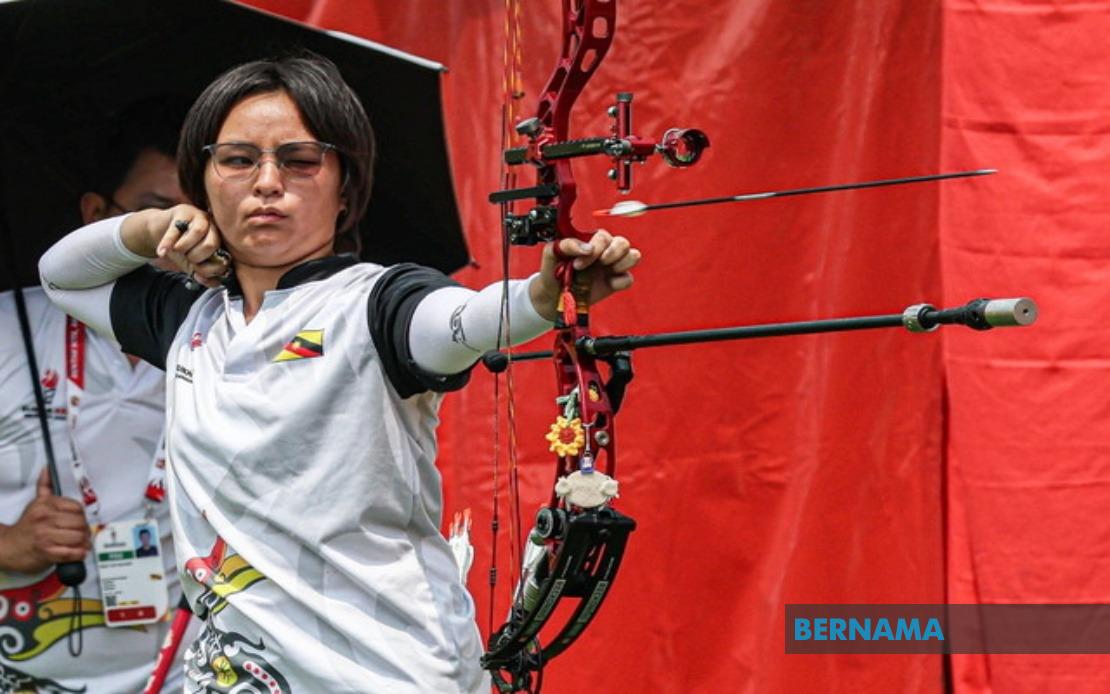
Wee Yee Qi's decision to abandon the recurve discipline in favour of compound archery late last year has already vindicated itself spectacularly, with the Sarawak archer claiming dual gold medals during her maiden SUKMA Games appearance at the National Institute of Valuation stadium in Bangi today. The 17-year-old's breakthrough on the regional competition stage suggests that the tactical shift may prove instrumental in advancing her trajectory toward senior-level representation.
The Miri-born competitor first struck gold in the mixed team event, partnering with Eason Lau Hui Wan to edge out Kedah's Muhammad Zaim Ahmad and Ili Nabihan Shafizan in a tightly contested final that finished 151-150. That narrow victory provided an early indication of Sarawak's archery depth at this year's Games, setting the tone for what would become an exceptional showing in the compound discipline.
Yee Qi's medal haul extended almost immediately afterwards when she combined with teammates Aira Nadirah Aizuddin and Nur Zara Aisyah Khairul Fadly to secure gold in the women's team competition, with Sarawak ultimately prevailing 217-213 over Terengganu. The second victory proved particularly dramatic given that the Sarawak trio spent the opening three ends trailing their opponents, only to orchestrate a decisive recovery in the final round to overcome Terengganu's Airazalia Azrai, Nur Shafiena Mohd Shuhamri and Putri Aqiera Issandra Ismayuddin.
In remarks to the national news agency following the finals, Yee Qi attributed her rapid ascent to consistent guidance from her coaching staff, crediting their investment in her development and willingness to expose her to competitive environments at multiple levels. She articulated particular gratitude toward her family's unwavering support throughout her sporting journey, which began when coaching staff identified her aptitude during school activities some six years ago. That early identification catalysed her transition into formal archery training and ultimately fostered the sporting passion that has come to define her adolescence.
The archer's shift away from recurve archery emerged from tactical considerations rather than circumstance. She acknowledged that her earlier efforts in the recurve discipline had failed to generate the competitive impact she sought, prompting a reassessment of her technical approach. The compound transition, however, appears to have unlocked potential that was previously constrained, with the immediate competitive success suggesting a more natural alignment between her physical attributes and the compound discipline's technical demands.
Despite her sudden prominence at SUKMA 2026, Yee Qi's immediate future involves a temporary departure from competitive archery. The examination calendar demands her attention for the next several months, with the Sijil Pelajaran Malaysia test scheduled for November requiring her full academic commitment. The timing presents the familiar challenge facing young Malaysian athletes attempting to balance educational obligations with sporting aspirations, though her stated intention to resume concentrated archery focus after completing her examinations suggests a clear prioritisation of the sport's longer-term possibilities.
Yee Qi's ultimate ambition extends beyond regional Games success toward full national representation at senior international competitions. That trajectory, should she sustain her current momentum following her SPM examinations, would position her among Malaysia's emerging archery prospects during a period when the nation seeks to strengthen its Olympic archery pipeline. The compound discipline has gained prominence in recent Olympic cycles, making her specialisation potentially advantageous for medium-term selection possibilities.
Sarawak's archery contingent demonstrated broader competitive strength beyond Yee Qi's individual performances. The state's dominance in the compound events reflected accumulated investment in the discipline across multiple age groups and gender categories, suggesting a coordinated development approach rather than isolated achievement. This structural strength within a single state programme has implications for how other regional archery associations assess their own competitive positioning heading into future Games.
Outside the compound medals, Selangor secured the mixed team bronze medal through Muhammad A'rif A'fiq Suhaimi and Nur Alyaa Nazurah Fadzil Fairuz, who defeated Sabah's Hiew Ichin and Catherine Looi Mei Qi Abdullah 154-152 in a closely fought third-place playoff. Selangor's women's team also claimed bronze after prevailing 219-212 against their counterparts, indicating that despite Sarawak's dominance, the compound archery field retains sufficient competitive depth to produce closely contested outcomes across medal positions.
For Southeast Asian archery observers, Yee Qi's emergence carries significance beyond Sarawak's immediate sporting interests. The region has produced limited internationally competitive archers in recent decades, making the identification and development of technical specialists at her age and performance level worthy of attention. Should coaching staff and sporting bodies successfully integrate her academic commitments with continued technical refinement following her SPM period, she could represent an important addition to Malaysia's Olympic archery representation in future Games cycles.

