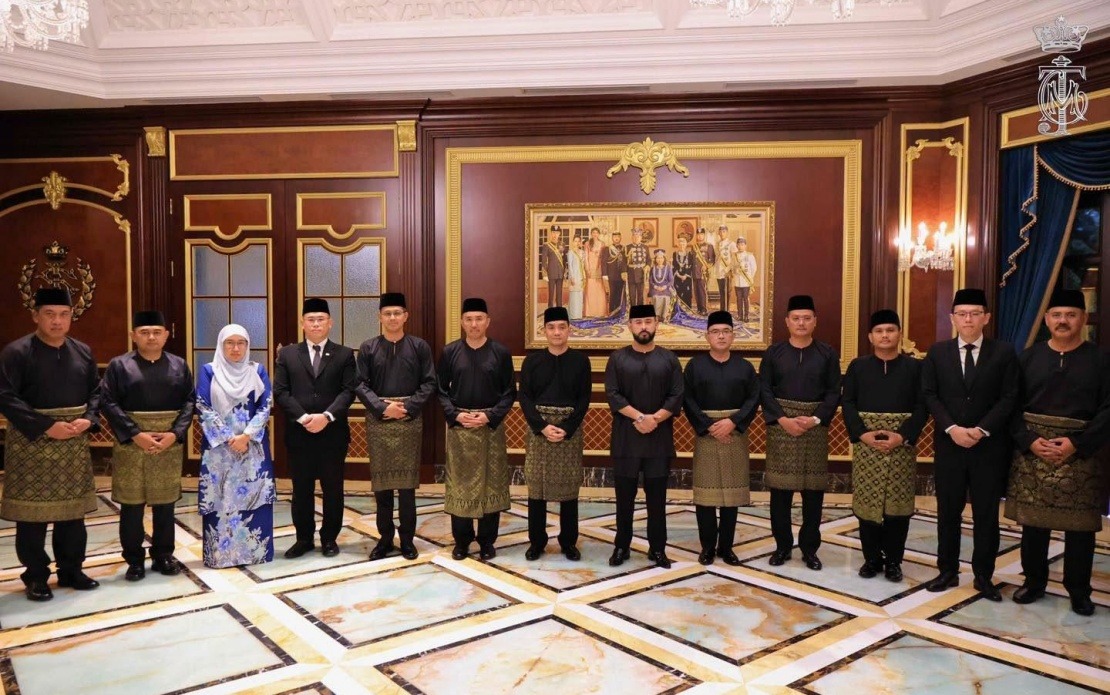
Ten newly appointed members of the Johor State Executive Council were sworn in during a formal ceremony held at Istana Bukit Serene on July 18, administered by the Regent of Johor, Tunku Mahkota Ismail. The ceremonial event marked a significant milestone in the formation of the state government following the recent electoral success that has reshaped the political landscape of Malaysia's southern industrial heartland. The proceedings saw Menteri Besar Datuk Onn Hafiz Ghazi, Royal Court Council Yang Dipertua Datuk Dr Abdul Rahim Ramli, and State Secretary Datuk Mohammed Ridha Abd Kadir in attendance, underscoring the formal nature of the constitutional proceedings.
The Exco membership comprises both seasoned legislators and newly elected representatives, reflecting a balanced approach to governance. Six experienced assemblymen joined the council: Mohd Hairi Mad Shah from Larkin, Datuk Mohd Jafni Md Shukor from Bukit Permai, Mohd Fared Mohd Khalid from Semerah, Ling Tian Soon from Yong Peng, Lee Ting Han from Paloh, and Mohamad Fazli Mohamad Salleh from Bukit Pasir. Their reappointment suggests continuity in policy direction and administrative experience within the executive branch, maintaining expertise in critical portfolios that typically manage state affairs.
Four newly elected assemblymen also took their oaths, making their inaugural entry into the state executive framework. This group includes Md Israk Abdullah representing Kukup, P. Pannir Selvam from Perling, Hasrunizah Hassan from Pulai Sebatang, and Muhammad Naqib Md Ghazali from Panti. The inclusion of these first-time Exco members demonstrates the ruling coalition's confidence in fresh political talent and its commitment to generational renewal within the state administration. These appointments often signal which constituencies and demographic groups the government intends to prioritize in its policy agenda.
The formation of this new Exco directly follows Onn Hafiz's investiture as Menteri Besar for his second consecutive term, a position he secured just the previous Sunday. As the Machap assemblyman, Onn Hafiz retained his seat with an impressive majority of 15,375 votes, a result that consolidated his political standing within the state. His reelection to the top executive post reflects broad acceptance among BN's coalition partners and the electorate, positioning him to lead the next phase of Johor's governance and development priorities.
The political mandate underlying these appointments is historically significant for the state. Barisan Nasional achieved a commanding victory in the 16th Johor state election, securing 48 of the 56 state assembly seats. This landslide performance provides the coalition with an overwhelming legislative majority and substantial political capital to advance its agenda without procedural obstacles. The scale of the victory underscores voter confidence in BN's economic stewardship and policy platforms, particularly relevant given Johor's status as an economic powerhouse and strategic gateway to Singapore and the region.
For Malaysian observers and Southeast Asian analysts, the Johor election outcome carries implications extending beyond state boundaries. Johor's electoral performance influences national political dynamics, as the state's economic significance—its manufacturing base, port facilities, and investment potential—makes it a barometer of public sentiment towards federal governance and coalition stability. The BN's resounding success in Johor provides momentum for the national ruling coalition and indicates sustained voter support for the coalition's governance model in a key constituency.
The composition of the new Exco also reflects deliberate ethnic and geographic representation, a hallmark of Malaysia's federal power-sharing arrangements. With both Malay-Muslim and Malaysian Indian representatives in the council, the government signals inclusive governance across the state's diverse communities. Johor's multicultural population and its role as a crucial economic region necessitate executive representation that acknowledges this diversity, ensuring that development policies and resource allocation address varied community interests.
The immediate priorities facing this reconstituted Exco are likely to include infrastructure development, attracting foreign and domestic investment, and managing the state's recovery from economic pressures. Johor has experienced significant transformation over recent years, with renewed focus on special economic zones, technology parks, and manufacturing hubs. The state's position in the broader regional context—particularly its relationship with Singapore and its role in Malaysia's economic corridors—suggests that interstate cooperation and trade facilitation will feature prominently in the council's agenda.
The administrative machinery supporting this Exco includes institutional structures and bureaucratic frameworks that have been refined over multiple electoral cycles. With State Secretary Datuk Mohammed Ridha Abd Kadir overseeing implementation, continuity in administrative processes should facilitate smooth execution of policy initiatives. The formal oath-taking ceremony, steeped in constitutional tradition and royal oversight, reinforces the legal foundations upon which the council's authority rests, a particularly important symbolic gesture in Malaysia's constitutional monarchy framework.
Looking ahead, the performance of this Exco will significantly influence Johor's development trajectory over the next five years. The council's ability to deliver on promises, manage state finances prudently, and respond to emerging socioeconomic challenges will determine whether BN retains its commanding position in subsequent electoral cycles. For regional observers monitoring Malaysia's political stability and economic governance, the Johor Exco's functioning offers important indicators of coalition coherence and administrative effectiveness at the sub-national level.

