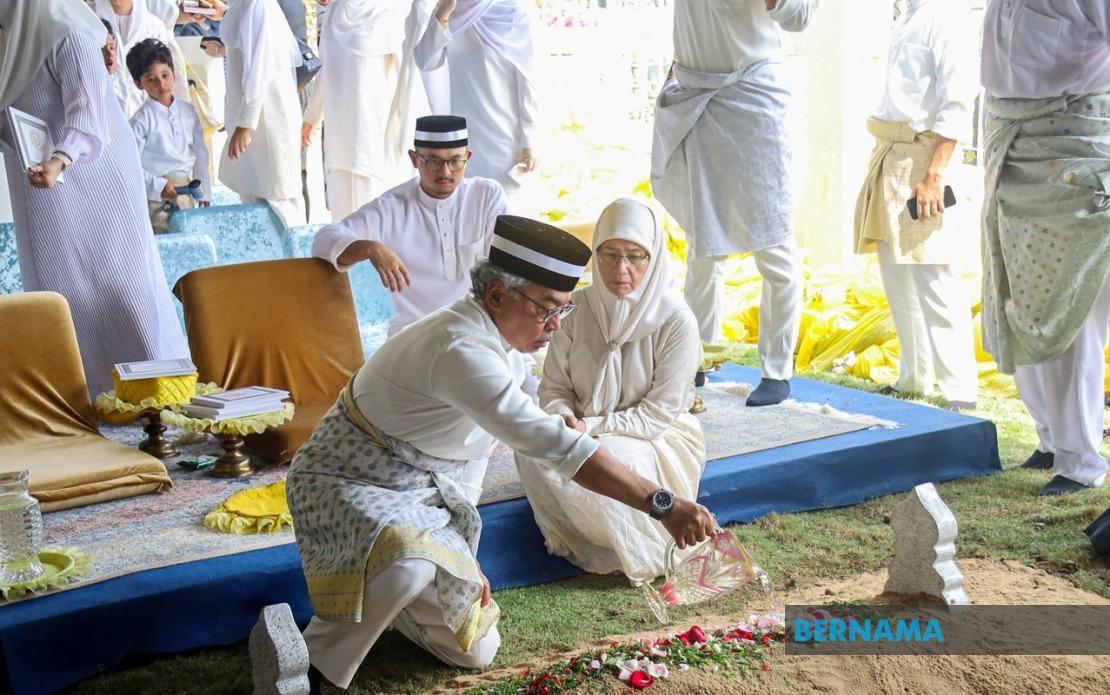
The remains of Tengku Datuk Seri Aishah, elder sister of Pahang Sultan Al-Sultan Abdullah Ri'ayatuddin Al-Mustafa Billah Shah, were interred at the Royal Mausoleum in Pekan on Wednesday, concluding a day of funeral observances that reflected her prominent standing within the royal household. The 69-year-old passed away at a Kuala Lumpur hospital at 9.25 pm the previous evening, prompting immediate arrangements for her final rites to be conducted according to Islamic tradition and royal protocol.
The burial ceremony drew significant attendance from Malaysia's political establishment, underscoring the respect accorded to the deceased and her family's standing. Present were Pahang Sultan Al-Sultan Abdullah and his consort Tengku Ampuan of Pahang Tunku Azizah Aminah Maimunah Iskandariah, alongside Tengku Mahkota of Pahang Tengku Hassanal Ibrahim Alam Shah, who represents the continuation of the sultanate's lineage. The presence of Melaka Yang Dipertua Negeri Tun Mohd Ali Rustam and Pahang Menteri Besar Datuk Seri Wan Rosdy Wan Ismail demonstrated cross-state recognition of the occasion's importance within Malaysia's constitutional monarchy framework.
Funeral arrangements began in the capital, where prayers were conducted at the Khalid bin Al-Walid Mosque along Jalan Padang Tembak in Kuala Lumpur. The ceremonial transfer from the nation's administrative centre to Pahang underscored the deceased's deep connections to the state, with the remains transported by air from Subang Air Base to facilitate the journey. This logistical coordination, typical of royal funeral proceedings, ensured that the deceased could be returned to her home state for final interment according to family wishes and established custom.
Upon arrival in Pekan, the remains were conveyed to the Sultan Ahmad 1 Mosque, where they arrived at 1.25 pm. A second round of funeral prayers was observed following the zuhr (midday) prayer, allowing for additional congregational participation and spiritual observance. The provision of two separate prayer ceremonies—one in the capital and one in Pahang—reflects the traditional practice of affording the deceased multiple opportunities for community participation in Islamic funeral rites, particularly when the individual holds prominence within their family and society.
The interment itself took place with full ceremonial honours befitting the deceased's royal status and familial connection to the sultanate. The burial site, positioned beside the Sultan Ahmad 1 Mosque, forms part of the Royal Mausoleum complex—a significant designation reserved for members of the ruling family. Pahang Mufti Datuk Dr Asmadi Mohamed Naim presided over the spiritual aspects of the final rites, leading the recitation of Yasin, followed by tahlil and concluding prayers. These elements constitute the core spiritual observances in Islamic funeral tradition, ensuring that the deceased receives appropriate religious recognition at the moment of committal.
A poignant moment in the proceedings saw the Sultan and Tengku Ampuan perform the traditional act of sprinkling rose water and scattering flowers upon the grave. This gesture, performed by close family members immediately following burial, carries deep spiritual and emotional significance within Islamic practice and Malaysian royal custom. The act represents the family's final expression of love and respect while symbolising the transient nature of earthly existence—a principle central to Islamic teaching on mortality and the hereafter.
Tengku Datuk Seri Aishah's passing marks a notable transition within Pahang's royal circle. As the elder sister of the current Sultan, she would have occupied a respected position within the state's institutional hierarchy, particularly given her generation's connection to Sultan Ahmad Shah, the previous Sultan of Pahang who served until his death. The deceased's longevity to age 69 and her survival through several changes in the sultanate's leadership reflect the stability often associated with senior royal family members who serve as custodians of institutional memory and continuity.
The funeral arrangements, while solemn in their purpose, also serve as a demonstration of institutional cohesion within Malaysia's constitutional framework. The attendance of state leaders from beyond Pahang and the coordinated involvement of religious officials, state administrators, and security services highlight how the nation's political system marks significant occasions within the royal family. Such ceremonial events, conducted with meticulous attention to protocol, reinforce the symbolic importance of the monarchy within Malaysia's governance structure and social fabric.
For Pahang specifically, the passing of a senior member of the ruling family carries implications for succession narratives and institutional continuity. While Tengku Mahkota Tengku Hassanal Ibrahim Alam Shah represents the clear line of succession, the presence of elder family members like the deceased often provided counsel and historical perspective to younger generations navigating their roles. Her absence may prompt reflection within the state administration on the transition of responsibilities and wisdom within the royal household, a consideration that extends beyond immediate bereavement to longer-term institutional planning.
The Royal Mausoleum in Pekan, as the final resting place for significant members of Pahang's ruling family, represents a geographical anchoring of the state's historical continuity. Each burial within its grounds adds to the accumulated narrative of dynastic succession and family history, creating a physical manifestation of the state's institutional memory. Tengku Datuk Seri Aishah's interment there places her permanently within this historical geography, ensuring that her place within Pahang's royal lineage remains materially marked for future generations.
In the weeks and months following the funeral, the royal household and state administration will likely observe customary periods of mourning and reflection. Within Islamic tradition, this period provides opportunity for the community to remember the deceased's contributions and character. For those who knew her personally or professionally, the loss represents the departure of someone who bridged the sultanate's past and present, carrying within her institutional knowledge and family perspective that cannot be easily replicated.

