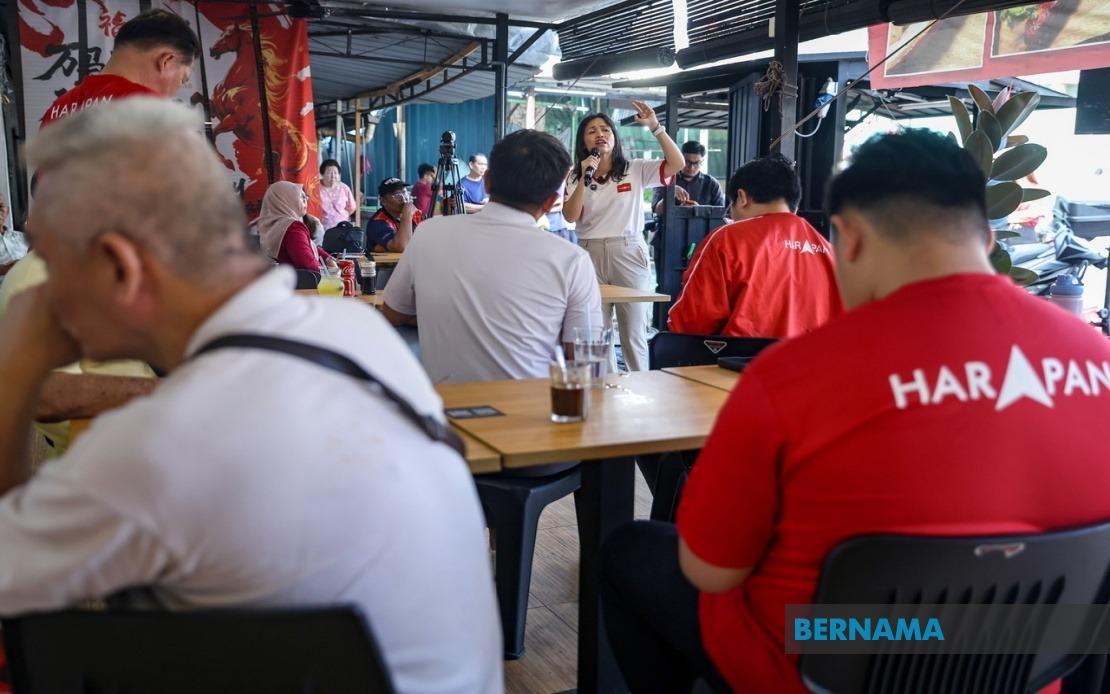
The Johor state election campaign has become entangled in fresh controversy over the alleged politicisation of a government-sponsored vocational training event. Johor DAP chairman Teo Nie Ching has called on Menteri Besar Datuk Onn Hafiz Ghazi to provide a public explanation regarding claims that Technical and Vocational Education and Training (TVET) students were pressured to attend a programme that subsequently became a platform for canvassing support for the Barisan Nasional (BN) candidate.
The dispute centres on the Johor MARA TVET Roadshow held at the Inland Revenue Board (LHDN) Hall in Kluang on July 4. According to complaints received by the DAP, students and their parents were instructed that participation in the event was mandatory, with warnings that non-attendance would be recorded as absenteeism. The allegation raises fundamental questions about the blurring of lines between legitimate government activities and partisan political campaigning during the election period.
Teo, who also serves as Deputy Communications Minister, articulated the core concern facing the opposition during this contentious state election. While she acknowledged that Onn Hafiz's presence at a government function is unremarkable in itself, she contested the manner in which the platform was allegedly exploited. According to her account, the Menteri Besar reportedly used the occasion to directly encourage students to support the BN candidate, even openly referencing the candidate's election number. This conduct, she argued, fundamentally violated the principle that official government programmes should remain politically neutral, particularly when attendance is made compulsory for school-age participants.
The DAP politician framed the controversy not merely as a procedural violation but as a matter of principle affecting young Malaysians. She pointedly asked whether such conduct was appropriate, positioning the issue as one a parent would naturally find troubling. This rhetorical approach proved effective in widening the discourse beyond technical election rules to encompass broader concerns about institutional integrity and the protection of youth from political pressure.
Teo further noted that the party possessed documentary evidence supporting the allegations, including the official programme schedule, written communications mandating attendance, and video recordings purporting to show the contested remarks. The availability of such materials strengthens the factual foundation of the complaint and suggests the DAP intends to pursue the matter systematically rather than through casual political rhetoric.
The question of venue ownership adds another dimension to the controversy. Teo specifically challenged whether a hall belonging to a government agency could legitimately be utilised for political campaigning, even if such campaigning was technically classified as part of an official government programme. This raises important governance questions about the proper use of state resources and public facilities during election periods, issues that are increasingly relevant across Southeast Asian democracies wrestling with institutional independence during electoral campaigns.
Pakatan Harapan (PH) has indicated it will consider formal intervention through the Election Commission (EC), with the decision delegated to individual constituency candidates. This procedural approach suggests the opposition is building a careful legal and institutional record rather than relying solely on public accusations. Such measured tactics could prove significant if electoral disputes require formal adjudication in the coming weeks.
The controversy also intersects with broader political messaging within the Johor campaign. Teo used the occasion to challenge Onn Hafiz's recent criticism of federal government policies, which the Menteri Besar had characterised as burdensome to ordinary Malaysians. She countered that the state government conveniently claims credit for popular policies while deflecting blame for unpopular measures onto federal leadership, the DAP, or PKR, despite the Cabinet's role in approving major national policies. This pattern reflects the increasingly fractious relationship between federal and state governance in Malaysia, where coalition partners frequently engage in blame-shifting.
Tan Sri Lim Kit Siang, the veteran DAP leader, used the same gathering to articulate a broader political vision. He called on Johor voters to transcend what he characterised as divisive racial politics and instead rally behind what he termed the Malaysian Dream, grounded in principles of equality, freedom, prosperity, and respect for human rights. His intervention suggests the opposition views this state election as consequential not merely for Johor's immediate governance but for Malaysia's longer-term trajectory toward a more inclusive political culture.
Lim emphasised that constructing a genuinely united Malaysia is a gradual undertaking requiring sustained commitment rather than merely fragmented electoral support. He urged voters to consolidate their backing for a coherent political alternative rather than dispersing their votes, an implicit acknowledgment that vote-splitting remains a critical tactical challenge for PH in maintaining competitive momentum across the 56 contested seats.
The Johor state election involves 172 candidates competing for representation across the 56 available constituencies. With early voting commencing on July 7 and main polling scheduled for July 11, the campaign period is compressed, intensifying both the significance of controversies like the TVET incident and the pressure on opposition parties to mobilise support efficiently. The allegations of improper use of government facilities during this critical phase underscore the heightened stakes as both coalitions seek to secure control of a strategically important state.
For Malaysian observers, this controversy illuminates persistent tensions between institutional neutrality and partisan advantage during elections. Whether through the mandatory attendance of students at facilities later used for political purposes or through the deployment of government platforms for campaigning, the episode reflects challenges that Malaysian electoral institutions and regulators continue to grapple with. The manner in which relevant authorities—particularly the Election Commission—address such allegations during the compressed campaign window will carry implications for how future state and national elections are conducted and perceived.

