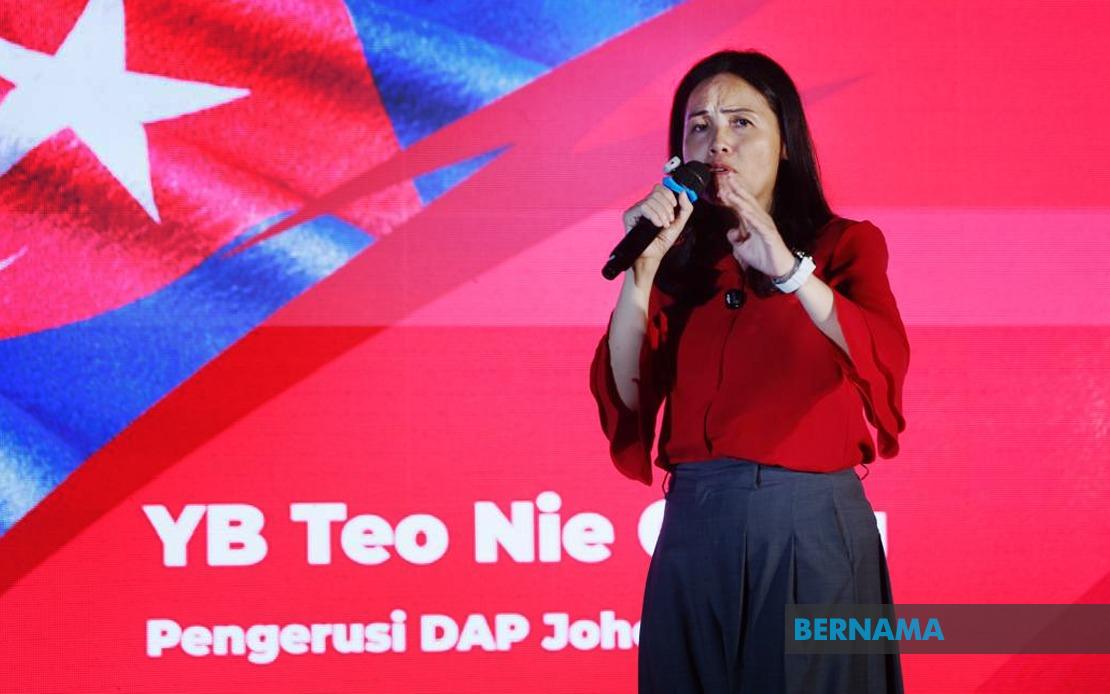
Democratic accountability took centre stage in Johor's election campaign on Tuesday when DAP chairman Teo Nie Ching challenged the state government's controversial decision to allow the appointment of assemblymen without voter participation. Speaking at a Pakatan Harapan rally in Paloh, Teo expressed alarm that the mechanism bypasses electoral scrutiny and risks eroding public confidence in Malaysia's democratic institutions at a critical moment for the nation's political trajectory.
The Johor State Legislative Assembly approved amendments in May permitting the appointment of up to five assemblymen, framed by authorities as a measure to strengthen the assembly's composition and operational capacity. However, Teo's criticism cuts to a fundamental tension within Malaysia's political system: the balance between effective governance and genuine representative democracy. Her pointed questioning of who would receive these appointments—particularly given substantial PAS support in the election—reflects broader anxieties within the opposition about power consolidation in state politics.
Teo, who also holds the position of National DAP Wanita chairman and Deputy Communications Minister, grounded her objections in democratic principle rather than partisan calculation. She contended that appointed officials cannot claim legitimacy conferred by voters at the ballot box, a foundational premise of democratic governance. This absence of electoral validation creates structural accountability gaps that undermine transparency in administration and public trust in government institutions.
The mechanics of appointment become especially contentious in Johor's political landscape, where coalition dynamics have shifted substantially. Teo's implicit reference to PAS's electoral support hinted at deeper concerns about which coalition partners might benefit from unelected seats. In Malaysian state politics, appointed positions frequently serve as mechanisms to shore up ruling coalitions without subjecting them to democratic verdict—a pattern that has bred cynicism toward institutional reforms.
Despite these criticisms, Teo pivoted to defending the Unity Government's broader governance record, framing the current administration as imperfect but genuinely committed to systemic improvement. She acknowledged that the MADANI Government cannot claim perfection, a candid admission that distinguishes her argument from simplistic partisan cheerleading. Instead, she emphasised incremental, institutionalised reforms that she contends will benefit future generations.
Education policy emerged as a centerpiece of her defence. The guarantee of matriculation placement for all SPM students achieving 10A grades, regardless of socioeconomic background, represents a significant equalisation measure. Equally notable is expanded access to tertiary programmes for Unified Examination Certificate holders, a policy with particular resonance for Malaysian Chinese communities navigating educational pathways. These changes address structural inequalities in Malaysia's education system.
Financial allocations to Chinese independent schools underwent marked expansion under the current administration. Teo highlighted the increase from RM12 million in 2019 to RM20.16 million in the current budget year, a 68 per cent rise reflecting renewed commitment to vernacular education. For communities that have historically experienced resource constraints relative to vernacular schools in other states, this reallocation carries symbolic and practical significance.
Teo framed these achievements within a larger narrative about democratic accountability operating across extended timeframes. Her assertion that democracy constitutes a long-distance endeavour rather than a sprint acknowledged the frustrations of voters seeking rapid change, whilst counselling patience with systemic processes. This framing becomes crucial as Malaysians consider voting patterns in a 2026 general election context.
The Johor state election unfolding Saturday presents 2.7 million voters with choices extending beyond immediate governance performance to competing visions of democratic legitimacy and institutional reform. With 56 state representative seats at stake, the election will determine not merely coalition control of Johor but broader momentum for either deepening or constraining mechanisms like appointed assemblymen.
Teo's intervention highlights fault lines within Malaysian politics between efficiency-oriented governance models and participation-centred democratic approaches. Her defence of Unity Government achievements whilst simultaneously challenging appointed assemblymen positions indicates that reformist coalitions themselves contain tensions about institutional design and accountability mechanisms. These tensions will likely persist regardless of Saturday's outcome.
The context of appointed assemblyman positions extends beyond Johor. Other Malaysian states have implemented or considered similar mechanisms, raising questions about whether efficiency imperatives increasingly override orthodox democratic procedures. Teo's public questioning signals that coalition partners retain capacity to contest governance choices within the ruling arrangement.
With Malaysian voters increasingly scrutinising both performance and institutional legitimacy, Saturday's election in Johor will test whether voters prioritise delivery of material benefits or insist upon preserving democratic procedures as non-negotiable. Teo's dual strategy—challenging institutional innovations whilst defending policy outcomes—maps the contested terrain Malaysian politics now occupies.

