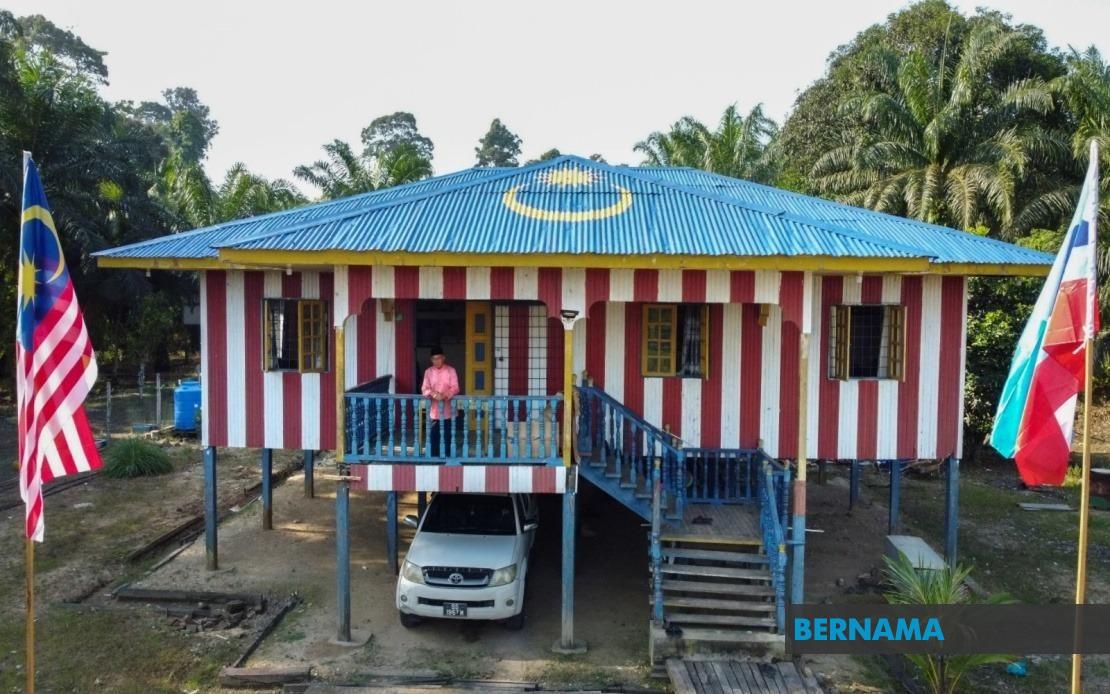
In the Batu 15 neighbourhood of Sandakan, a wooden residence has evolved into an unmistakable declaration of national devotion, its walls bearing the unmistakable crimson and white of Malaysia's flag alongside the celestial symbols that define the nation's identity. The home, christened Teratak Gemilang by its owner, 68-year-old entrepreneur Mohd Halikin Angga, represents far more than an unconventional architectural statement. It embodies a deeply personal interpretation of what it means to cherish one's country, expressed through paint, carefully curated memorabilia, and an unwavering commitment to keeping the spirit of patriotism alive within his community.
Mohd Halikin's vision for transforming his residence into a permanent expression of national pride took root in 2004, emerging from a poignant emotional reaction to the fate of flags following Independence Day festivities. Observing discarded national flags littering roadsides or tumbling from vehicles struck a chord with the entrepreneur, compelling him to create something lasting and respectful. Rather than witness the Jalur Gemilang relegated to temporary display, he resolved to enshrine its imagery within his own walls, fashioning a structure that would perpetually honour Malaysia's sovereignty and the sacrifices that secured it.
The genesis of this unconventional project also drew inspiration from familial reverence. Mohd Halikin's parents had navigated the complexities of the colonial period, witnessing Malaysia's transformation from administered territory to independent nation. Their lived experiences during those formative decades instilled within him a profound appreciation for the freedoms and progress the nation had achieved. By converting his dwelling into Teratak Gemilang, he channelled this gratitude into a tangible tribute that would serve as a daily reminder of his parents' generation's resilience and his own commitment to preserving their legacy.
Architecturally, the house commands attention through its deliberate design choices. The roof features a striking deep blue backdrop crowned with a golden-yellow crescent moon and 14-pointed star, mirroring the symbolism of the national emblem. Bold red and white striping adorns the walls, while multiple Jalur Gemilang banners flutter around the compound's perimeter. This chromatic intensity transforms the ordinary residential structure into a visual manifesto, impossible to overlook whether one passes by during National Month celebrations or on any ordinary day. The consistency of this display underscores Mohd Halikin's conviction that patriotism should not remain confined to designated commemorative periods.
Beyond its exterior presentation, Teratak Gemilang functions as an informal historical repository and cultural space. Upon entering, visitors encounter a modest gallery honouring Malaysia's political leadership across successive eras. The living room walls display portraits of the Yang di-Pertuan Agong, the Yang di-Pertua Negeri Sabah, and every prime minister from the nation's founding figure Tunku Abdul Rahman Putra Al-Haj through to the present office holder. This curation reflects Mohd Halikin's belief that such figures merit remembrance and reflection, serving as touchstones for contemplating the nation's political journey and the individuals who have steered its course.
Among his most treasured possessions rests a historically significant photograph capturing Tunku Abdul Rahman convening with twenty North Borneo leaders in 1961 to deliberate over Malaysia's formation. The photograph's acquisition itself speaks to Mohd Halikin's dedication to his mission. Having discovered it within a newspaper while en route to perform Umrah in 2005, he persuaded the cabin crew to permit him to preserve and subsequently frame this historical documentation. Such meticulous attention to securing and displaying materials connected to Malaysia's formative moments distinguishes Teratak Gemilang from a mere coloured dwelling, elevating it to the status of a personal archive celebrating national consciousness.
Mohd Halikin's patriotic conviction extends intimately into his personal life through his naming choices for his seven children. Three of his offspring bear names honouring prominent national figures and statesmen. His eldest child received the name of former Prime Minister Tun Dr Mahathir Mohamad, while his second child carries the name of former Prime Minister Tun Abdullah Ahmad Badawi. His sixth child, Nur Zahirah, was named in tribute to the 13th Raja Permaisuri Agong. Rather than regarding nomenclature as a mere practical necessity, Mohd Halikin conceives names as vessels of aspiration, vehicles through which subsequent generations might maintain connection with the legacies of those who shaped Malaysia's development.
Over more than two decades, Teratak Gemilang has evolved into a destination that draws photographers and curious visitors throughout the year, particularly during the National Month when Malaysian patriotic sentiment reaches its zenith. Motorists and pedestrians frequently pause to capture images, inadvertently spreading awareness of Mohd Halikin's personal mission through social networks and word-of-mouth. This organic circulation of his home's image has transformed what began as an individual expression into a collective talking point, prompting broader conversations about the manifestations of national pride and the various ways citizens choose to honour their country.
Mohd Halikin has made an unambiguous commitment to maintaining Teratak Gemilang's painted appearance in perpetuity. He views the preservation of the house's patriotic aesthetic not as a temporary gesture but as a lifelong undertaking, a permanent fixture within his community that will continue broadcasting his unwavering affection for Malaysia. This steadfastness reflects a philosophy that love for one's nation should transcend ceremonial occasions, permeating the ordinary rhythms of daily life and finding expression in the spaces one inhabits.
Looking toward future occasions for national celebration, Mohd Halikin harbours ambitious aspirations for Teratak Gemilang's role in strengthening social cohesion. He envisions his home functioning as a catalyst for unity among Sabah's ethnically diverse populace, particularly during the forthcoming Malaysia Day and National Day observances scheduled for 2026. Rather than serving purely as a personal monument, Teratak Gemilang represents his belief that individual expressions of patriotism, when undertaken with genuine conviction and offered openly to the community, can resonate across cultural boundaries and reinforce the multicultural foundations upon which Malaysia's stability rests. In this conception, his painted walls become more than decoration; they transform into an invitation for others to contemplate what national belonging signifies within a demographically heterogeneous society.

