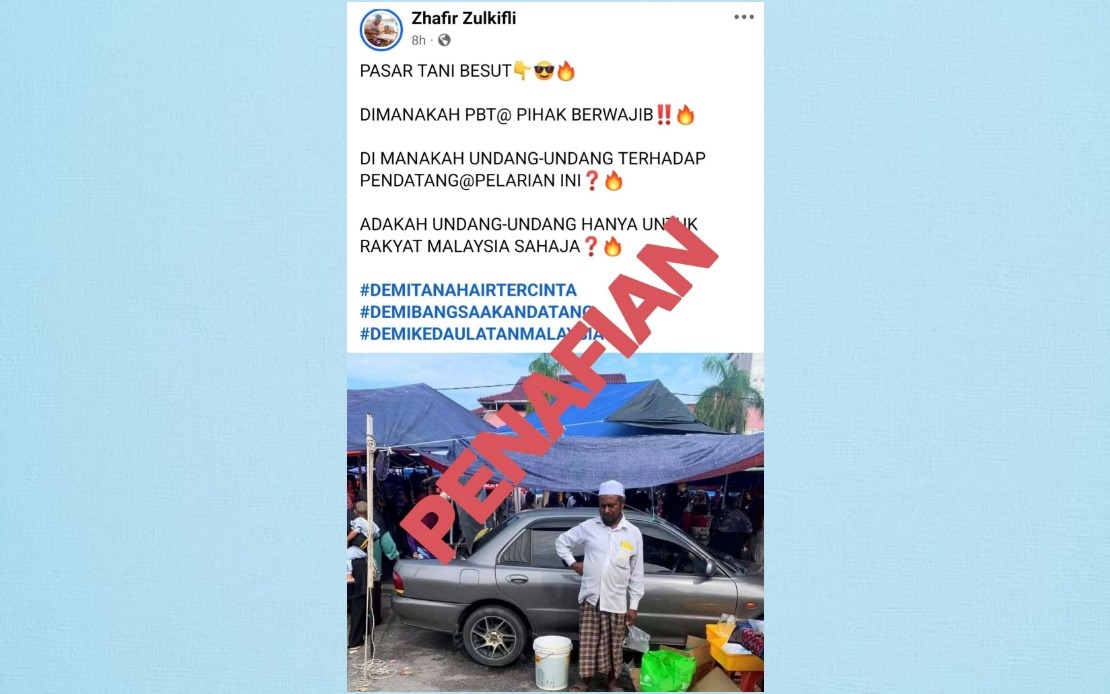
The Terengganu Federal Agricultural Marketing Authority (FAMA) has moved to dispel allegations that circulated widely on social media suggesting non-Malaysian traders were being permitted to operate at farmers' markets under its administration. The authority issued a formal statement denying any involvement in the controversial incident that sparked public discussion online, clarifying instead that the episode in question took place at an entirely separate venue outside its operational sphere.
According to FAMA's clarification, the viral post showing a man believed to be a foreign national vending vegetables originated from Kuala Besut Morning Market, which operates independently and falls outside the agency's direct supervision. This distinction proves crucial, as it underscores the territorial boundaries between different market operators and regulatory bodies in Terengganu, a nuance that was absent from the initial social media narrative that prompted widespread concern among local traders and residents.
FAMA's portfolio in the Besut district is limited to two specific venues operating on fixed schedules designed to ensure proper management and food security oversight. Jerteh Farmers' Market functions every Thursday morning from 7 am until 1 pm, while Alor Lintang Farmers' Market operates on Saturday mornings during the same hours. Both establishments maintain standardised operating procedures and vendor screening mechanisms that the authority asserts comply with national trading regulations and citizenship requirements.
The viral social media incident highlights the growing tension surrounding informal market operations across Malaysia's east coast regions. With farmers' markets becoming increasingly popular as platforms for direct producer-to-consumer sales, questions about vendor verification procedures and regulatory oversight have gained prominence among stakeholders concerned about fair competition and the protection of local livelihoods. In Terengganu, where agricultural produce sales represent a significant economic component, such allegations can rapidly generate friction within trader communities and among consumers conscious of supporting domestic commerce.
FAMA's swift public response reflects institutional awareness of how unsubstantiated claims can damage market confidence and breed mistrust between authorities and participating vendors. By explicitly separating the implicated Kuala Besut Morning Market from its officially managed facilities, the authority attempts to contain reputational damage while establishing clear accountability lines. This approach suggests that multiple market operators in Besut may answer to different administrative bodies, each responsible for enforcing their own compliance standards regarding trader eligibility and documentation.
The distinction between farmers' markets and conventional morning markets represents an important categorisation in Malaysia's agricultural retail landscape. Farmers' markets typically emphasise direct sales by agricultural producers, often featuring stricter vendor vetting procedures and premium positioning as quality-assured outlets. Morning markets, by contrast, traditionally accommodate broader trader demographics and may lack the formalised registration requirements characteristic of purpose-built agricultural facilities. This structural difference may explain why concerns about unauthorised foreign participation proved more plausible to social media audiences than FAMA's subsequent clarification.
For Malaysian farmers and legitimate small traders operating within regulated markets, allegations of uncontrolled foreign competition strike at fundamental economic security concerns. Competition from vendors without proper documentation or business registration rights represents not merely a regulatory violation but a threat to fair market conditions. FAMA's statement implicitly acknowledges this underlying anxiety by emphasising its institutional commitment to maintaining market standards through proper administration, even while redirecting responsibility for the specific incident elsewhere.
The incident demonstrates how social media's amplification dynamics can obscure jurisdictional realities and blur distinctions between separately managed commercial spaces. A single image, devoid of location context or market identification details, can generate broad allegations affecting multiple operators and undermining public confidence in regulatory systems. FAMA's response strategy—providing specific operational details and clear delineation of its authority boundaries—represents standard institutional crisis communication while highlighting the challenges facing agricultural authorities managing public perception across decentralised market networks.
Looking forward, the episode suggests value in enhanced public communication by market operators regarding vendor verification procedures and citizenship requirements. Greater transparency about how traders gain market access, what documentation they must provide, and how authorities verify compliance could help preempt similar allegations. For Malaysian readers concerned about supporting local agricultural sectors, understanding these administrative frameworks supports informed choices about where to purchase produce and which markets maintain robust oversight systems.
Terengganu's agricultural marketing infrastructure continues developing as the state positions itself within Malaysia's modernising food systems. FAMA's role extends beyond responding to individual incidents toward broader market professionalisation and regulatory credibility. The Kuala Besut situation, while potentially isolated, underscores the importance of consistent enforcement across all market types operating within the state, regardless of administrative designation or supervisory jurisdiction.

