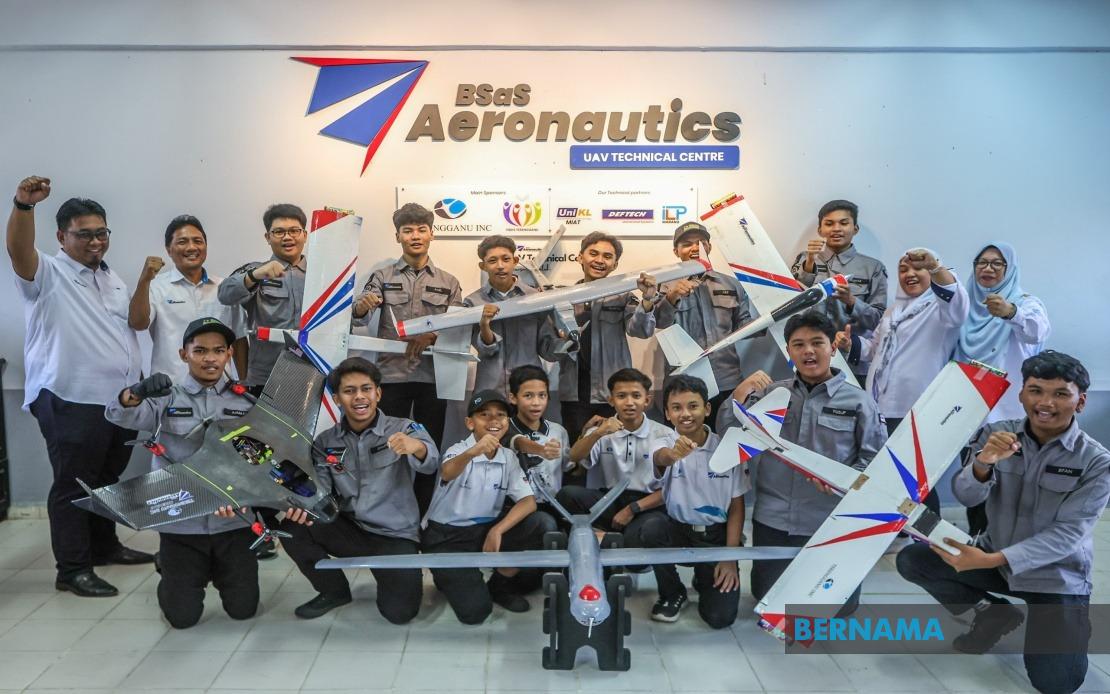
A groundbreaking educational venture at SMK Bukit Sawa in Terengganu's Marang district demonstrates how local schools can cultivate expertise in advanced aerospace technology. The initiative has empowered 35 secondary students to design and construct their own unmanned aerial vehicles using the same industrial-grade techniques and materials employed by professional engineers, proving that cutting-edge technological training need not be confined to university laboratories or private institutions.
Launched in 2023, the TI-BSAS UAV In School programme emerged from a collaborative vision between educators, state authorities, and the private sector. Badrul Hisyam Zakaria, an English teacher who coordinates the initiative, recognised an opportunity to channel his interest in remote-controlled aircraft into structured pedagogical outcomes. Working alongside two colleague teachers, he has guided students through the complete lifecycle of unmanned aerial vehicle development, overseeing the construction of more than five fully operational units. Each aircraft represents a substantial investment, with individual units valued between RM6,000 and RM10,000, highlighting the seriousness and technical sophistication of the undertaking.
The programme's evolution reflects Malaysia's growing capacity in aerospace innovation. Initial models utilise Global Positioning System technology for autonomous target detection and tracking, operating according to pre-programmed flight paths and coordinates. However, the programme is advancing beyond these foundations. Students now work on next-generation systems incorporating artificial intelligence capabilities, enabling aircraft to visually identify and monitor targets in real-time. This progression from GPS-dependent navigation to AI-enhanced perception mirrors broader global trends in autonomous systems development and positions participating students at the frontier of contemporary aerospace engineering practice.
Corporate commitment has proven essential to the programme's viability and sustainability. Terengganu Incorporated, a state-linked enterprise, has channelled RM75,000 through its corporate social responsibility framework since the initiative's inception. The funding deployment reveals strategic thinking about resource allocation: RM45,000 supported the launch phase in 2023, while an additional RM30,000 commitment in 2026 ensures continuity and capability expansion. This multi-year funding approach contrasts sharply with episodic sponsorship models, suggesting recognition that meaningful technological skill development requires sustained institutional support rather than one-off grants.
The programme demonstrates particular attentiveness to socioeconomic equity considerations. Terengganu Incorporated's leadership explicitly framed the initiative as targeted assistance for students from the B40 household income category, addressing the reality that hands-on technical training in emerging fields often remains inaccessible to economically disadvantaged cohorts. By embedding advanced aerospace education within the public secondary school system rather than restricting it to fee-paying institutions or urban centres, the programme broadens the talent pipeline from which Malaysia's future aerospace workforce might be recruited.
Tangible achievements validate the investment and pedagogical approach. Most notably, SMK Bukit Sawa secured top honours in the UAV Avionics Integration Challenge for secondary schools during the MyAERO Challenge 2026 competition held at MAEPS Serdang in Selangor last June. This recognition from a national-level competition indicates that student work meets genuinely competitive technical standards. Beyond immediate accolades, the initiative's longer-term human development impact proves equally significant. Two former participants currently pursue aircraft engineering degrees at Universiti Kuala Lumpur, whilst three additional alumni have advanced to science-stream matriculation programmes. These trajectories suggest the programme successfully catalyses career pathway progression in technical fields.
The strategic vision underlying the TI-BSAS initiative extends beyond individual student outcomes. Badrul Hisyam articulated an explicitly developmental timeframe, anticipating that within three to four years, early participants will complete aviation-focused tertiary qualifications and potentially enter Malaysia's aerospace industry. This patient, long-term perspective reflects understanding that educational interventions bear fruit gradually. Rather than claiming immediate employment outcomes, programme leadership acknowledges the extended pipeline between secondary exposure, university training, and industry entry, yet maintains confidence that the foundation-building currently underway will yield qualified professionals.
National self-sufficiency considerations animate the programme's rationale. Malaysia presently relies substantially on imported unmanned aerial vehicle technology and expertise from established international manufacturers and engineering firms. The TI-BSAS initiative directly addresses this dependency by cultivating domestic capacity for original UAV design and development. By training cohorts of secondary students in indigenous aerospace innovation, the programme contributes incrementally but meaningfully to Malaysia's technological sovereignty and reduces long-term reliance on foreign suppliers for capability in this strategically significant domain.
The geographic location of the initiative within Terengganu holds particular relevance. Marang, a district with significant marine and agricultural dimensions, represents a region where unmanned aerial vehicle applications could address genuine practical needs in environmental monitoring, fisheries management, and precision agriculture. Students exposed to these technologies whilst grounded in their home district may increasingly recognise local applications and deployment opportunities, potentially catalysing future entrepreneurship or career development rooted in regional problem-solving rather than abstract technical curiosity.
Industry-education partnerships of this character remain relatively uncommon within Malaysia's secondary sector, making the SMK Bukit Sawa model noteworthy for replication. The collaboration addresses acknowledged skills gaps in emerging technological domains whilst maintaining public education accessibility. For Malaysian policymakers and educational authorities considering how to position the country competitively within global aerospace and advanced manufacturing sectors, the Terengganu initiative offers practical evidence that secondary institutions, when properly resourced and supported, can function as genuine incubators of technological capability rather than serving merely as credential-granting institutions.
The trajectory from secondary student projects to university-level specialisation and eventual industry participation represents precisely the talent pipeline Malaysia requires to develop indigenous aerospace expertise. As students progress through the TI-BSAS programme and transition into tertiary education, their foundational practical knowledge positions them distinctively compared to peers encountering unmanned systems only at university level. This experiential head start potentially accelerates their professional development and enhances their capacity to contribute meaningfully to Malaysia's evolving aerospace sector.

