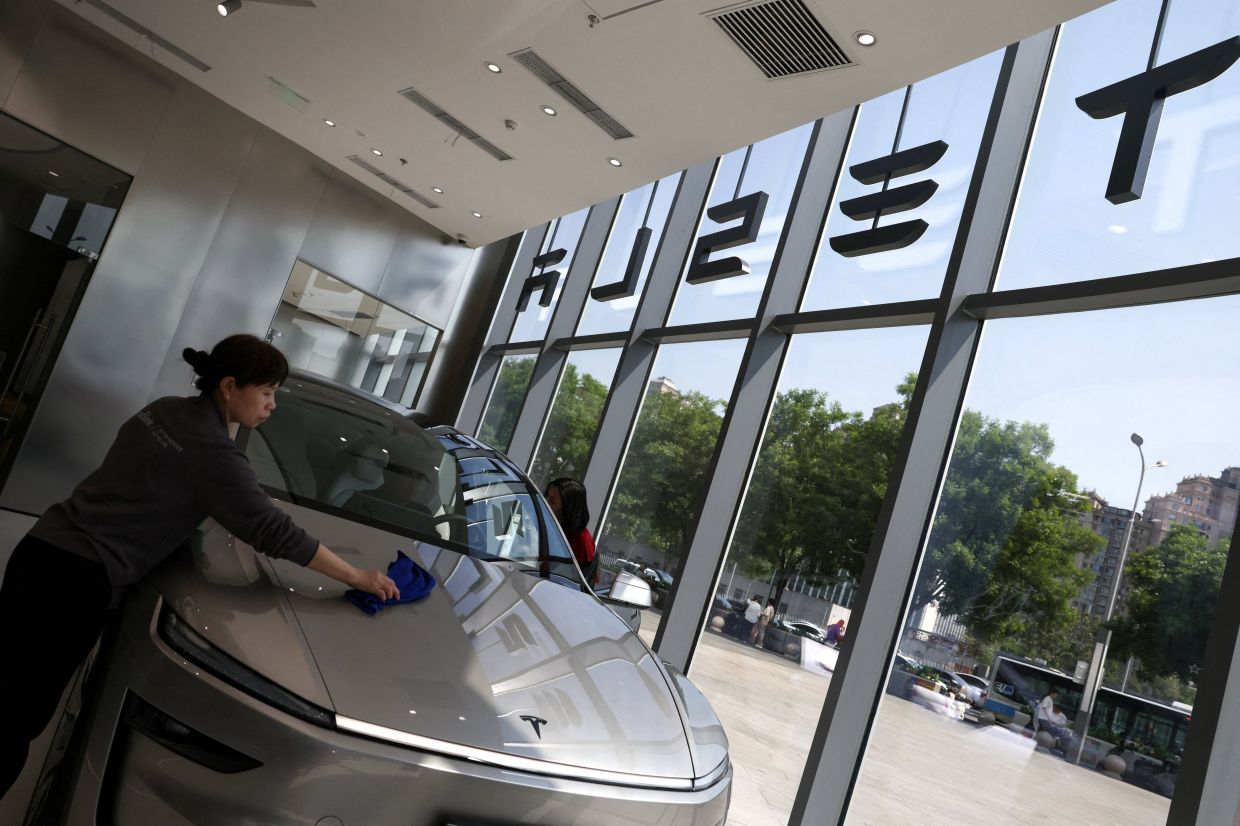
Tesla has announced the largest product recall in mainland China's electric vehicle market, with Elon Musk's company pledging to address a door-handle defect affecting approximately 2.98 million vehicles. The unprecedented scale of the recall underscores mounting pressure from Chinese regulators and consumers determined to strengthen automotive safety standards across the sector—a shift with ripple effects for manufacturers throughout Southeast Asia.
The catalyst for this regulatory crackdown traces back to a tragic incident in October in Sichuan province, where a Xiaomi SU7 Ultra caught fire and a 31-year-old driver perished. Eyewitnesses attempting to rescue the occupant found themselves unable to open the vehicle's doors, a scenario that exposed a critical vulnerability in cars equipped with retractable door handles. The incident crystallized public concern and prompted Chinese authorities to treat the issue as a systemic safety failure rather than an isolated mishap.
In February, China's Ministry of Industry and Information Technology announced formal plans to ban retractable door handles entirely. Beginning next year, all vehicles sold in the Chinese market must feature both internal and external door handles capable of mechanical operation under all circumstances—including accidents and power failures. This mandate represents one of the most stringent door-safety requirements globally and establishes a regulatory floor that manufacturers cannot circumvent. While Tesla is not alone in the affected pool, it bears the largest burden with its 2.98 million-vehicle recall dwarfing competitors' responses.
Tesla's remediation strategy involves multiple components rolled out sequentially. From September 25, the company will add warning labels to internal door handles across recalled vehicles, a straightforward but symbolic first step. More substantially, Tesla will deploy over-the-air software updates to modify window-control systems, automatically lowering vehicle windows following collision detection. This design workaround addresses the immediate crisis but represents a Band-Aid solution rather than fundamental hardware redesign—a reality that suggests Tesla may face additional compliance measures as regulations tighten.
Parallel to the door-handle recall, Tesla is simultaneously addressing a separate issue affecting 2.74 million Model 3 and Model Y vehicles assembled at its Shanghai facility. These vehicles require OTA updates to ensure advanced driver-assistance functions remain engaged when drivers fail to respond appropriately during emergency situations. The dual recall illustrates how retractable door handles and autonomous safety systems are becoming inseparable concerns in regulatory frameworks.
Shanghai's role as Tesla's manufacturing hub amplifies the significance of these recalls. In 2025, the facility produced approximately 851,000 vehicles destined for both domestic Chinese consumption and export markets, representing more than half of Tesla's global output. This concentration of production in a single location means that regulatory changes in China immediately cascade across Tesla's international supply chains and customer bases throughout Asia and beyond.
Industry observers in China frame the recall phenomenon as a necessary correction. Zhang Wenjie, who operates a car maintenance workshop in Shanghai, characterizes the door problem as a consequence of lax safety consciousness that emerged during the rapid expansion of the EV sector. According to maintenance professionals working in major Chinese cities, the expectation is that large-scale recalls by Tesla and domestic manufacturers will collectively elevate industry-wide attention to product design and quality control. Rather than viewing recalls as commercial disasters, some analysts see them as painful but productive mechanisms for standardizing safety practices.
The regulatory environment in China is hardening precisely because the country has become the world's largest EV market, giving authorities both the incentive and leverage to enforce stringent safety standards. Chinese regulators can credibly threaten market exclusion, which compels manufacturers to comply immediately. This contrasts sharply with fragmented Southeast Asian markets where regulatory coordination remains weak, suggesting that safety standards achieved in China will eventually diffuse across the region as multinational manufacturers harmonize specifications.
For Malaysian and Southeast Asian automotive markets, China's regulatory moves carry direct implications. Many vehicles sold in this region are either manufactured in Chinese plants, engineered to Chinese specifications, or destined for eventual export to China after domestic sales cycles. As Chinese regulators impose mechanical door-opening requirements, OTA software safeguards, and collision-response protocols, manufacturers will find it economically rational to apply these standards uniformly across all markets rather than maintaining multiple specifications. This de facto harmonization may accelerate safety improvements in less-regulated markets without requiring formal regulatory action.
Tesla's position as the recall leader reflects both its significant market share in China and the inherent vulnerabilities of retractable door handles in its current vehicle lineup. The company's Shanghai factory churned out vehicles that collectively represented more than half of global Tesla production last year, despite a company-wide output decline of 8.6 percent to 1.63 million units annually. This dependence on Chinese manufacturing and the Chinese market—Tesla's second-largest globally after the United States—means that regulatory compliance becomes non-negotiable regardless of cost implications.
Looking ahead, the door-handle mandate represents a watershed moment for EV design philosophy. Manufacturers must now engineer vehicles where mechanical redundancy trumps sleek aesthetics, where safety systems function during power loss, and where emergency access cannot be compromised by software failures. For a region like Southeast Asia, where EV adoption is accelerating but regulatory frameworks remain underdeveloped, observing how China's mandates reshape the automotive industry provides a template for appropriate safety governance.
The broader significance extends beyond individual recalls. China's assertion of regulatory authority over vehicle design standards signals that the world's largest EV market will not defer to manufacturers' safety assessments. This shift from permissive to prescriptive regulation will pressure the entire automotive supply chain—from component suppliers to assembly facilities across Southeast Asia—to upgrade their safety protocols proactively. Companies that anticipate these regulatory currents gain competitive advantage, while those that resist face recalls, market suspension, and reputational damage.
Tesla's handling of this crisis, though costly, demonstrates that even dominant manufacturers must adapt swiftly when regulators establish bright-line safety requirements. For consumers across the region, the precedent offers reassurance that mass-market vehicles will increasingly incorporate redundant safety systems and that regulators possess tools to enforce accountability. The question facing Southeast Asian policymakers is whether they will emulate China's assertive approach or continue allowing manufacturers to set their own safety standards.

