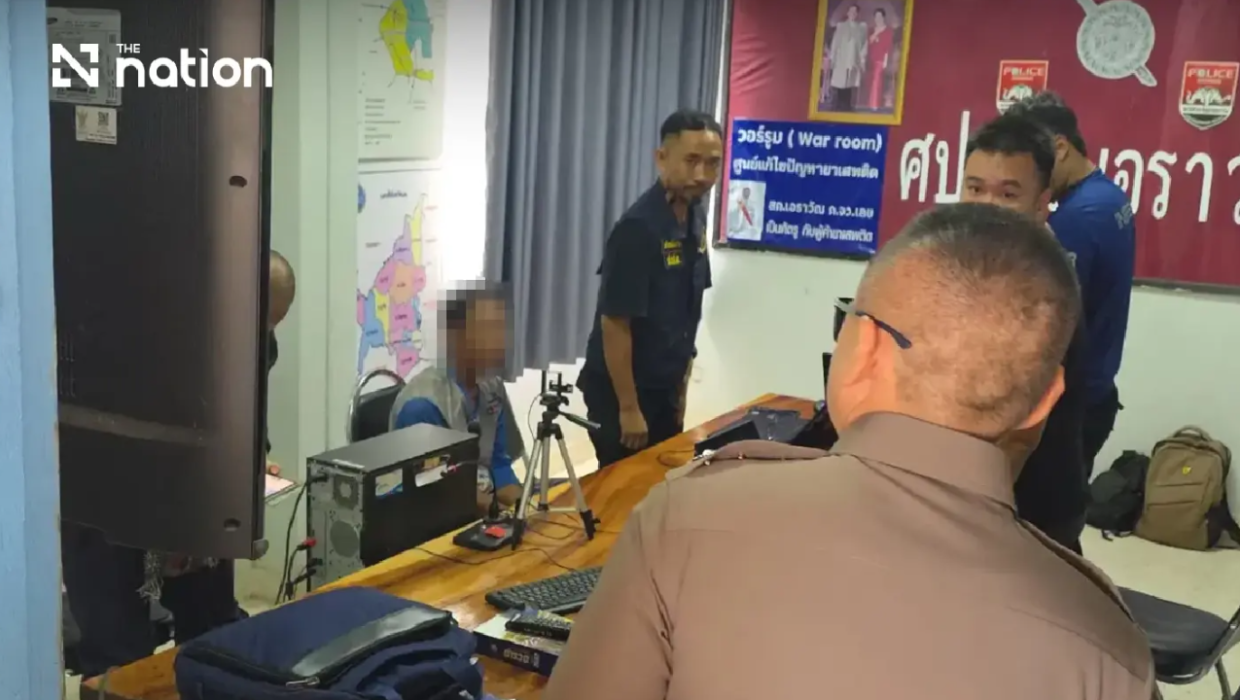
A husband-and-wife team has been taken into custody by Thai police investigators in Loei province as authorities expand their probe into what officials characterise as an international drug trafficking operation. The arrests follow the detention of a Thai Airways flight attendant identified as Mina at Melbourne Airport, where Australian authorities discovered approximately one kilogram of heroin concealed in her luggage. The discovery prompted Thai narcotics officials to launch a broader investigation into the network allegedly responsible for supplying the contraband.
The operation demonstrates the sophisticated methods employed by transnational smuggling rings that exploit commercial airline networks and ordinary workers to move drugs across borders. By targeting airline personnel, such networks exploit the relative ease with which flight crew members can transport luggage internationally without raising suspicion. The heroin case represents precisely the kind of cross-border trafficking threat that has preoccupied regional law-enforcement agencies for years, as drug syndicates continuously adapt their methods to circumvent customs and detection procedures.
Thursday's arrests in Chiang Khan district marked a significant breakthrough in connecting Thailand-based operatives to the Melbourne seizure. Officers from Chiang Khan Police Station, acting on intelligence about a pair allegedly linked to addresses in the district, initially visited a property in That subdistrict. When the suspects were not present, investigators learned they had been employed as rubber tappers, a common cover occupation in rural areas where cash payments and irregular schedules mask illicit side activities. The authorities, including personnel from the Office of the Narcotics Control Board, subsequently located Athit, 43, working on a temple roof in Wang Saphung district's Sri Songkhram subdistrict.
During preliminary questioning at Erawan Police Station, Athit allegedly confessed to receiving payment for dispatching parcels on six separate occasions. According to police records, he claimed to have been compensated with 8,000 baht—approximately US$240—per delivery by an unidentified Lao national. His account suggests a hierarchical operation where local operatives at the bottom of the chain handle the logistics without necessarily understanding the full scope of the network. Three parcels were dispatched through a parcel service operating from Chiang Khan, with two originating from Ban That and another from Erawan district. The most recent consignment, according to investigators, was sent on June 28, 2026, though authorities have not confirmed whether this particular package reached its intended destination or formed part of the shipment intercepted in Australia.
Thatsaphon, 42, Athit's wife and a Lao national, was subsequently apprehended following the discovery of a black Mitsubishi Triton pickup truck registered in Loei parked at a rubber plantation in Erawan district. The vehicle's location suggested active involvement in coordinating movements between operational zones. When interrogated at Erawan Police Station, Thatsaphon denied any knowledge of or participation in the alleged smuggling activities. Her detention nonetheless indicates that authorities suspect broader household involvement, whether through knowledge, facilitation, or financial benefit from the suspected criminal enterprise.
The case exemplifies the compartmentalised structure typical of professional narcotics networks, where individual participants maintain limited awareness of the overall operation. By dispersing tasks across different individuals and locations, traffickers reduce the risk that a single arrest or investigation will unravel the entire supply chain. The Office of the Narcotics Control Board has signalled its intention to pursue questioning of both detainees to identify higher-level participants—those who ordered the shipments, provided financial backing, or coordinated cross-border logistics. Such upstream investigations often prove crucial in disrupting the decision-makers and financiers who orchestrate these operations.
According to the ONCB secretary-general, the investigation underscores how international drug networks exploit personnel at multiple operational tiers to move narcotics while minimising exposure to law enforcement. The statement reflects official recognition that airline staff, small-scale couriers, and local logistics operatives form a disposable outer layer of trafficking organisations, insulating core members from direct involvement in border crossings or custody of contraband. Successful dismantling of such networks requires investigative work that traces connections backward through the supply chain to identify and prosecute those directing operations.
Collaboration between Thai and Australian law-enforcement agencies proved instrumental in initially detecting the shipment and subsequently enabling Thai authorities to identify potential domestic operatives. Such bilateral cooperation represents a growing necessity in Southeast Asia, where drug trafficking has become increasingly internationalised. The ability of authorities in one country to notify and coordinate with counterparts in another country transforms isolated arrests into opportunities for broader network disruption. The Melbourne seizure has thus catalysed a multi-jurisdictional investigation that, if successful, could yield intelligence about export routes, financial mechanisms, and command structures serving the broader transnational network.
The ONCB has committed to intensifying its investigation and pursuing legal action against individuals implicated at every operational level. Beyond prosecuting street-level operatives, authorities signal determination to identify and prosecute those occupying supervisory and financial roles. The agency has additionally pledged enhanced cooperation with foreign law-enforcement bodies to intercept shipments, disrupt transportation corridors, and target financial flows supporting such networks. These commitments reflect the Thai government's stated drug-suppression policy, which aims to shift enforcement focus from low-level users and distributors to high-level traffickers and organisers.
For Southeast Asian readers, the case highlights the persistent vulnerability of regional borders and transportation infrastructure to exploitation by international drug syndicates. Thailand's geographic position as both a transit point and source country for narcotics makes it a focal point for trafficking operations targeting markets throughout Asia, Oceania, and beyond. The integration of Thai workers into international smuggling networks, whether knowingly or through coercion and economic desperation, reflects the region's broader challenges with organised crime, poverty, and limited economic opportunity in rural areas. The investigation outcome will provide valuable intelligence about how such networks operate and adapt, potentially informing strategies across regional law-enforcement agencies contending with similar threats.

