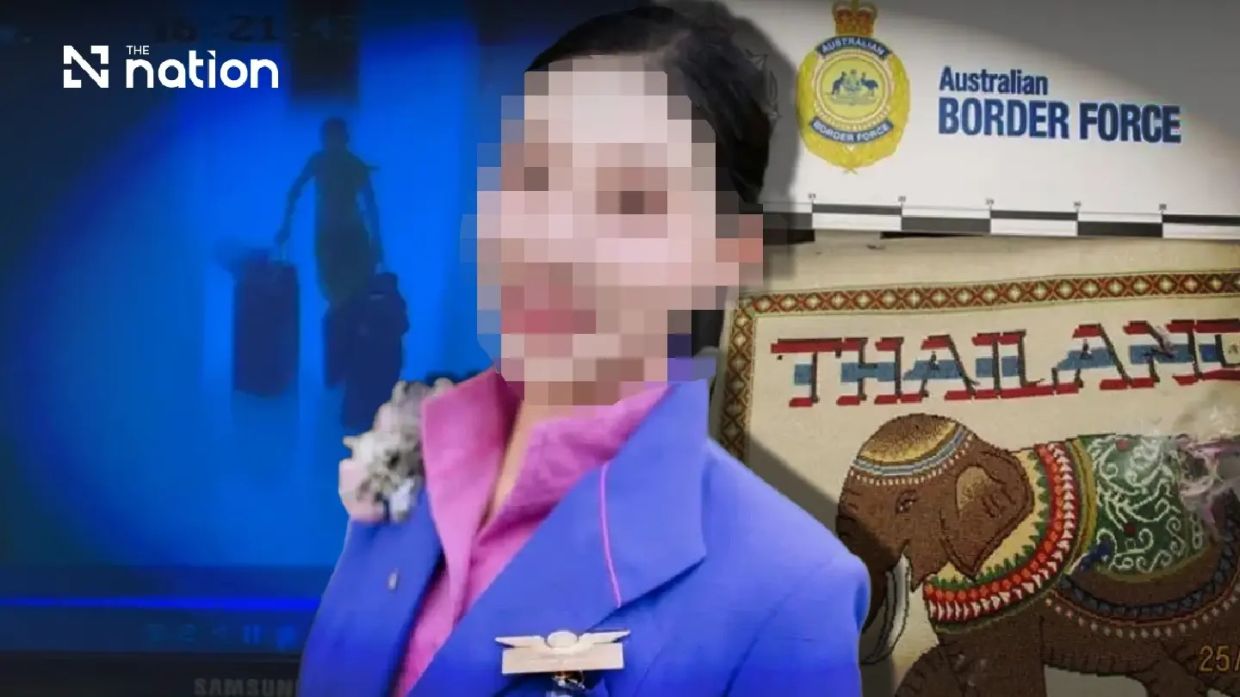
Thai narcotics authorities are expanding their probe into the case of a flight attendant apprehended at Melbourne Airport with 900 grammes of heroin, with investigators now pointing to a sprawling transnational criminal network that spans Thailand, Australia, and Laos. The Office of the Narcotics Control Board (ONCB) and allied security agencies have determined that the woman remains in detention rather than facing formal charges, while Thai officials coordinate with Australian police and the embassy to build her legal defence. The emerging picture suggests an elaborate smuggling operation orchestrated by crime syndicates operating in the Golden Triangle, the notorious drug-producing region straddling Thailand's northern border.
Deputy ONCB secretary-general Areepak Ngernbamroong outlined the investigation's scope during a briefing on Monday, July 6, revealing that the case has fractured into multiple jurisdictional territories requiring coordinated agency responses. The Department of Special Investigation has assumed primary responsibility after three to four individuals in Bangkok were arrested and over 26 kilogrammes of heroin seized, indicating the network operates as a large-scale international criminal enterprise rather than a simple smuggling incident. Evidence uncovered during the Bangkok arrests included delivery riders receiving packages from foreign nationals and involvement of a Lao couple, with investigators identifying two distinct distribution channels: parcel services and direct hand-to-hand transfers.
The modus operandi reveals a sophisticated social engineering operation targeting vulnerable couriers. Police Major General Theeradet Thumsuthee, deputy commissioner of the Metropolitan Police Bureau, disclosed that network operators create fake online profiles and dispatch messages en masse to flight attendants and frequent international travellers, proposing payments in exchange for transporting items across borders. This strategy exploits the occupational mobility of airline staff while creating plausible deniability through layered operational compartmentalisation. The scale and international character of these activities convinced Thai officials that the Department of Special Investigation rather than conventional narcotics divisions should lead the investigation.
Central to the Australian end of the operation is an individual identified as Dear, a Thai national with a decade-long residence in Australia whose citizenship status remains unclear to Thai authorities. Investigators have determined that Dear functioned as the intended recipient of the Melbourne shipment and appeared to play this role repeatedly in previous smuggling operations. Thai officials have accumulated multiple pieces of evidence connecting Dear to this network and transferred them to the Australian Federal Police (AFP), which will now pursue broader investigation into the final narcotics recipients and the broader Australian-based criminal structure. The AFP discovery of payment information on mobile phones provided the initial lead, though Thai investigators cannot yet reconcile conflicting accounts regarding compensation amounts.
The flight attendant's account to authorities, as relayed through her boyfriend's statement, portrays a woman potentially deceived about the contents of her cargo. According to investigators, she received a parcel containing elephant-patterned bags delivered by a courier, subsequently placed it in her suitcase only after opening and inspecting each bag and finding nothing suspicious. The suitcase passed through Thai airport X-ray screening without triggering alerts, suggesting heroin was inserted after the parcel left Thailand or that detection failures occurred. However, Areepak cautioned that authorities cannot yet definitively determine whether the flight attendant acted with knowledge of the contraband or was manipulated through incomplete information.
Payment discrepancies further muddy the legal picture. Australian police identified approximately 8,800 baht (US$264) based on mobile phone evidence, yet Thai investigators discovered conflicting reports of two separate 1,700-baht transfers supposedly made upon package receipt and when air tickets became available, totalling 3,400 baht. Critically, examination of the flight attendant's bank records revealed no such transactions, and her account balance remained minimal, complicating investigators' ability to confirm whether money actually changed hands or in what amounts. This evidentiary fog leaves prosecutors without clear proof of financial incentivisation, potentially supporting arguments that she was deceived regarding both the cargo's true nature and any compensation structure.
The delivery rider's testimony introduces further ambiguity regarding the flight attendant's involvement. The courier claimed he had executed similar deliveries three or four times previously but stated this represented his first time delivering parcels to this particular flight attendant. This account potentially supports contentions that she was specifically targeted rather than a repeat participant in smuggling operations, and that the rider himself may have been unaware of cargo contents beyond his immediate instructions. Areepak emphasised that these evidentiary strands require deeper forensic questioning before authorities can determine whether insufficient awareness constituted a valid legal defence.
The Golden Triangle connection illuminates the investigation's broader geographic and organisational dimensions. Areepak explained that the drug-producing regions located north of Thailand have traditionally supplied narcotics routed through northern Thai provinces, but intensified interdiction efforts have forced trafficking networks to adapt their transport corridors. Contemporary smuggling operations increasingly funnel drugs through north-eastern Thailand, exploiting the region's proximity to Laos and its porous Mekong River crossings. The river in provinces including Nakhon Phanom, Bueng Kan, Loei, and Nong Khai remains relatively narrow while stretching considerable distances, creating enforcement challenges that overwhelm personnel resources dedicated to continuous border monitoring.
The north-eastern rerouting demonstrates criminal networks' operational flexibility when confronted with enhanced security measures. Narcotics move from Golden Triangle production zones northward before being transferred through north-eastern crossing points rather than traditional northern routes, a logistical adjustment that Thai officials have documented through coordinated intelligence sharing with Lao authorities. The ONCB deputy secretary-general stressed that this evolving trafficking pattern did not reflect Laotian governmental negligence, as both nations maintain continuous information exchange and collaborative interdiction efforts. Nevertheless, the inherent geographical constraints of the Mekong border create enforcement gaps that traffickers systematically exploit.
Most seized narcotics arrive already packaged before undergoing successive transfers between criminal cells until reaching domestic storage locations, obscuring the supply chain's origins. The heroin involved in the Melbourne case likely represents merely one operational segment of a vastly larger organisational apparatus connected to Golden Triangle manufacturing operations. Authorities are investigating whether the flight attendant case represents the network's primary smuggling methodology or instead comprises a secondary distribution channel within a more complex trafficking infrastructure. This understanding has prompted Thai and Australian authorities to collaborate intensively, with Thai officials providing evidentiary packages to the AFP, the Thai embassy, and Thai consulates to support the detained woman's legal proceedings.
The investigation's implications extend beyond this individual case, illuminating evolving transnational organised crime adaptations that threaten the broader region. As Southeast Asian nations intensify border interdiction and conventional trafficking route security, criminal organisations increasingly recruit airline personnel and leverage social media deception to circumvent detection systems. The compartmentalised operational structure, where individual couriers and recipients remain unaware of broader network dimensions, complicates prosecution while obscuring the full criminal conspiracy's scope. Malaysian authorities monitoring similar patterns within their jurisdiction should recognise that this case demonstrates how Golden Triangle production networks penetrate multiple Southeast Asian nations simultaneously through increasingly sophisticated recruitment and distribution methodologies.

