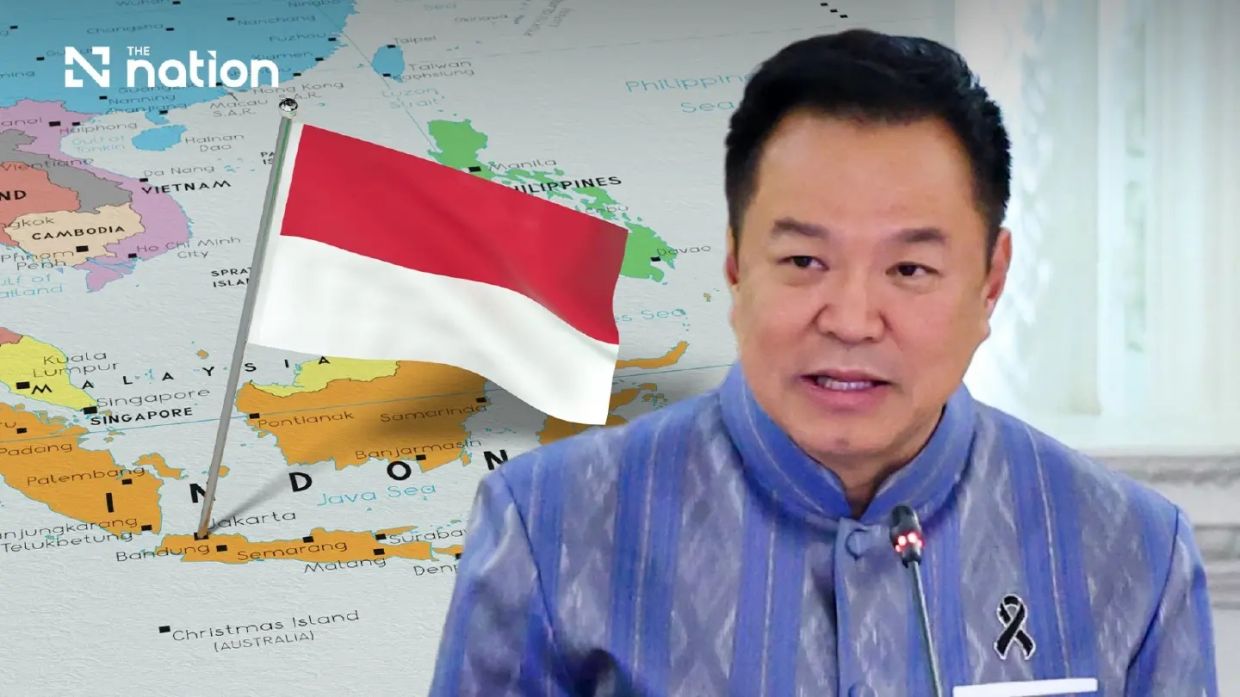
Prime Minister Anutin Charnvirakul is set to undertake a landmark official visit to Indonesia on August 3 and 4, marking the first time a sitting Thai prime minister has made such a trip in more than a decade and a half. The two-day engagement represents a significant diplomatic moment for Southeast Asia's two largest founding members of Asean, signalling a renewed commitment to strengthening ties at the highest political level after an extended period of limited premier-to-premier contact.
During his stay in Jakarta, Anutin will meet with Indonesian President Prabowo Subianto to chart a course for enhanced bilateral cooperation across multiple critical domains. The talks will encompass traditional areas of government partnership as well as emerging concerns, with trade and investment serving as centrepieces alongside sectors including tourism, security matters, food security assurances, energy collaboration, educational exchanges and business facilitation. This comprehensive agenda reflects both nations' understanding that modern statecraft requires engagement across interconnected economic and security domains rather than compartmentalised diplomacy.
A particularly significant element of the visit involves Anutin's address at the Asean Secretariat, where he will articulate Thailand's strategic vision for the regional bloc while simultaneously laying groundwork for the country's assumption of the Asean chairmanship in 2028. This dual purpose underscores how Thailand views the Indonesia visit not merely as a bilateral opportunity but as a foundational step in preparing for enhanced regional leadership responsibilities. By securing Indonesia's buy-in early, Thailand positions itself to drive collaborative initiatives with greater legitimacy and support throughout its eventual chair term.
Government Spokesperson Rachada Dhnadirek emphasised that the visit aims to translate the personal rapport between leaders into concrete initiatives under the Thailand-Indonesia strategic partnership framework. Rather than remaining confined to official communiqués, the Thai government explicitly envisions outcomes that generate tangible benefits for businesses, workers and consumers across both economies. This pragmatic orientation signals a shift towards foreign policy that directly connects diplomatic engagement with measurable economic returns for ordinary citizens.
Indonesia's strategic weight in the regional calculus cannot be overstated. With a population of approximately 280 million and standing as Asean's largest economy by output, the archipelago nation represents an enormous potential market for Thai exporters and investors seeking growth beyond domestic constraints. The scale and diversity of Indonesia's consumer base, industrial capacity and resource endowments mean that success in deepening market access there could meaningfully reshape Thailand's economic trajectory. Thai agricultural producers, manufacturers and service providers have long eyed Indonesia's vast middle class, yet bureaucratic barriers and limited high-level political momentum have constrained expansion efforts.
Rachada articulated how closer partnership mechanisms could facilitate broader Thai penetration of Indonesian markets for goods and services while simultaneously strengthening supply-chain integration between the two economies. She highlighted particular opportunities for both large Thai corporations and the smaller and medium-sized enterprises that form the backbone of Thailand's private sector to establish or expand operations in Indonesia. The government views the visit as creating political conditions favouring such commercial flows through reduced friction and enhanced regulatory coordination.
Beyond conventional trade metrics, Thai officials see value in positioning their nation as a knowledge and technology partner for Indonesian development priorities. The two countries possess complementary strengths in various sectors—from agriculture and food processing to energy systems and digital innovation—suggesting productive opportunities for technical cooperation, joint research initiatives and skills transfer programmes. Such exchanges would deepen economic interdependence while building human and institutional relationships that reinforce political partnerships.
The timing of this visit carries additional significance given the fluid international environment. As geopolitical competition intensifies among major powers and global supply chains undergo reconfiguration, Thailand recognises that leveraging relationships with fellow Asean members becomes increasingly critical for maintaining regional stability and economic space for smaller nations. Indonesia, as Asean's anchor, naturally occupies centre stage in any such strategy. By reinforcing ties with Jakarta at the leadership level, Bangkok signals both to domestic constituencies and international observers its commitment to maintaining Southeast Asia as an autonomous region capable of managing its own affairs.
The structured programme spanning two days reflects careful diplomatic choreography designed to maximise outputs. The first day features formal ceremonies, one-on-one discussions between Anutin and Prabowo followed by full delegation meetings, and joint press appearances—all designed to generate political visibility and underscore the visit's importance. The second day shifts toward practical business engagement, with Anutin's participation in a business forum organised jointly by Indonesia's Chamber of Commerce and Industry and the Thai Chamber of Commerce in Indonesia. This format directly connects government-level initiatives with private-sector decision-makers, creating mechanisms for translating political goodwill into commercial action.
Anutin's subsequent meetings with Asean Secretariat leadership and Indonesian private-sector representatives demonstrate how the visit extends beyond traditional state-to-state diplomacy. By engaging with the regional bureaucracy overseeing Asean affairs, the Thai delegation reinforces Thailand's voice in institutional discussions. Similarly, direct exposure to Indonesian business leaders creates networks and relationship foundations that can endure beyond formal governmental exchanges, potentially catalysing investments and partnerships that would have remained unlikely without high-level political blessing.
For Malaysian observers and policymakers, this Thai-Indonesian rapprochement carries implications worth monitoring. Malaysia, as Asean's third-largest economy and a nation with significant trade relationships throughout the region, has stakes in how bilateral dynamics among larger neighbours evolve. Enhanced Thai-Indonesian cooperation could reshape intra-Asean commerce patterns and influence how the bloc coordinates on regional initiatives. Depending on implementation, such partnership could create new opportunities for Malaysian firms to participate in expanded supply chains or conversely might concentrate economic benefits among Thai and Indonesian enterprises at Malaysia's relative expense.
The visit also signals how Asean's founding generation of relationships continues to shape the bloc's trajectory. Thailand and Indonesia, as original members alongside Malaysia, Philippines, Singapore and Vietnam, retain disproportionate influence in shaping consensus and driving regional initiatives. When their leaders engage intensively, the reverberations extend throughout Asean's institutional structures and economic networks. Thailand's preparation for 2028 chairmanship gains credibility when Indonesia's government demonstrates visible support, effectively blessing Bangkok's readiness to shepherd regional affairs during a period of anticipated geopolitical complexity.

