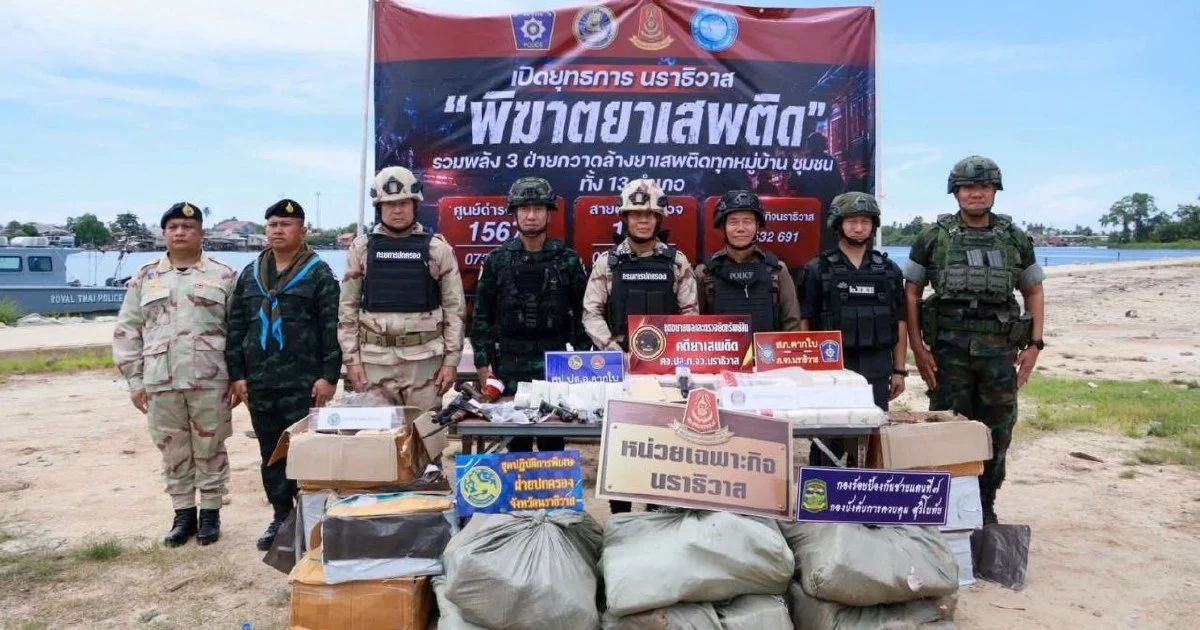
Thai law enforcement has dismantled a significant portion of drug trafficking operations in its southern border regions, with authorities in Narathiwat province apprehending 233 individuals suspected of involvement in organised narcotics distribution. The scale of the operation underscores the persistent challenge both Thailand and Malaysia face in combating transnational drug smuggling networks that exploit the porous Malay-Thai frontier.
The month-long enforcement sweep, which concluded recently, revealed sophisticated criminal supply chains that specifically targeted Malaysian markets. Intelligence gathered during the investigation indicates that several arrested individuals maintained active connections with Malaysian-based trafficking syndicates, suggesting a well-established distribution system stretching across national boundaries. This finding reinforces long-standing concerns among regional security agencies about the interconnected nature of Southeast Asian drug networks.
Narathiwat province, situated in Thailand's southernmost region adjacent to Malaysia's Kelantan and Perlis states, has historically served as a critical transshipment point for contraband moving between the two nations. The province's geography, combined with inadequate border infrastructure and limited surveillance capabilities, has made it an attractive operating base for criminal enterprises seeking to move narcotics into Malaysian population centres. The recent crackdown demonstrates that Thai authorities are escalating pressure on these networks at source.
The arrest of 233 suspects represents a substantial blow to trafficking operations in the region, though enforcement officials acknowledge this action likely represents only one section of much larger criminal organisations. Drug syndicates typically operate through cellular structures that compartmentalise operations, meaning the removal of one group creates limited disruption to overall supply chains unless coordinated with simultaneous action in other jurisdictions. This structural reality explains why Malaysian and Thai authorities increasingly emphasise bilateral intelligence sharing and coordinated enforcement efforts.
The revelation of Malaysian connections carries particular significance for domestic law enforcement agencies in Kuala Lumpur. Malaysian traffickers involved in cross-border smuggling typically occupy middle management positions within regional supply chains, sourcing bulk quantities from Thailand and distributing them through local street-level networks. Understanding these linkages helps Malaysian authorities identify vulnerable points in distribution systems and target higher-level operatives who maintain international relationships.
The RM1.2 million drugs interdiction mentioned in relation to this operation reflects only the detected portion of trafficking attempts. Industry analysts estimate that Malaysian authorities intercept perhaps 10-15 percent of drug shipments destined for domestic markets, suggesting the volume flowing through undetected remains substantial. This enforcement gap represents a persistent vulnerability that both nations must address through enhanced border monitoring and intelligence coordination.
Thailand's commitment to intensified drug enforcement reflects domestic political pressures and international obligations under narcotics control conventions. The Thai government faces significant health and social consequences from both domestic and transit drug trafficking, with methamphetamine production and distribution representing a particular concern. By targeting trafficking networks at source rather than only addressing consumption-side issues, Thai authorities aim to reduce harm across the region.
For Malaysian readers and policymakers, the significance of this operation extends beyond immediate drug supply disruptions. The identification of Malaysian connections within arrested individuals' networks demonstrates that local criminal enterprises maintain active engagement with international suppliers despite previous enforcement actions. This persistence suggests that profit incentives within Malaysian markets remain sufficiently attractive to warrant ongoing risk-taking by traffickers.
Cross-border trafficking through the Malay-Thai frontier presents distinctive challenges compared to maritime smuggling routes. Land borders facilitate rapid movement of smaller shipments that individual couriers can carry, making comprehensive interdiction logistically difficult despite increased enforcement resources. The month-long duration of Thailand's crackdown indicates the systematic approach required to achieve meaningful impact against established trafficking infrastructure.
Cooperation between Malaysian and Thai authorities continues to develop, with both nations recognising that unilateral enforcement efforts produce limited results against transnational criminal organisations. Information exchanges regarding suspect identities, smuggling methodologies, and distribution networks have become increasingly routine, though experts suggest further integration of border enforcement mechanisms and joint surveillance operations could yield improved outcomes.
The broader implication of this operation concerns the evolution of Southeast Asian drug trafficking patterns. As enforcement pressure increases in maritime routes and traditional transit zones, criminal networks adapt by intensifying utilisation of land borders and exploring alternative pathways. Thailand's crackdown may therefore prompt traffickers to shift operations rather than cease activities entirely, requiring Malaysian authorities to remain vigilant against redirection of smuggling attempts toward other entry points.
Looking ahead, sustaining momentum against these networks requires consistent resource allocation and institutional commitment from both nations. The arrested individuals will likely face prosecution within Thai courts, potentially yielding additional intelligence about Malaysian connections through interrogation and evidence analysis. Extracting maximum counternarcotics benefit from this operation depends on effective information sharing between Bangkok and Kuala Lumpur regarding suspect identities, methodologies, and organisational structures.
The fundamental challenge confronting regional drug enforcement agencies remains the underlying economic incentives driving trafficking activities. Until Malaysia and neighbouring nations develop comprehensive strategies addressing both supply reduction and demand suppression simultaneously, enforcement operations such as Thailand's will remain necessary but insufficient responses to persistent transnational narcotics flows.

