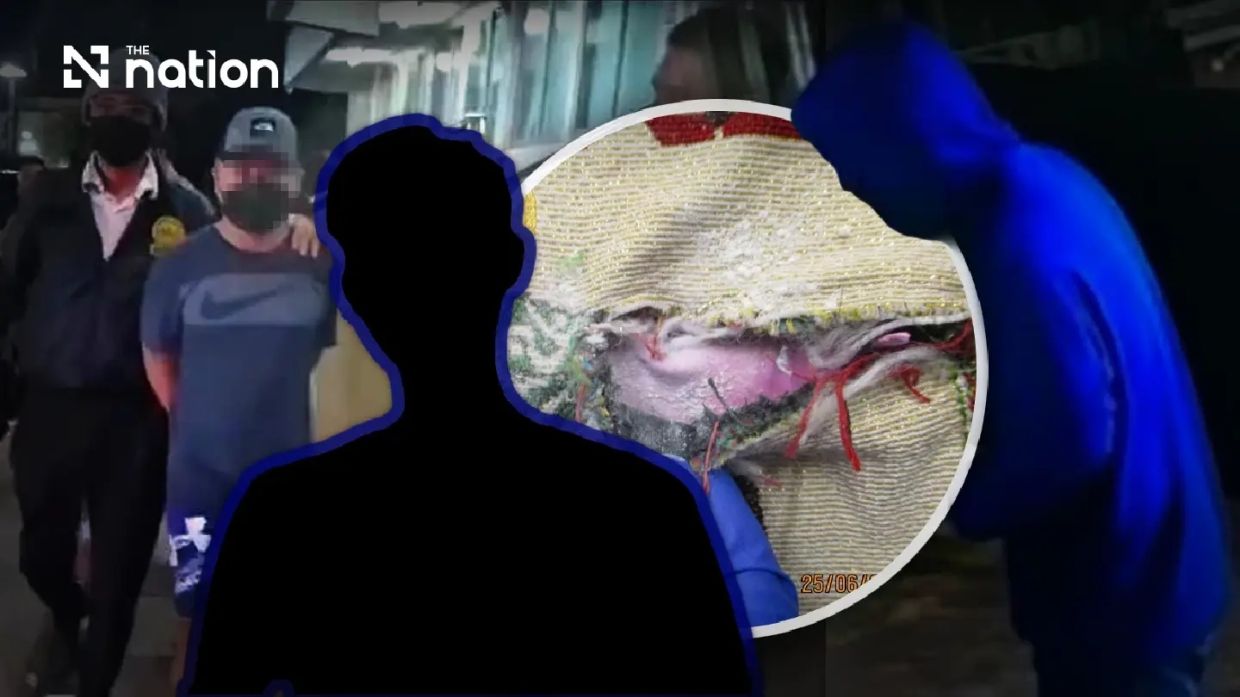
Thai authorities have widened their crackdown on an international narcotics network after arresting an intermediary suspected of coordinating heroin shipments destined for Australia. The suspect, identified as Ekkawit, was detained overnight in Phayao province as investigators continue piecing together the operations of what appears to be a well-organised cross-border trafficking ring involving multiple operatives and sophisticated delivery methods.
The Metropolitan Police Bureau's deputy commissioner Pol Maj Gen Theeradej Thamsuthee revealed that Ekkawit occupies a crucial position in the smuggling chain. According to police allegations, he functioned as a liaison between higher-level organisers and street-level couriers, receiving orders through online chat platforms and ensuring physical handoffs of narcotics packages to individuals tasked with transporting them internationally. This discovery suggests a hierarchical structure typical of major trafficking syndicates operating across Southeast Asia, where compartmentalisation shields senior members from direct law enforcement exposure.
Ekkawit allegedly operated under the online identity "Rin Rin" to communicate with Uthai, an earlier arrested suspect who was positioned directly below him in the network. The arrangement saw Ekkawit delivering an elephant-print fabric bag containing concealed heroin to Uthai in Chiang Kham district, who subsequently transferred the package to a commercial airline flight attendant named Mina for transport to Australia. This use of legitimate travel infrastructure and airline personnel represents a sophisticated approach to circumventing customs detection, exploiting the relative freedom granted to crew members at international airports.
During preliminary interrogation, Ekkawit admitted receiving THB100,000 for his role in the arrangement and claimed this was not his first involvement in such operations, admitting to participating in similar deliveries on two or three previous occasions. His willingness to disclose this information, whether voluntarily or under questioning, provides investigators with evidence of an established trafficking pattern rather than an isolated incident. The compensation structure reveals a tiered payment system where intermediaries like Ekkawit earn substantially more than street-level operatives, incentivising participation among those willing to take moderate operational risk.
The investigation has identified another crucial network member operating under the chat moniker "Rose Rose," whom police believe directed Ekkawit's activities and maintained contact with flight attendant Mina regarding her recruitment. Investigators discovered that Ekkawit and the Rose Rose operator are close relatives from Phayao province, with photographs showing them travelling together, suggesting family connections facilitate trust and operational security within the network. Rose Rose allegedly instructed Ekkawit to purchase an elephant-print bag in Chiang Mai and subsequently arranged for heroin to be concealed within it, though Ekkawit's claim that the concealment occurred in Laos remains unverified by authorities.
The operational methodology reveals considerable sophistication in logistics coordination. Once Ekkawit obtained the bag from Chiang Mai, he would notify Rose Rose, who would dispatch an associate to collect it for heroin insertion. After concealment, Rose Rose would arrange for Ekkawit to retrieve both the package and THB100,000 in compensation at a predetermined kilometre marker on a provincial roadway. Ekkawit would then coordinate Uthai's involvement, transferring THB60,000 through automated cash deposit machines to minimise physical contact and documentary trails. This compartmentalised payment system makes tracing financial flows and establishing culpability significantly more challenging for investigators.
Police have determined that Rose Rose, despite coordinating multiple operatives and managing overall logistics, likely does not represent the network's apex. The existence of an unnamed superior figure orchestrating operations at a higher level suggests the organisation extends beyond current apprehensions and may involve senior crime figures maintaining distance from direct trafficking activities. This hierarchical structure is characteristic of major narcotics networks across Southeast Asia, where insulation of leadership from operational details complicates dismantling entire organisations even when mid-level operatives are apprehended.
Uthai's testimony has proven inconsistent with police assessments of his actual involvement. He claimed participation in only five or six delivery operations, yet investigators discovered he maintained a rented room in Phra Nakhon Si Ayutthaya province for at least five to six months, suggesting considerably more frequent activity than admitted. Police believe Uthai's initial statement was formulaically prepared before arrest to minimise his apparent culpability, a common defensive strategy among lower-level syndicate members seeking reduced criminal exposure during interrogation.
The flight attendant Mina's involvement highlights the vulnerability of airline personnel to recruitment by trafficking organisations. Commercial crew members enjoy significant movement freedom and reduced scrutiny at international borders compared to ordinary passengers, making them attractive recruitment targets. The promise of substantial compensation for a single carry operation—likely thousands of dollars—creates financial incentive for individuals working in modestly-paid service sector positions. This recruitment vulnerability extends across regional airlines and represents an ongoing security concern for aviation authorities throughout Southeast Asia.
Deputy National Police Chief Pol Gen Samran Nuanma was scheduled to personally interrogate Ekkawit following his arrival at the Narcotics Suppression Bureau on Friday, July 10, 2026, indicating senior leadership involvement in this investigation's coordination. This level of executive engagement suggests Thai authorities regard the case as significant enough to warrant high-level attention, possibly due to the international dimensions involving Australian jurisdiction and the sophisticated operational structure revealed through questioning.
Investigators are now expanding their focus to apprehend remaining network members and disrupt operational channels. The identification of Rose Rose as a key coordinator provides a critical intelligence target, as further investigation of communications and associations could expose additional operatives and illuminate the network's geographic reach across Thai provinces. The case exemplifies how modern trafficking organisations exploit legitimate transportation systems and exploit economic disparities that incentivise participation among vulnerable service sector workers throughout the region.

