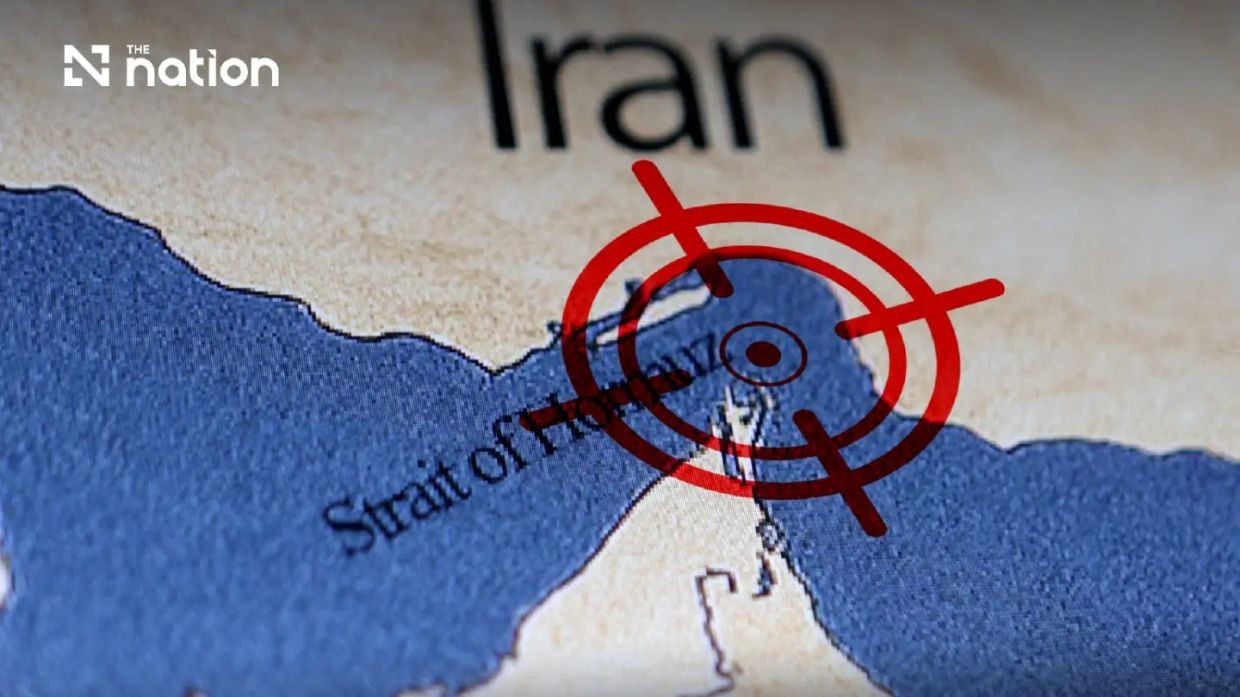
A merchant vessel flying the Thai flag came under attack near the Strait of Hormuz, according to reports from Iran's semi-official Tasnim news agency, as mounting military hostilities between Washington and Tehran pose an unprecedented threat to commercial shipping in the region's vital waterways. The incident marks the latest in a series of aggressive encounters in one of the world's most strategically important maritime corridors, through which roughly one-third of all seaborne traded oil passes annually. Details remain sparse, with neither the vessel's operator, Thai authorities, nor independent maritime monitoring organisations providing confirmation or identifying the ship, its owners, or the nationalities of crew members aboard at the time of the alleged assault.
The ambiguity surrounding the reported attack reflects the fog of escalating claims and counter-claims that now characterises the Persian Gulf standoff. Tasnim's account offered no specifics regarding damage to the vessel, injuries to its crew, or the exact location of the incident, leaving significant gaps in understanding the severity of what occurred. This pattern of unverified assertions from multiple parties—both Iranian military sources and American defence officials—has become characteristic of the current crisis, making it difficult for shipping companies, insurers, and maritime observers to assess genuine threats with confidence. The absence of independent verification underscores a broader challenge facing the international maritime community as it attempts to navigate increasingly hostile waters.
Iran's Islamic Revolutionary Guard Corps Navy has issued stark warnings about the deteriorating security environment, declaring the Strait of Hormuz increasingly unsafe and claiming complete closure of the waterway due to what it characterises as American military aggression. Simultaneously, the IRGC reported intercepting four oil tankers allegedly attempting passage with US military support, ordering them to remain stationary during what it described as a joint missile-and-drone operation. These claims have not been independently substantiated, and vessel details including identities, locations, and registration information were withheld. The Iranian navy has explicitly warned shipowners to heed Iranian military notices rather than depend on protection from American forces, a pointed message aimed at undermining confidence in US security guarantees throughout the Gulf.
Compounding these tensions, Tasnim also reported that two oil tankers caught fire following explosions in waters Iranian media characterised as mined, specifically in the southern section of the strait. The recurring reports of fires and explosions in tanker operations raise particular concerns, as such incidents can trigger catastrophic environmental and economic consequences beyond immediate human casualties. If such events continue or escalate, they could create severe disruptions to global petroleum supplies and significantly alter the risk calculus for international shipping companies deciding whether to traverse the route or redirect vessels around Africa—a vastly more expensive and time-consuming alternative.
The cascading security incidents in the Strait of Hormuz arrive amid an intensifying cycle of American military strikes targeting Iranian military infrastructure. The United States Central Command announced its seventh consecutive night of air operations, with attacks launched at 7pm GMT on Friday intended to degrade Iran's broader military capabilities. Pentagon officials declined to immediately release comprehensive target lists or quantify damage assessments, maintaining operational secrecy. However, Iranian authorities have countered that these operations have inflicted collateral damage on civilian infrastructure across the country's southern regions, including destruction of bridges, airports, electrical grids, and railway networks. Iranian Foreign Minister Abbas Araghchi specifically reported that three individuals were killed in an attack targeting a bridge in Bandar Khamir, forming part of a broader toll of eight deaths claimed by Tehran in overnight strikes.
Iranian state media further cited a deputy governor of Bushehr province as alleging that American forces had attacked an Iranian oil tanker positioned at Kharg Island, a strategically significant crude export facility. These casualty and damage reports emanate exclusively from Iranian officials and state-connected news outlets, precluding independent verification of the claimed scope and severity of harm inflicted. The lack of outside confirmation creates space for possible exaggeration or propaganda value, yet the volume and specificity of damage claims suggest substantive strikes occurred. The distinction between verified events and contested claims has become increasingly difficult to discern in real-time reporting from the region.
Iran has responded to American strikes with its own military operations, asserting responsibility for attacks against US assets and military installations distributed across Bahrain, Jordan, Kuwait, and Qatar. Qatari authorities confirmed that their armed forces intercepted an incoming Iranian assault, though a child sustained injuries from debris generated by the defensive interception. The IRGC additionally claimed responsibility for targeting other US-associated military infrastructure throughout the Gulf region, though the extent of actual damage from these operations remains unclear and unconfirmed by independent sources. These tit-for-tat military exchanges create an environment where miscalculation or unintended escalation becomes increasingly probable.
The Iranian military also claimed successful destruction of a US MQ-9 Reaper drone over Bushehr using what it described as a newly developed air-defence system integrated into Iran's broader air-defence architecture. The American military had not immediately acknowledged loss of the unmanned aircraft in that location, maintaining silence about potential losses to Iranian capabilities. Such discrepancies in claims and counter-claims surrounding military equipment losses and damage assessments exemplify the broader information warfare dimensions of the current confrontation, where establishing factual baselines becomes challenging.
For Malaysia and other Southeast Asian nations, these developments carry significant implications beyond the immediate regional dynamics. The Malaysian economy remains substantially dependent on stable energy supplies and predictable shipping costs, both of which face disruption should Hormuz tensions persist or intensify. Malaysian shipping companies operating globally face increased insurance premiums and security risks if they transit the strait, while Malaysian energy security becomes vulnerable to supply shocks. Regional economies throughout Southeast Asia that rely on petroleum imports and manufacturing exports routed through global shipping lanes face potential inflationary pressures should maritime disruptions become prolonged. The escalating cycle of military operations and counter-operations in the Gulf raises concerns about whether diplomatic off-ramps remain viable or whether structural factors will drive further militarisation.
The persistent danger to commercial and civilian shipping represents perhaps the most consequential dimension of the US-Iran confrontation from a global economic perspective. Any sustained disruption to transits through the Strait of Hormuz would inevitably elevate freight charges, increase insurance costs, constrain available energy supplies, and create upward pressure on global commodity prices. The strait's centrality to international petroleum commerce means that even temporary closures or severe safety degradation would send ripple effects through world economies and financial markets. Shipping companies now face impossible calculations regarding risk tolerance and route selection, with alternative passages around Africa consuming weeks of additional transit time and substantially higher fuel costs.
The reported targeting of the Thai-flagged vessel, combined with claims regarding tanker incidents and competing assertions about military operations, collectively demonstrate the mounting jeopardy facing legitimate commercial shipping as tensions between Washington and Tehran continue their dangerous trajectory. The absence of reliable, independent information about incidents in the strait compounds these risks, as shipowners must make routing decisions amid profound uncertainty about actual threat levels. Unless diplomatic mechanisms succeed in de-escalating the cycle, the Strait of Hormuz faces a period of sustained danger that could reshape global energy markets, insurance practices, and maritime commerce patterns for years.

