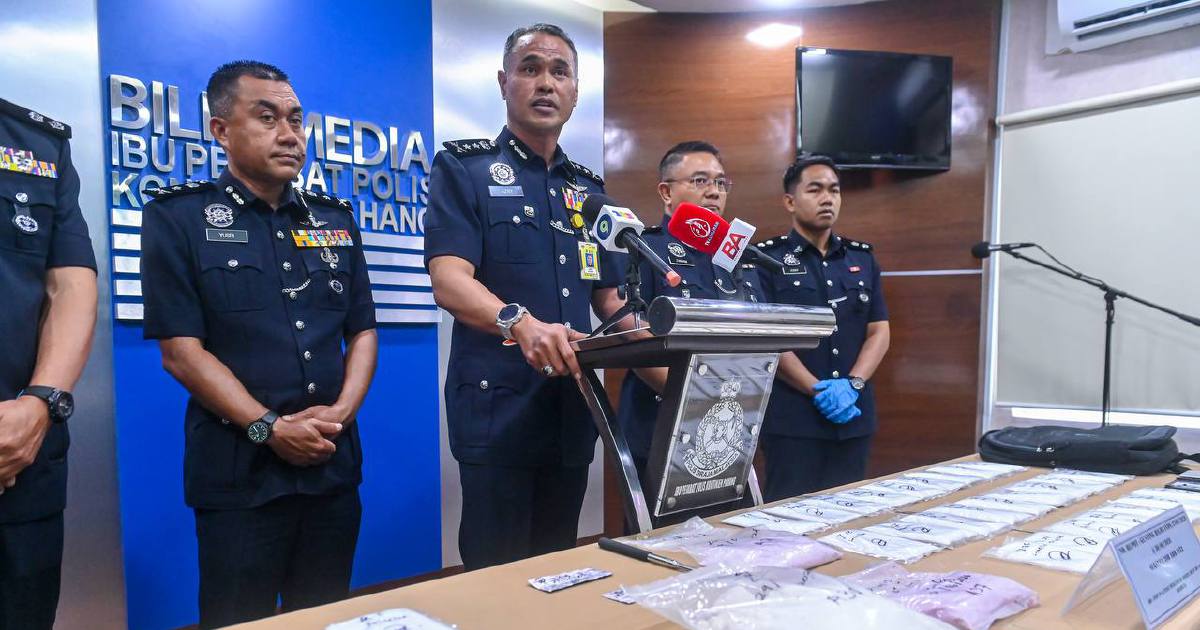
Authorities in Pahang have apprehended a Thai national and her local companion following the discovery of narcotics valued at approximately RM728,000 in the Genting Permai area of Bentong. The duo were taken into custody after an operation that uncovered evidence of coordinated drug courier activities spanning the previous three months, according to police sources in Kuantan.
The arrest represents a significant blow to what investigators describe as an organised supply network operating across the region. The suspects' alleged involvement in transporting controlled substances for an unnamed criminal organisation highlights the persistent challenge Malaysian law enforcement faces in combating transnational drug trafficking, particularly operations involving foreign nationals working in conjunction with local accomplices.
The Bentong district, situated along a major corridor within Pahang state, has become increasingly significant in the regional drug trade due to its strategic geography and accessibility to neighbouring jurisdictions. The seizure at Genting Permai suggests sophisticated distribution channels may be operating through residential and commercial zones that law enforcement continues to monitor.
Investigations into the couple's activities have revealed they were not independent operators but rather functioned as part of a hierarchical structure within a larger criminal enterprise. This distinction is crucial for understanding drug trafficking dynamics in Malaysia, where courier networks typically serve as insulating layers between street-level distribution and high-level organisational command. The three-month timeframe of alleged operations suggests the syndicate maintained sustained activity before authorities identified and disrupted the supply chain.
The involvement of a foreign national in the operation underscores the regional nature of contemporary drug trafficking. Thailand, despite being a significant source country for methamphetamine and other synthetic drugs, has also become a transit point for narcotics originating from production hubs in the Golden Triangle and beyond. Cross-border courier networks utilising tourists, migrant workers, and individuals on temporary visas have become an established trafficking methodology across Southeast Asia.
For Malaysian enforcement agencies, cases of this magnitude require coordinated intelligence gathering and surveillance operations that can take weeks or months to execute. The timing and precision of the arrest in Genting Permai suggests either actionable intelligence from informants or detection through roadside checks and monitoring of known trafficking corridors. The specific location choice by traffickers may reflect assessment of surveillance patterns in the area.
The seized drugs, valued at RM728,000, represent a substantial quantity that would have generated significant street-level profits when distributed through smaller dealers. At typical Malaysian retail prices, this haul could translate to thousands of individual transactions across multiple distribution points, illustrating the volume dynamics of modern drug networks. The economic incentives driving courier recruitment—where individuals earn comparatively modest sums while organisations capture disproportionate margins—perpetuate recruitment cycles despite increasing enforcement pressure.
International cooperation has become essential in disrupting these networks. While the source material provides no indication of cross-border investigation elements, cases involving Thai nationals typically involve consultation with relevant Thai authorities regarding the syndicate's operations, source of supply, and intended distribution markets. Such coordination remains inconsistent across the region, though bilateral agreements between Malaysia and Thailand have gradually improved information-sharing protocols.
The investigation's progression from arrest to prosecution will likely involve forensic analysis of communications, financial transactions, and network mapping to establish culpability among higher-level organisational members. The couple's alleged status as couriers means they typically possess limited knowledge of command structures, making their cooperation—whether voluntary or secured through plea arrangements—crucial for dismantling the broader operation.
This seizure occurs within a broader context of intensifying synthetic drug production and trafficking across Southeast Asia. Law enforcement agencies throughout the region have reported escalating methamphetamine seizures, particularly in countries serving as transit hubs between production zones and consumption markets. Malaysia's enforcement response has expanded detection capabilities at ports and airports, though land border vulnerabilities remain significant given the porous nature of regional boundaries.
The case also reflects evolving trafficking methodologies that exploit regional mobility patterns. The use of couples and mixed-nationality teams may represent deliberate strategy to reduce suspicion during transit and distribution operations. Gender dynamics in trafficking networks, particularly the involvement of women as couriers or operatives, have shifted substantially over recent years as criminal organisations recognise potential advantages in recruitment and operational execution.
As investigations continue, authorities will examine whether the arrested pair maintained connections to other active networks or whether their detention disrupts a localised segment of a larger transnational operation. The RM728,000 seizure, while substantial, may represent only a fraction of monthly trafficking volumes if the syndicate operated multiple courier teams across different routes and jurisdictions. Understanding the full scope of the network remains essential for comprehensive enforcement strategy.

